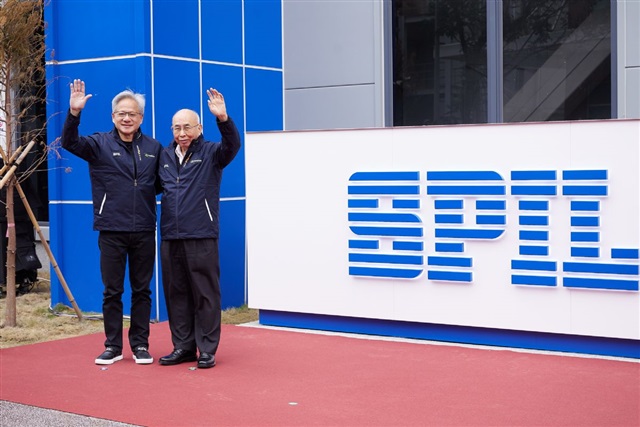
Jensen Huang didn’t pick a conference room or an industry trade show to mark Nvidia’s 33rd anniversary. He chose Akihabara, the Tokyo district that for decades has been synonymous with electronic components, hardware enthusiasts, and DIY tech culture. The visit — captured in a photo credited to Michael Lee — is an explicit tribute to the galaxy of partners that quietly enabled Nvidia to evolve from a gaming graphics card maker into the backbone of global artificial intelligence.
This is not corporate folklore. It acknowledges a structural fact: without a network of component suppliers, board assemblers, system integrators, and local distributors, Nvidia GPUs would not reach data centers, on-premise servers, and developers’ workstations. Without those GPUs, the current wave of self-hosted large language models would be unthinkable. Akihabara embodies the physical place where this supply chain takes shape, from HBM memory to custom cooling systems, and where hardware experimentation often anticipates enterprise market needs.
The timing is no accident. As demand for inference and training accelerators grows exponentially, fueled by ever-larger models and increased focus on data sovereignty, the resilience of the supply chain becomes a critical factor. Organizations evaluating on-premise deployment of LLMs — driven by regulatory requirements, privacy concerns, or a straightforward TCO calculation — depend not only on the compute power promised by a spec sheet, but on the actual availability of hardware within reliable timeframes. Any weak link between the TSMC foundry and the rack installed in the server room can turn a self-hosting project into a bottleneck.
In this light, Huang’s gesture carries the weight of a stability signal. While some cloud providers attempt to decouple software from hardware with proprietary solutions, Nvidia reiterates that its strength lies in the extended partner ecosystem that materializes its architectures. For companies and AI teams that choose to keep data behind their own firewall, this solidity has tangible value: it lessens the risk that hardware upgrades, cluster expansions, or component replacements become critical operations.
There is also a geographic dimension. Japan is accelerating data residency policies, and several sectors — from healthcare to public administration — view on-premise deployment as a prerequisite for generative AI adoption. A well-established trust relationship with the local distribution and hardware integration ecosystem — exactly what Nvidia celebrates in Akihabara — can mean the difference between a simple commercial agreement and a presence embedded in the industrial fabric.
Finally, it is no coincidence that this unfolds in a district renowned for modding culture and deep optimization. Many professionals who today configure servers for on-premise inference first learned to tinker with hardware among those very shelves. The tribute is not only to commercial partners, but to an entire mindset: the one that sees control over physical infrastructure as the first step toward technological independence.






💬 Comments (0)
🔒 Log in or register to comment on articles.
No comments yet. Be the first to comment!