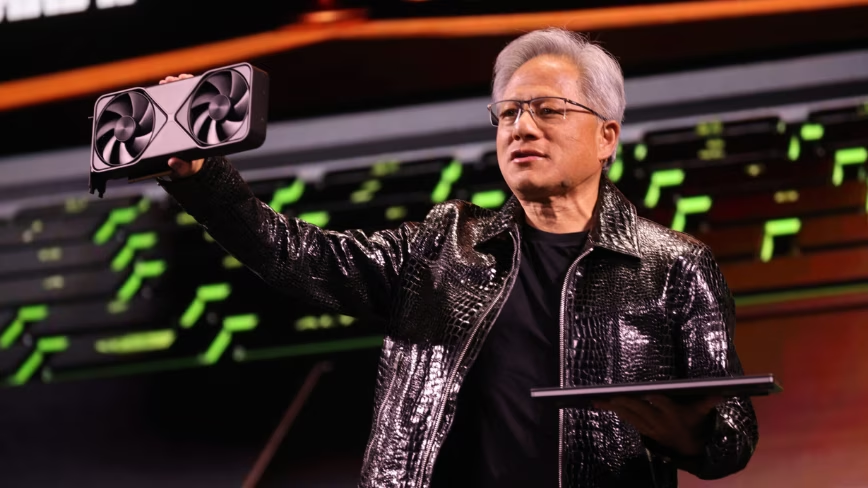
Jensen Huang's Absence from the China Delegation
Jensen Huang, CEO of Nvidia, is not among the US executives slated to join the business delegation heading to Beijing for the summit between President Donald Trump and President Xi Jinping. The news, reported by Reuters, highlights a notable absence from an event that will see the participation of other prominent figures from the American technological and industrial landscape.
Among the confirmed names for the mission are Tim Cook, CEO of Apple, and Elon Musk, CEO of Tesla. The delegation will focus on key sectors such as agriculture, manufacturing, and aviation. The absence of the leader of Nvidia, a company at the forefront of developing hardware for artificial intelligence, raises questions about the underlying dynamics of commercial and technological relations between the world's two largest economies.
Geopolitical Context and Implications for the Tech Sector
Relations between the United States and China have long been characterized by a complex interplay of cooperation and competition, with direct repercussions for the technology sector. Companies like Nvidia, which produce crucial components for the advancement of AI and high-performance computing, often find themselves at the center of these dynamics. The availability of advanced silicon and the management of global supply chains are fundamental aspects that influence deployment strategies and innovation.
In this scenario, decisions regarding participation in high-level business delegations can reflect broader corporate strategies aimed at navigating an evolving geopolitical environment. For businesses relying on cutting-edge technologies, the ability to maintain market access and ensure the continuity of their production pipelines is essential, especially when considering on-premise or cloud deployment options.
Market Dynamics and Nvidia's Strategy
Nvidia holds a dominant position in the GPU market, with its components being indispensable for the training and inference of Large Language Models (LLM) and other artificial intelligence applications. Its market strategy is intrinsically linked to its ability to operate effectively in international contexts, balancing growth opportunities and potential restrictions.
AI workload deployment choices, ranging from public cloud to self-hosted or air-gapped solutions, are often influenced not only by technical considerations such as VRAM or throughput but also by macroeconomic and geopolitical factors. The Total Cost of Ownership (TCO) of an AI infrastructure, for example, can be significantly impacted by hardware availability and commercial policies between countries.
Future Prospects for AI Deployments
The artificial intelligence ecosystem continues to evolve rapidly, with increasing interest in solutions that guarantee greater control and data sovereignty. This prompts many organizations to carefully evaluate the pros and cons of on-premise deployments versus cloud offerings. Regulatory compliance, data security, and infrastructure customization are decisive factors.
In a context where geopolitical tensions can influence the availability of key technologies, strategic planning becomes crucial for CTOs and infrastructure architects. AI-RADAR, for instance, offers analytical frameworks on /llm-onpremise to help evaluate the trade-offs between different deployment architectures, considering aspects such as scalability, latency, and specific hardware requirements, regardless of individual corporate decisions.





💬 Comments (0)
🔒 Log in or register to comment on articles.
No comments yet. Be the first to comment!