
Jensen Huang's Endorsement at Computex
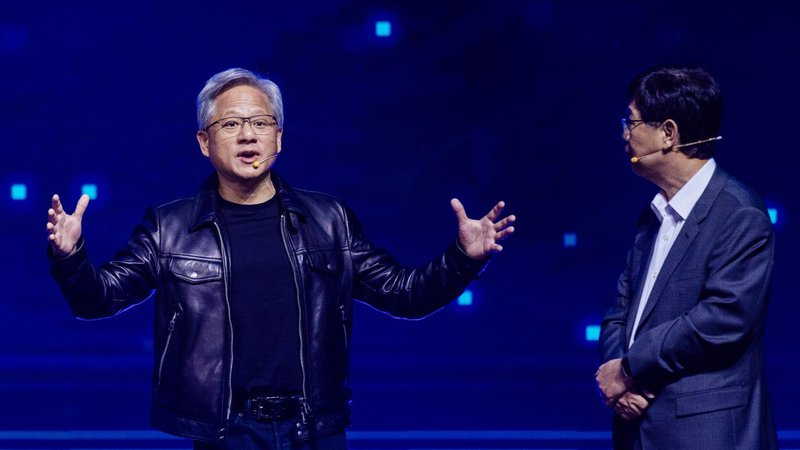
Jensen Huang, a prominent figure in the tech industry and CEO of NVIDIA, captured attention at Computex by joining Marvell's CEO on stage. His statement, labeling Marvell as "the next trillion-dollar company," did not go unnoticed. This recognition, reported by Digitimes, underscores Marvell's growing importance in the global technology landscape.
Huang's assertion is not merely a compliment but a strong signal about future market directions and the companies positioning themselves as pillars of innovation. In an era dominated by artificial intelligence and Large Language Models, the role of providers of robust and high-performance infrastructure becomes increasingly strategic to support complex workloads.
Marvell's Role in the AI Ecosystem
Marvell is a key player in developing silicon solutions and network infrastructure essential for modern data centers. Its offerings range from Data Processing Units (DPUs) to network controllers and custom ASICs, all critical components for managing the intensive workloads required by AI and LLMs. These elements are fundamental for ensuring efficient data movement and low-latency processing, crucial aspects for the Inference and training of complex models.
Marvell's technologies enable offloading network and storage tasks from CPUs, freeing up valuable resources for AI computations performed by GPUs. This architectural approach is particularly relevant for companies choosing to deploy their AI stacks on-premise, where the optimization of every hardware component directly contributes to overall performance and Total Cost of Ownership (TCO).
Implications for On-Premise Deployments and Data Sovereignty
For organizations evaluating on-premise LLM deployments, the quality and integration of network infrastructure and silicon are decisive factors. Solutions like those offered by Marvell allow for the construction of robust self-hosted environments, ensuring greater control over data and security. This is crucial for sectors with stringent compliance and data sovereignty requirements, where cloud solutions may not always be the preferred option.
The ability to manage the entire AI pipeline within corporate boundaries, supported by high-performance hardware, offers advantages in terms of latency, throughput, and customization. While the initial investment (CapEx) for bare metal infrastructure can be significant, long-term operational cost (OpEx) optimization and greater flexibility can justify this choice for many enterprises. For those evaluating on-premise deployments, AI-RADAR offers analytical frameworks on /llm-onpremise to assess specific trade-offs.
Future Perspectives in AI Infrastructure
Jensen Huang's praise for Marvell highlights a broader trend in the technology sector: the increasing value of companies providing the fundamental building blocks for the AI era. This is not just about GPUs but an entire ecosystem of hardware components that must work in synergy to support increasingly demanding workloads.
The future of artificial intelligence, particularly for enterprise applications and LLMs, will increasingly depend on the ability to integrate advanced hardware solutions into efficient and scalable architectures. Companies like Marvell, with their expertise in silicon and networking, are strategically positioned to capitalize on this evolution, helping to define the standards for the next generation of AI infrastructure.







💬 Comments (0)
🔒 Log in or register to comment on articles.
No comments yet. Be the first to comment!