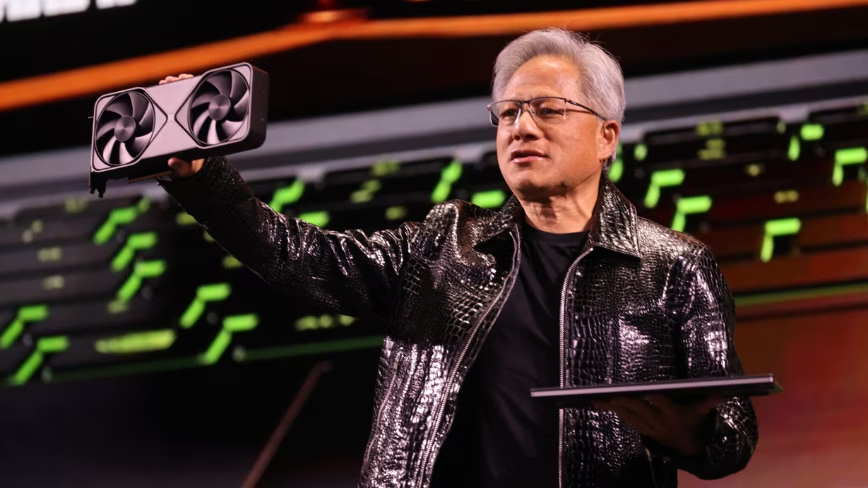
Jensen Huang recalled how a $5 million check from Sega in 1995 kept Nvidia from vanishing before it became the linchpin of modern artificial intelligence. “Without what Sega did for us, Nvidia would not be here today,” the CEO said, having flown to Tokyo to thank the videogame company. That near-bankruptcy now weighs on the entire AI ecosystem: without that capital, the market for parallel-computing GPUs would look radically different, and with it the options for those designing on-premise infrastructure for Large Language Models.
The episode is far more than a historical anecdote. Sega unwittingly set off a butterfly effect that cemented Nvidia’s position as the almost exclusive supplier of accelerators for LLM training and inference. Today, anyone evaluating a local deployment of models like Llama or Mistral bumps into the reality of CUDA lock-in: A100 or H100 GPUs have become the forced choice for acceptable throughput, and alternatives — FPGAs, AMD-based solutions, or custom chips — remain marginal precisely because of the fifteen-year head start Nvidia built with its software ecosystem.
The paradox is that an investment meant to advance polygon rendering in games ended up shaping the infrastructure on which language models run. The structural consequence is a concentration of technological power that directly affects total cost of ownership (TCO) and data sovereignty: organizations wanting to keep models in-house, perhaps for GDPR compliance or to avoid cloud latency, still have to reckon with a single hardware vendor. Shortages, high prices, and dependence on a centralized supply chain become concrete risks for those planning large-scale on-premise architectures.
There’s a subtler lesson. The trajectory that turned Nvidia from a maker of enthusiast graphics cards into an AI pillar shows how fragile and unpredictable the origin of enabling technologies can be. Today we see a proliferation of startups working on neuromorphic chips, RISC-V accelerators, or inference frameworks optimized for heterogeneous hardware. If one of them ever displaces the current dominance, it might come through an equally oblique bet — from an apparently distant sector. For IT decision-makers, the takeaway is to heed weak signals: the next hardware platform for LLMs may not come from the usual names but from a lateral investment, just as it happened with Sega.
Meanwhile, those operating in the on-premise space must deal with the present: CUDA remains the dominant framework, and open alternatives (like ROCm) are closing the gap but still require niche expertise. Serving tools such as vLLM or Ollama simplify inference but do not solve the downstream dependency on Nvidia silicon. This is where TCO analysis and lock-in risk assessment become essential — not as academic exercises, but as day-to-day practice to prevent a single link in the chain from blocking the entire AI strategy.








💬 Comments (0)
🔒 Log in or register to comment on articles.
No comments yet. Be the first to comment!