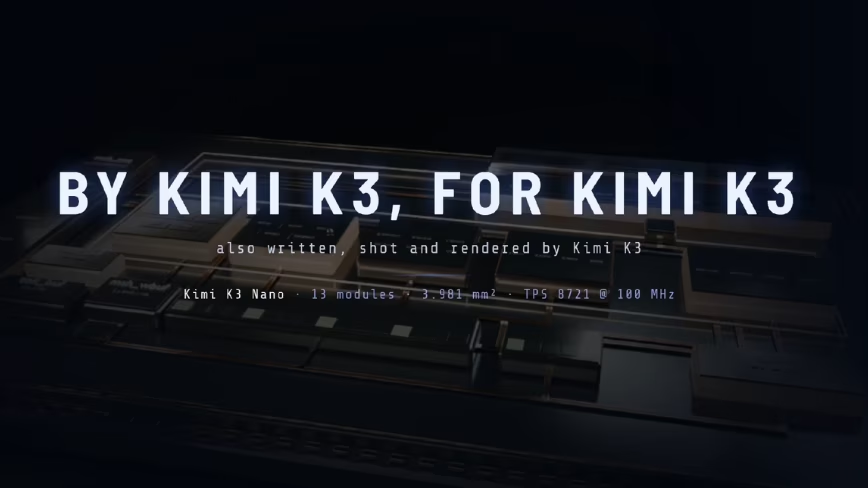
It’s not just a leaderboard upset. When a model built in Beijing leaps to the top of a frontend coding competition in under a day, ahead of Claude and GPT-5.6 Sol, the noise goes far beyond benchmarks. Hours after launch, David Sacks — the Trump administration’s AI advisor — was hammering the table: "This is how you lose the AI race." Vinod Khosla, the veteran venture capitalist, blamed US immigration policy. Gary Marcus, ever the academic gadfly, demanded a congressional investigation. Wall Street watched. And Kimi K3, meanwhile, took third place on Artificial Analysis’s Intelligence Index.
Beneath the bluster lies a discomfort that transcends geopolitics. Moonshot AI’s model isn’t a toy; it’s an LLM that excels at UI generation, the kind of real-world task that engineering teams integrate into development pipelines daily. The speed of its ascent — 24 hours — is itself a data point: technical differentiation is now a weekend affair, and top-tier models can emerge from any latitude, with training costs constantly compressing.
The Dependency Short Circuit
Enterprise AI infrastructure teams should look past the political noise. The real lens is API dependency. If the best model for a specific task comes from a vendor in a jurisdiction subject to export controls or sudden geopolitical friction, cloud integration becomes a regulatory and operational chokepoint. This isn’t fantasy: Moonshot AI is a Chinese company, and access to its models could be restricted tomorrow by fresh sanctions, just as your development team has adopted it as a de facto standard.
The alternative isn’t to shun outside innovation, but to absorb it into a stack that maintains full control over data and runtime. Open-weight models — whether Kimi K3 eventually proves to be one or not, the lesson applies to any LLM that can run on owned hardware — become sovereignty levers. On-premise infrastructure, or at least a hybrid setup with local inference nodes, lets you execute any checkpoint regardless of its geographic origin, without negotiating contracts or waiting for political clearance. Those who lock their toolchain exclusively to the APIs of three big Western vendors today are exposing themselves to a double penalty: paying a premium for models that may be surpassed in hours, and getting trapped in a supply chain they don’t control.
The Right Posture for Deployment Decisions
The takeaway from Kimi K3 isn’t “embrace China” or “close the gates.” It’s that world-class coding capability is no longer a monopoly of California labs. That shifts the center of gravity for deployment choices from brand loyalty to architecture flexibility. A GPU-equipped compute node that can load third-party models, paired with a fine-tuning pipeline that lets you adapt new checkpoints rapidly, costs less — in both TCO and strategic risk — than a perpetual subscription to a single ecosystem.
Investing in on-premise AI today doesn’t just protect your data. It buys optionality: the ability to test, adopt, and integrate the best model, from any country, without asking permission from Washington or Beijing.








💬 Comments (0)
🔒 Log in or register to comment on articles.
No comments yet. Be the first to comment!