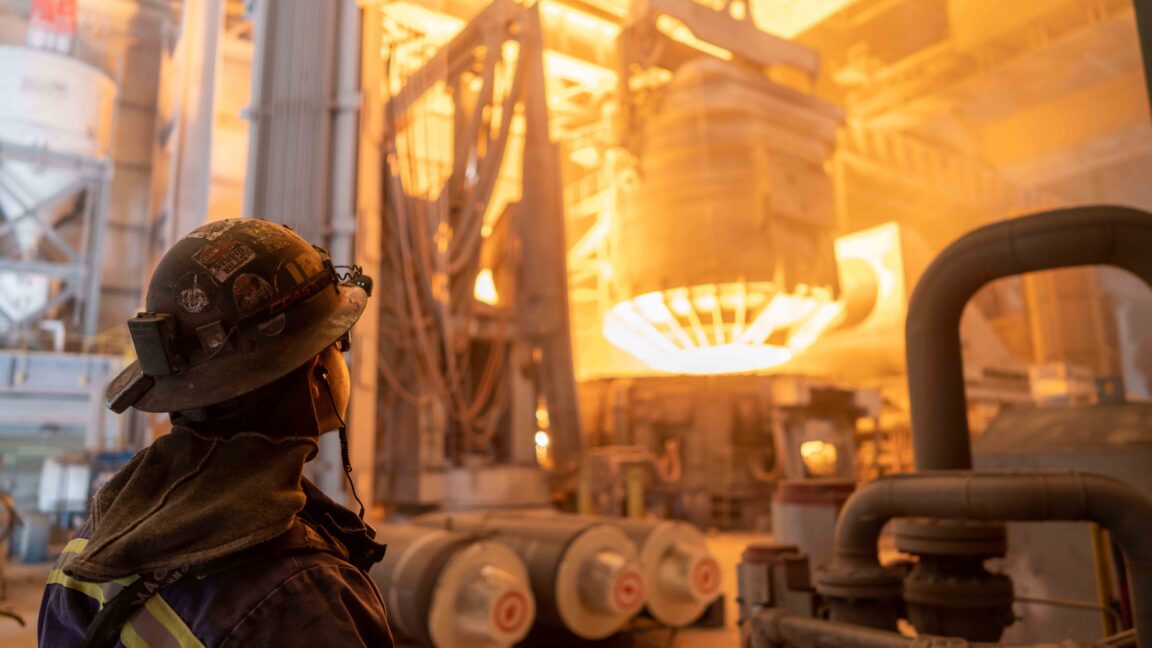
As the Trump administration tries to revive manufacturing under the ‘Made in America’ banner, the infrastructure powering artificial intelligence is squeezing the very industrial base it wants to protect. According to a Reuters analysis, manufacturers in the Rust Belt are paying much higher electricity bills because the explosion of data centers is straining PJM Interconnection, the largest US grid operator. The case of Belden Brick, a 141-year-old Ohio brickmaker, is emblematic: its monthly bill has surged from $1,600 to $12,000 due to a higher monthly capacity charge in the PJM region. Meanwhile, the Steel Manufacturers Association warns that steel mills concentrated in that zone are already paying tens of millions of dollars more per year for electricity, which accounts for 20 to 40 percent of production costs.
The friction is not just an industrial policy story. It is an early indicator of how the AI race is structurally deforming the electricity market, with consequences that spill far beyond brick and steel factories. PJM, serving 13 states from Illinois to Virginia, has seen a wave of connection requests from new data centers, often clustered together. These 24/7 loads increase the need for generation and transmission capacity, driving up precisely those capacity charges that hit all industrial customers. It’s not only the consumed energy that costs more: it’s the guarantee that the grid can handle peak demand, a cost distributed proportionally among large users.
For anyone planning to self-host LLMs, the lesson is immediate. An on-premise GPU cluster for inference or fine-tuning, even at moderate scale, looks to the grid operator much like an energy-intensive manufacturing plant. If deployed in an area congested by hyperscalers, the capacity charge can turn a Total Cost of Ownership calculated on pure energy into a much higher figure than anticipated. This is not speculation: in Virginia the transmission tariff for large industrial customers has risen by about 60 percent in two years, coinciding with the data center concentration in Loudoun County.
The structural implications go beyond a single geography. First, organizations with long-term power purchase agreements (PPAs) with renewable producers – typically large cloud providers – can shield themselves from these hikes, whereas anyone plugging a compute rack into a factory or office ends up paying spot rates or unnegotiated capacity charges. Second, the tension between AI demand and grid capacity makes location a strategic criterion in on-premise deployment: installing an inference server in Frankfurt, Dublin or a low-density data center area can radically alter the energy component of TCO.
A third, subtler effect is critical for the open-weight model ecosystem and for those avoiding the cloud for data sovereignty reasons. The rise in fixed grid costs pushes toward efficiency at every level: aggressive model quantization, architectures that minimize VRAM requirements, and scheduling workloads during lower-tariff hours. The economic pressure is accelerating the same direction as privacy needs: local inference with smaller models, possibly on edge hardware. In some regions, the capacity charge could make continuous operation of a multi-GPU server prohibitive and instead reward on-demand-only configurations – a dynamic reminiscent of off-peak cloud pricing, but inverted.
The story of Belden Brick and the American steel mills, therefore, is not a sectoral curiosity. It is a wake-up call for anyone planning to run Large Language Models outside the proprietary data centers of the usual giants. The real cost of electricity is no longer a given in a TCO spreadsheet: it depends on the grid region, total load, and the capacity games that big data centers are rewriting. AI-RADAR will keep exploring this intertwining of hardware, grids, and regulation, offering tools to evaluate deployment scenarios in light of a variable that manufacturing is already paying for dearly.










💬 Comments (0)
🔒 Log in or register to comment on articles.
No comments yet. Be the first to comment!