The Impact of AI on the Optical Supply Chain
The exponential advancement of artificial intelligence, particularly with the proliferation of Large Language Models (LLMs), is redefining the priorities and needs of global technological infrastructure. This “1.6 trillion shift” – a reference to the enormous value and investment shift generated by AI – is not limited to software or algorithms but extends deeply to the hardware components and raw materials that enable its operation.
At the heart of this revolution, the need to process and transfer massive amounts of data at ever-increasing speeds has put pressure on the optical component supply chain. These elements are crucial for high-speed interconnections within and between data centers, essential for powering the most demanding AI workloads. The rapid acceleration of demand is now highlighting points of fragility in sectors previously less in the spotlight.
The Critical Role of Indium Phosphide (InP)
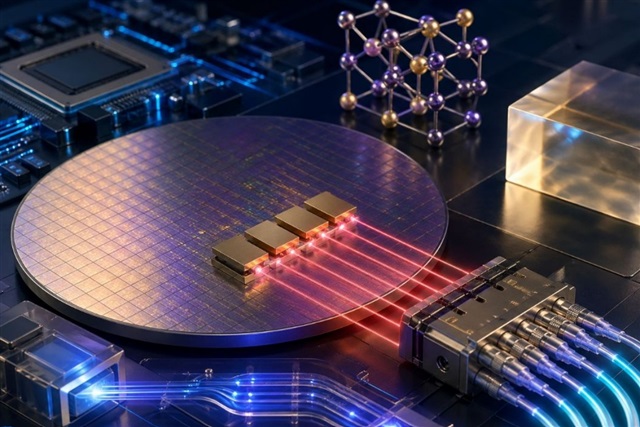
In this context, Indium Phosphide (InP) has emerged as a material of strategic importance and, at the same time, a potential bottleneck. InP is a compound semiconductor used in the production of high-performance optoelectronic devices, such as lasers, photodiodes, and modulators, which are at the core of optical transceivers. These transceivers are the components that convert electrical signals into optical signals and vice versa, enabling data transmission over optical fiber at extreme speeds.
Its ability to operate at specific wavelengths and offer superior performance in terms of speed and energy efficiency makes it irreplaceable for the high-bandwidth data communication applications required by AI. Large-scale LLM inference and training, often involving clusters of thousands of GPUs, critically depend on interconnections that can handle terabytes of data per second with minimal latency. Without adequate InP availability, the production of these essential components may not keep pace with demand, creating delays and increasing costs across the entire value chain.
Implications for On-Premise Deployments and TCO
The increasing pressure on the InP supply chain has direct implications for organizations planning or expanding their AI deployments, particularly for self-hosted or on-premise solutions. CTOs, DevOps leads, and infrastructure architects must carefully consider the availability and cost of these critical components. A bottleneck in InP supply can translate into longer lead times for network hardware, higher costs for optical transceivers, and ultimately, a significant impact on the Total Cost of Ownership (TCO) of AI projects.
For those evaluating on-premise deployments, AI-RADAR offers analytical frameworks on /llm-onpremise to assess the trade-offs related to the availability and cost of critical components like those based on InP. Data sovereignty and control over infrastructure are often key motivations for choosing self-hosted solutions, but these decisions must be balanced with the reality of global supply chains and the potential volatility of prices and availability of essential materials.
Future Outlook and Mitigation Strategies
Addressing the criticality of Indium Phosphide will require a multifaceted approach. The industry could explore material diversification, invest in new manufacturing technologies, or improve the efficiency of current fabrication pipelines. Research and development into alternative materials or innovative optical architectures could offer long-term solutions, but in the short to medium term, reliance on InP remains significant.
For businesses, a proactive strategy includes supply chain mapping, negotiating long-term contracts with suppliers, and considering inventory buffers for critical components. Understanding these market dynamics is crucial for technical decision-makers who need to ensure the scalability and resilience of their AI infrastructures, balancing performance needs with the economic and logistical realities of the global supply chain.







💬 Comments (0)
🔒 Log in or register to comment on articles.
No comments yet. Be the first to comment!