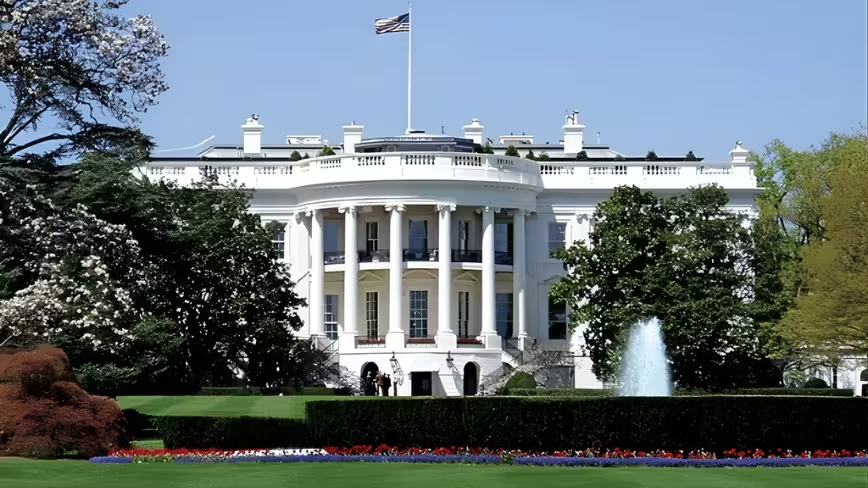
A Strategic Initiative for US AI
The Trump administration has announced a significant move to strengthen the United States' position in the global artificial intelligence landscape. The objective is to support the export of US-made, "full-stack" AI products and services through a massive federal export financing program. This initiative underscores the growing strategic importance of AI internationally and Washington's intent to promote its key technologies.
The plan involves deploying billions of dollars in export financing, drawing from the resources of the Export-Import Bank (EXIM). EXIM, the official export credit agency of the United States, possesses over $100 billion in unused statutory lending capacity. The White House intends to channel a substantial portion of these funds towards AI export packages, aiming to make American solutions more competitive in foreign markets.
EXIM's Role and "Full-Stack" Packages
At the heart of this strategy is the utilization of EXIM's financial capacity to "underwrite" AI exports. This means that US companies developing and offering complete AI solutions, from software to hardware, will be able to benefit from federal financial support for their international sales. The definition of "full-stack AI export packages" suggests a holistic approach, which could include not only software and models but also the necessary hardware infrastructure for their Deployment, such as servers, GPUs, and storage solutions.
The Commerce Department is actively seeking industry-led consortia to define and structure these export packages. This public solicitation aims to involve private sector players in formulating competitive and comprehensive offerings that can meet the needs of global markets. The emphasis on "full-stack" packages is particularly relevant for technical decision-makers evaluating AI solutions, as they often require complex integration across various components.
Implications for Deployment and Data Sovereignty
For international companies and organizations considering the adoption of AI solutions, such an initiative can influence Deployment decisions. Federal financing could make US offerings more attractive from a TCO (Total Cost of Ownership) perspective, especially for large-scale projects requiring significant infrastructure investments. While the source does not specify hardware details, "full-stack packages" could include concrete specifications like GPU VRAM or system Throughput capabilities, crucial elements for Inference and Fine-tuning of Large Language Models.
In a global context where data sovereignty and regulatory compliance are growing priorities, the accessibility of complete and financed AI solutions could offer new options. For those evaluating on-premise Deployments or air-gapped environments, the availability of integrated and financially supported packages might simplify acquisition and implementation, reducing complexities associated with integrating components from different vendors. AI-RADAR offers analytical frameworks on /llm-onpremise to evaluate the trade-offs between self-hosted and cloud solutions, considering factors like data control and operational costs.
Future Prospects in the Global AI Market
This move by the Trump administration is set against a backdrop of increasing geopolitical competition for leadership in AI. Supporting the export of AI technologies is not just an economic matter but also a strategic one, aimed at extending the technological influence of the United States globally. The ability to offer complete and financially accessible solutions could accelerate the adoption of American standards and technologies across various sectors and countries.
The success of this initiative will depend on the ability of industry consortia to develop competitive offerings and the willingness of international markets to adopt these solutions. It remains to be seen how this policy will affect the balance among global AI providers and what responses will come from other nations also aiming to consolidate their position in the artificial intelligence sector.





💬 Comments (0)
🔒 Log in or register to comment on articles.
No comments yet. Be the first to comment!