Adobe's Firefly AI Assistant: Creative Cloud Becomes a Unified Conversational Interface
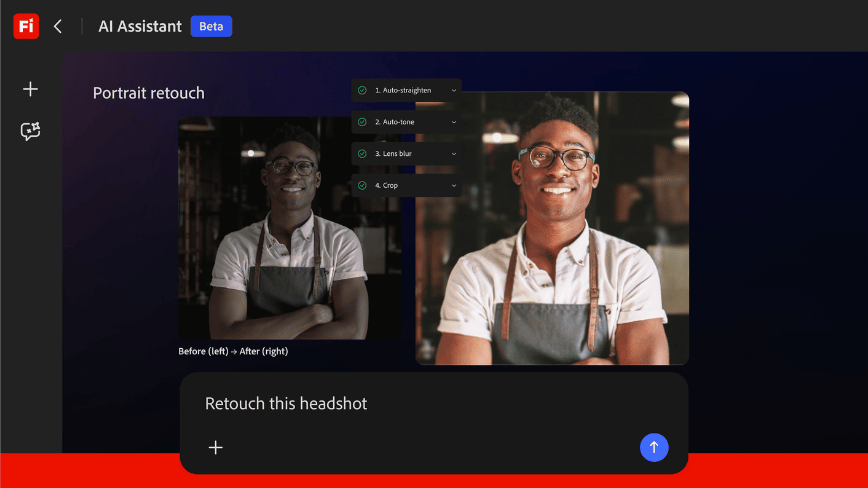
Adobe recently introduced Firefly AI Assistant, a new conversational agent designed to optimize and orchestrate operations within the Creative Cloud suite. This tool aims to transform interaction with professional applications such as Photoshop, Premiere, Lightroom, Illustrator, Express, and Frame.io, allowing users to issue commands and manage complex workflows using natural language. This initiative marks a significant step towards a more intuitive and integrated user interface, where the complexity of tools is mediated by direct dialogue with artificial intelligence.
Previously known by the codename Project Moonlight, Firefly AI Assistant is set to enter public beta in the coming weeks. This strategic move by Adobe highlights the company's commitment to integrating advanced generative AI capabilities into its flagship products, responding to the growing demand for automation and simplification in creative processes. The goal is to enable professionals to focus more on the creative aspect, delegating repetitive or technically complex tasks to AI.
Technical Details and Integration with External LLMs
At the core of Firefly AI Assistant is its ability to act as a true task orchestrator. Using natural language, the assistant can interpret user intentions and translate them into specific actions across various Creative Cloud applications. One of its key features is the ability to maintain context across multiple sessions, ensuring continuity in the workflow that reduces the need to repeat instructions or reconfigure settings. This aspect is crucial for professional workflows that often span several days or require interruptions.
A key element of Adobe's strategy is the integration with third-party Large Language Models (LLM), including models like Anthropic’s Claude. This choice allows Firefly to leverage the advanced language understanding and generation capabilities offered by these LLMs, without having to develop every component internally. In parallel, Adobe announced Firefly Image Model 5 and the ability to create Custom Models, offering users and businesses tools to further personalize the generative AI capabilities according to their specific needs, an aspect that opens new perspectives for brand identity and stylistic consistency.
Implications for Deployment and Data Sovereignty
The integration with third-party LLMs, while offering flexibility and access to cutting-edge technologies, raises important considerations for enterprises, particularly for CTOs, DevOps leads, and infrastructure architects. Reliance on external cloud services for processing sensitive or proprietary data can pose significant challenges in terms of data sovereignty, regulatory compliance (such as GDPR), and security. For organizations operating in regulated sectors or handling highly confidential information, the choice to use external LLMs requires a careful evaluation of risks and benefits.
In this context, the discussion around on-premise or hybrid deployments for AI/LLM workloads becomes crucial. Although Firefly AI Assistant integrates with external models, the principle of control over data and infrastructure remains a priority for many companies. A self-hosted LLM deployment offers complete control over the environment, allowing data to be kept within the corporate perimeter and adhering to stricter security and compliance requirements, including air-gapped environments. This approach, while potentially requiring a higher initial investment in hardware (GPU, VRAM) and expertise, can result in a more predictable Total Cost of Ownership (TCO) and greater peace of mind regarding long-term data governance. For those evaluating on-premise deployments, AI-RADAR offers analytical frameworks on /llm-onpremise to assess specific trade-offs related to performance, costs, and security requirements.
Future Prospects and Final Considerations
Adobe's introduction of Firefly AI Assistant represents a significant evolution in the landscape of creative tools, promising to democratize access to complex functionalities and accelerate workflows. The ability to interact with Creative Cloud applications via natural language has the potential to redefine the user experience, making it more fluid and less dependent on in-depth knowledge of each individual tool.
However, for businesses and IT professionals, adopting such solutions requires a holistic view that goes beyond mere functionality. The choice between integrating with cloud-based AI services and implementing self-hosted solutions for their own LLMs continues to be a central debate. While integrated solutions like Firefly offer convenience and immediate access to advanced capabilities, considerations regarding data sovereignty, security, and TCO drive many organizations to explore alternatives that ensure greater control. The future will likely see a coexistence of both approaches, with companies balancing the flexibility offered by external services with the need to maintain control over their most critical assets.


💬 Comments (0)
🔒 Log in or register to comment on articles.
No comments yet. Be the first to comment!