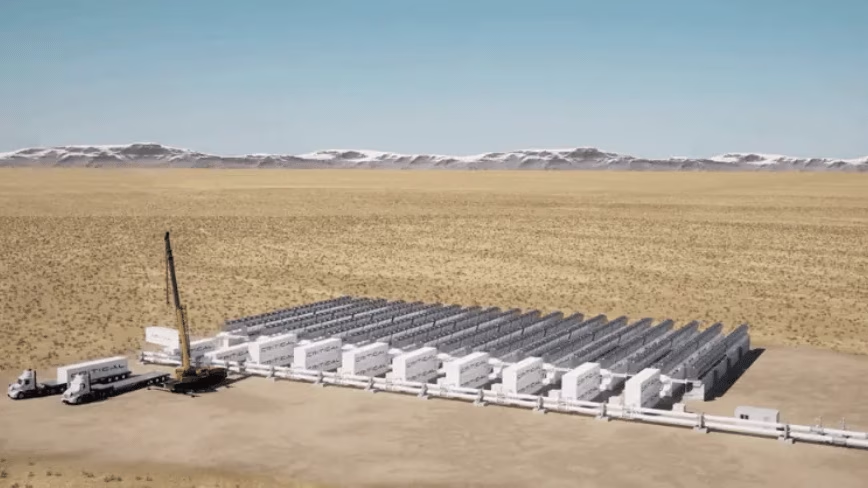
The Energy Hunger of Artificial Intelligence
The exponential advancement of artificial intelligence is generating unprecedented energy demand, posing significant challenges to global infrastructure. Large Language Models (LLMs) and their training and inference workloads require massive amounts of electricity, often 24/7. This need for continuous and reliable power represents a problem that intermittent renewable sources, such as solar and wind, cannot solve on their own.
Imagining a data center operating at full capacity at 3 AM, with no wind or under a cloudy sky, highlights the limitations of an energy infrastructure based solely on these technologies. The necessity for a constant, always-available baseload has become a critical factor for the sustainability and efficiency of AI deployments, pushing research towards innovative solutions in the energy sector.
Critical Energy and the Geothermal Promise
In this context, the Los Angeles startup Critical Energy emerges with an ambitious proposal. Founded by a former SpaceX engineer, the company recently raised $22 million to pursue the goal of providing "always-on" energy through geothermal power. This technology harnesses the Earth's internal heat to generate electricity continuously, regardless of weather conditions or time of day.
Critical Energy focuses on a specific aspect of geothermal innovation: addressing the bottleneck that, according to industry analysts, has shifted from the drilling phase to the turbine. Improving the efficiency and capacity of geothermal turbines is crucial to unlocking the full potential of this energy source, making it a more scalable and competitive solution for the needs of modern data centers.
Implications for On-Premise Deployments
The availability of reliable and cost-effective energy is a fundamental pillar for organizations evaluating on-premise or self-hosted AI deployments. Unlike cloud solutions, where energy management is abstracted by the provider, a local infrastructure requires careful planning of energy supply. Geothermal power, with its ability to provide a constant baseload, could significantly reduce the Total Cost of Ownership (TCO) in the long term, eliminating dependence on volatile or expensive energy sources.
For CTOs, DevOps leads, and infrastructure architects, the choice of energy source is not just a matter of cost, but also of data sovereignty, compliance, and operational resilience. A data center powered by a stable and controllable source offers greater autonomy and security, crucial aspects for air-gapped environments or those with stringent regulatory requirements. AI-RADAR, for instance, offers analytical frameworks on /llm-onpremise to evaluate the trade-offs between different deployment options, including energy factors.
Future Prospects and Challenges
The investment in Critical Energy underscores a growing trend: the search for sustainable and resilient energy solutions to support the growth of artificial intelligence. While geothermal power offers significant advantages in terms of continuity, its large-scale implementation still presents challenges, including initial installation costs and the need for geologically suitable sites.
Nevertheless, the potential of this technology to provide clean and constant energy makes it a promising candidate to power the next generation of AI infrastructures. Diversifying the energy mix, with an emphasis on sources like geothermal, will be essential to ensure that innovation in artificial intelligence can proceed without being hindered by energy or environmental constraints, contributing to a more sustainable future for the tech sector.







💬 Comments (0)
🔒 Log in or register to comment on articles.
No comments yet. Be the first to comment!