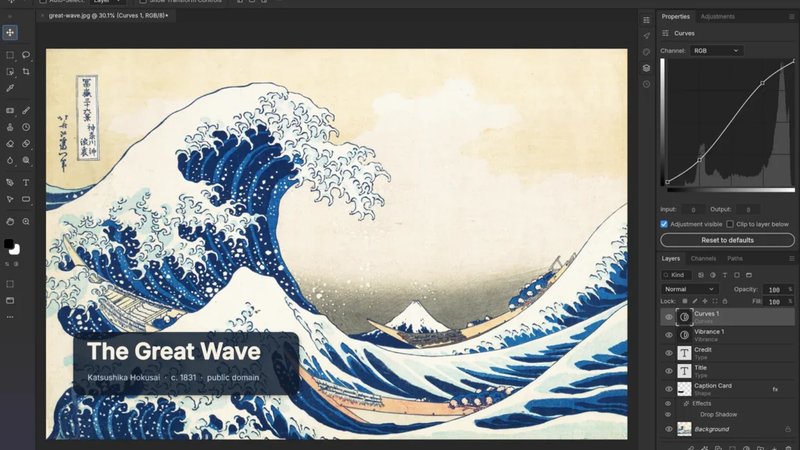
The ArtCraft project has turned three pillars of Adobe's suite into open-source code written in Rust. Claude Code and several AI agents produced clean-room reimplementations of Photoshop, Premiere and Lightroom, according to the source. The initiative presents itself as a demonstration of AI's ability to generate complex software, but it also opens legal questions that will not remain theoretical for long.
The clean-room approach is not new: it consists of rebuilding a program without access to the original source code, documenting every step to defend against copyright infringement claims. In theory, such a process can produce a compatible alternative without copying anything. But when the code is written by a model like Claude, the boundary gets blurry: it is impossible to know with certainty whether the LLM saw or memorized portions of the original code during training. This uncertainty shifts the burden of proof onto whoever generates and distributes the software.
The immediate value does not yet lie in replacing Photoshop or Premiere in production. The demonstration signals a structural change: the barrier to rewriting complex tools lowers when an AI agent can produce and iterate on a Rust codebase. The language choice is not accidental. Rust offers memory control and near-native performance, two qualities useful for graphics and video applications. If the ArtCraft project matures, users who prioritize local control could find a path different from a Creative Cloud subscription.
For those evaluating on-premise deployment, the prospect is interesting but should be observed with caution. An open-source Rust reimplementation can run on local machines without depending on Adobe's cloud services, giving teams control over files, projects and workflow. However, functional maturity, format support and compatibility with professional workflows remain open unknowns. AI-RADAR addresses these trade-offs in the framework at /llm-onpremise, separating promises from tools actually usable locally.
The second-order consequence is legal. If Adobe decides to challenge the project, the case would become a test bed for understanding how much an AI can 'remember' proprietary software and how much clean-room documentation matters when the author is an agent. This is not only an ArtCraft issue: it affects all tools generated with AI assistance, from internal pipelines to enterprise plugins. Companies using LLMs to write derivative code may find themselves having to prove the origin of every function, a compliance cost that few currently include in TCO.
The source provides no benchmarks or details on the actual functionality of the reimplementations. What remains, for now, is an experiment showing that an AI agent can generate a Rust base for complex creative applications. Whether it is a practical alternative or a legal provocation will be decided by the market response and, above all, by Adobe.


💬 Comments (0)
🔒 Log in or register to comment on articles.
No comments yet. Be the first to comment!