The Wave of Opposition Reshaping AI Infrastructure
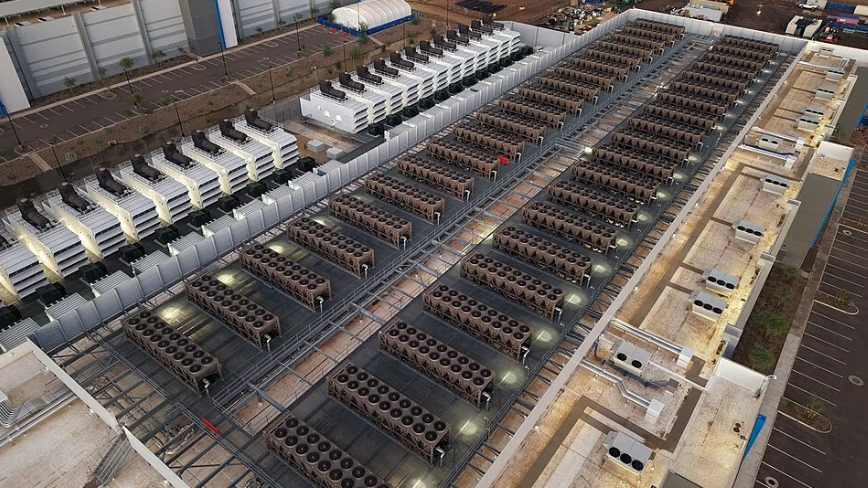
The expansion of the artificial intelligence industry, with its escalating demand for computational power, is increasingly encountering unforeseen obstacles on the infrastructure front. In the United States, in particular, local community opposition to the construction of new data centers has reached a scale that is beginning to redefine not only where, but also whether, the AI industry can actually build its foundations. This phenomenon, often driven by grassroots movements, is becoming a critical factor for anyone planning the deployment of AI workloads.
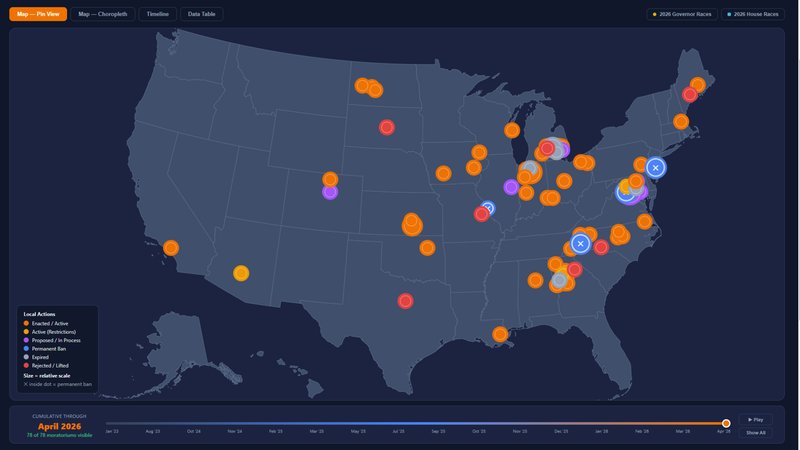
A recent report from Data Center Watch, a tracker maintained by AI research firm 10a Labs, has highlighted the extent of this issue. According to the study, in the first three months of 2026, activists blocked or delayed at least 75 data center projects. The total value of these projects amounts to a significant $130 billion, a figure that underscores the economic and strategic impact of this resistance.
The Context of Opposition and Its Reasons
Opposition to data center construction is not a new phenomenon, but its intensity and organization have grown exponentially with the advent of AI. The primary concerns of local communities often revolve around environmental impact, particularly the massive water and energy consumption required by these facilities. A large data center can consume the equivalent of a small city in terms of electricity and millions of liters of water for cooling, generating a significant ecological footprint.
In addition to these, issues related to noise pollution, landscape impact, and pressure on existing local infrastructure, such as power grids and roads, are often raised. Although data centers bring investment and, in some cases, jobs, the perceived benefits to communities do not always outweigh the environmental and social costs, thus fueling resistance. This complex scenario forces companies to carefully consider not only the technical feasibility but also the social acceptance of their infrastructure projects.
Implications for LLM and AI Deployment
For companies operating in the AI sector, especially those managing Large Language Models (LLM) or other intensive workloads, this growing opposition has direct implications for deployment strategies. Difficulty in finding new sites or obtaining necessary permits can result in significant delays, increased costs, and reduced flexibility in location choices. This further complicates the evaluation between cloud solutions and on-premise deployment.
Limited data center space availability may push companies towards cloud solutions, but this often involves trade-offs in terms of data sovereignty, control, and long-term Total Cost of Ownership (TCO). For those evaluating self-hosted alternatives or air-gapped environments, the difficulty of expanding or building new on-premise infrastructure makes planning even more critical. AI-RADAR offers analytical frameworks on /llm-onpremise to evaluate these trade-offs, considering factors such as silicon availability, GPU VRAM, and throughput requirements.
Future Outlook and Necessary Trade-offs
The current landscape suggests that the AI industry will need to undergo a phase of recalibration in its infrastructure expansion strategies. The search for data center sites will no longer be solely a matter of land availability and connectivity but will require careful evaluation of social acceptance and environmental sustainability. This could lead to a greater emphasis on energy-efficient solutions, optimization of existing hardware, and more distributed or edge computing deployments.
Companies will need to balance the need for computational power with increasing pressure for sustainability and social responsibility. Trade-offs will be inevitable: between deployment speed and environmental impact, between scalability and local acceptance, between initial costs and long-term TCO. The ability to navigate this complex environment will be crucial for the long-term success of AI initiatives, especially for those requiring dedicated infrastructure and granular control over their data and models.







💬 Comments (0)
🔒 Log in or register to comment on articles.
No comments yet. Be the first to comment!