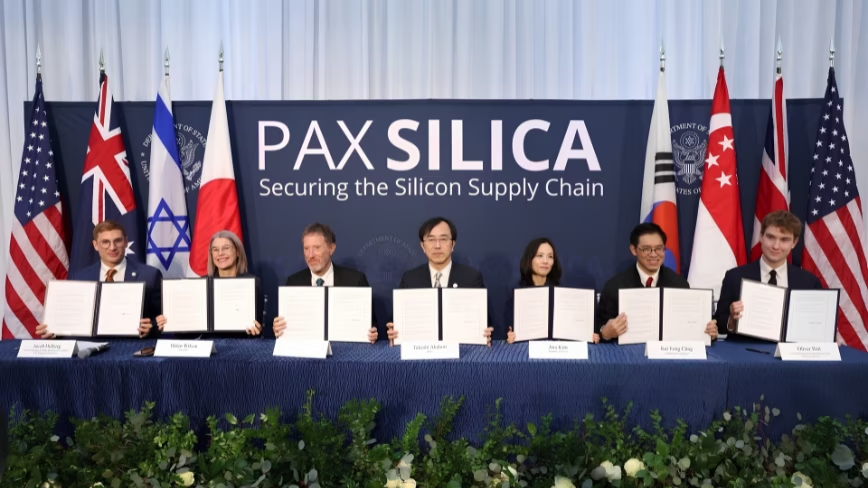
The European Union’s decision to join Pax Silica—the Washington-led effort to secure AI semiconductor supply chains and coordinate export controls against China—comes at an awkward political moment. Just two weeks earlier, Brussels had unveiled a tech-sovereignty agenda promising a path toward strategic autonomy. The coincidence is a short-circuit no one in Brussels can ignore.
A pact reshaping chip geopolitics
Pax Silica is a US-coordinated mechanism designed to prevent advanced semiconductors and manufacturing technologies from reaching Chinese hands. It is not a mere trade deal: behind the scenes, it paves the way for common export control standards and intelligence sharing on value chains. For the EU, joining means accepting a degree of alignment with American trade policy, with direct implications for research, domestic production, and chip access.
The problem, as many in Brussels know, is that France—the engine of European sovereignty—had already dismissed the initiative as ‘colonisation’ when it was informally proposed. The European executive now has to explain how this adhesion squares with the rhetoric of the Tech Sovereignty Package, a plan designed to reduce strategic dependencies. Industry analysts warn that export control alignment could end up slowing down independent computing projects and tying the hardware choices of European enterprises and research bodies.
Cascading effects on on-premise AI infrastructure
For those building or managing on-premise LLM inference and training infrastructure, the stakes are high. The most sought-after GPUs—such as NVIDIA’s A100 and H100—have already been subject to export restrictions toward China, causing ripple effects on delivery times and cloud machine availability. A strengthening of controls, extended across the European market, could further tighten procurement and influence the Total Cost of Ownership for self-hosted projects.
The tension between sovereignty and practical hardware access is a constant in this market. On one hand, keeping data and workloads within one’s own borders is essential for GDPR compliance and for regulated sectors like healthcare, finance, and public administration. On the other, without the guarantee of freely purchasing the most advanced components, on-premise deployment risks becoming an exercise in compromise, where relying on external—often American—cloud providers becomes the default option, partially eroding the goal of control.
The short-circuit with European strategy
The freshly announced Tech Sovereignty Package promises investments in chip fabs and skills, but the news reveals how fragile that path is. Today, AI silicon production remains concentrated in Asia and the Anglo-American supply chain. Pax Silica may accelerate a regulatory convergence that, while protecting against unwanted military uses, aligns Europe with Washington’s export dictates and limits its negotiating freedom toward other markets. In the space of two weeks, opposite extremes—sovereignty on one side, integration into American plans on the other—knocked on the same door.
For those observing the landscape from an on-premise and data-control perspective, the message is clear: local compute architectures are not built only with bits, but with real procurement policies. AI-RADAR monitors these dynamics closely, offering analysis and frameworks to assess the real trade-offs between autonomy, performance, and cost of self-hosted solutions.







💬 Comments (0)
🔒 Log in or register to comment on articles.
No comments yet. Be the first to comment!