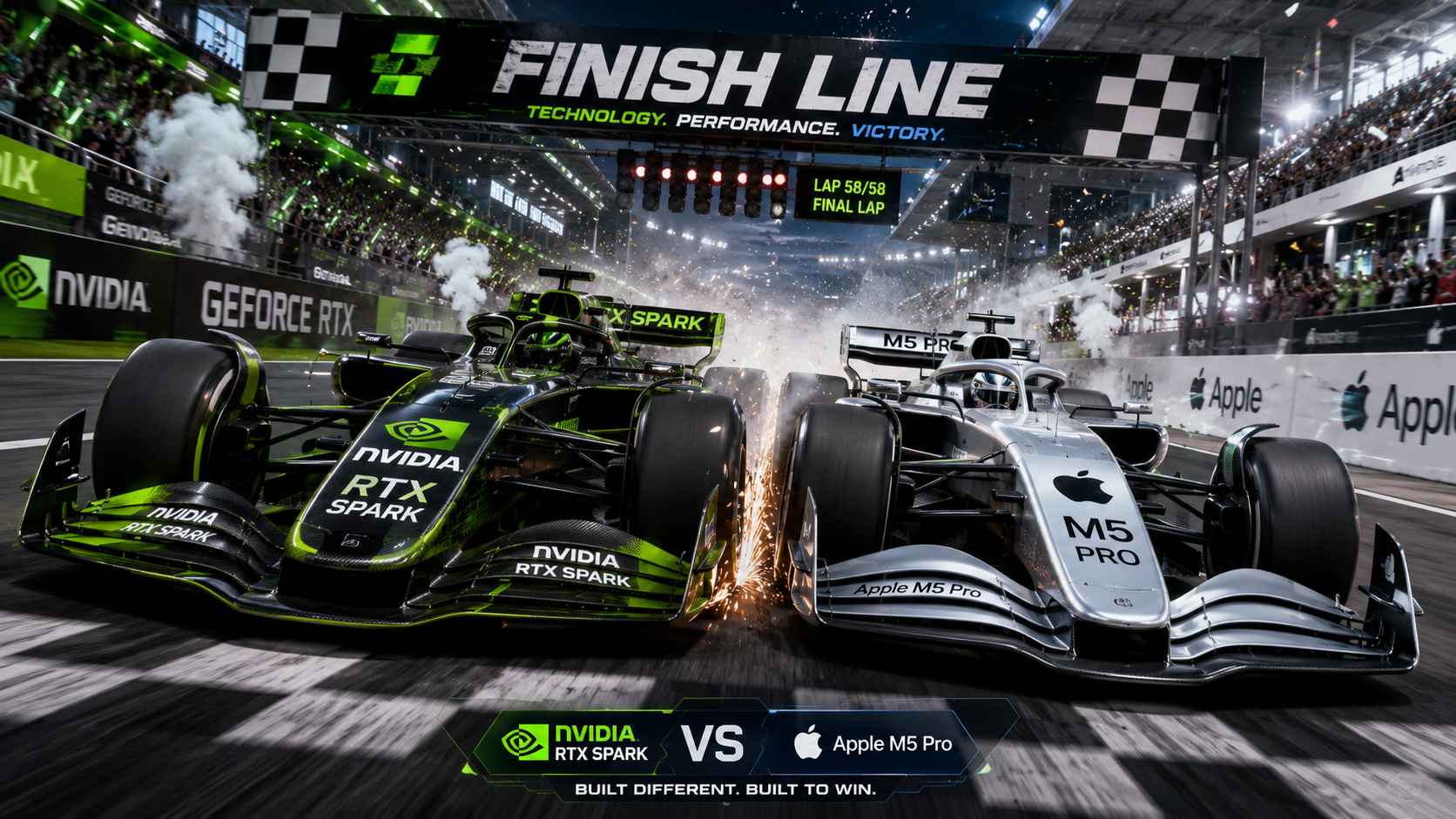
The Silicon Convergence: Nvidia, Microsoft, and the Era of Local Agentic Computing
The personal computer market is undergoing its most fundamental architectural transition since the introduction of the graphical user interface?
For forty years, the paradigm has remained stagnant: you click an app, you type, and the machine obediently executes your explicit commands. But at GTC Taipei during Computex 2026, Nvidia and Microsoft fundamentally blew up that model. The unveiling of the RTX Spark superchip signals a tectonic shift in client computing, pivoting the PC from a passive "tool" to an autonomous "teammate".
If you are an enterprise IT architect, an AI developer, or just a power user tired of paying a monthly subscription to rent someone else's cloud compute, this is the hardware event of the decade. But is it going to change the PC market as we know it? Absolutely. And should Apple, comfortably perched on its Apple Silicon throne since 2020, be worried? The answer is a resounding, complicated yes—with a massive, 614 GB/s asterisk attached.
The RTX Spark Architecture: Brute Force Meets Unified Memory
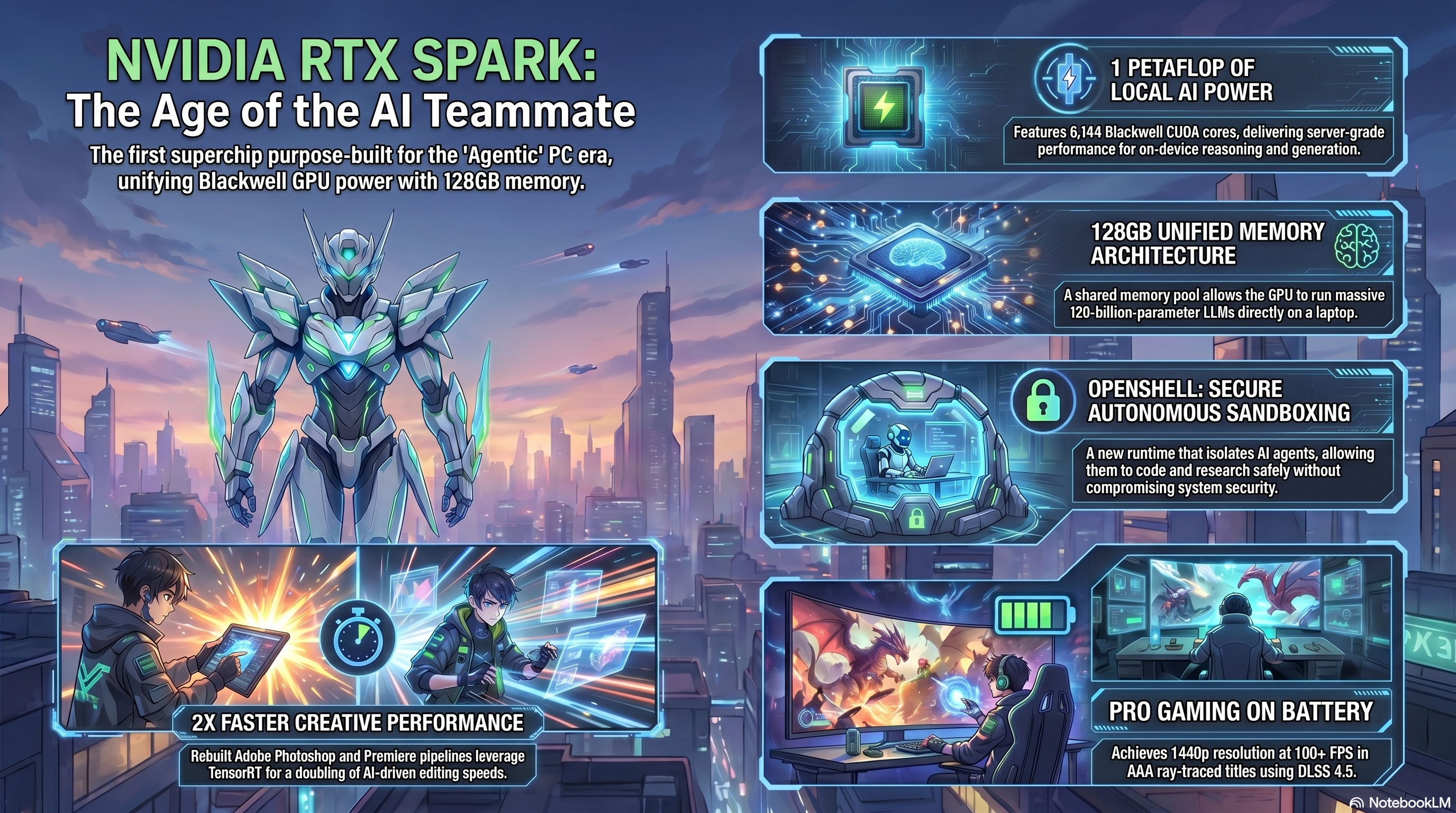
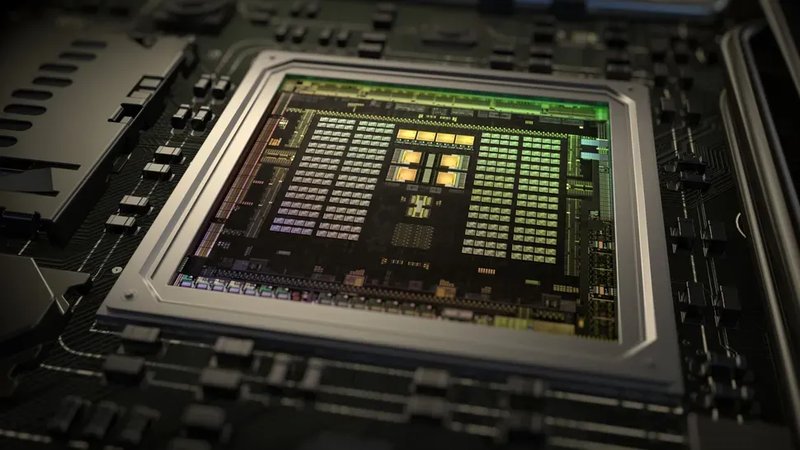
To understand the magnitude of this announcement, we must first look at the silicon itself. The RTX Spark is a Windows-on-Arm System-on-Chip (SoC) built on TSMC’s advanced 3nm node. Code-named the N1X, it fuses a Blackwell-generation GPU featuring 6,144 CUDA cores with a 20-core Nvidia Grace CPU (co-designed with MediaTek).
The defining feature of this chip, however, is its memory architecture. The RTX Spark sports up to 128GB of LPDDR5X unified memory connected via the NVLink-C2C bridge, allowing the CPU and GPU to dynamically share the entire pool.
Nvidia’s marketing department proudly claims this chip delivers "1 Petaflop of AI compute". Let us deploy a necessary dose of sarcasm here: that 1 Petaflop figure requires more asterisks than a pharmaceutical advertisement. It is a "sparse FP4" measurement—a 4-bit precision format with sparsity assumptions baked in. In reality, the dense throughput is closer to 500 TFLOPs. However, this does not diminish the achievement; hardware-level support for FP4 is exactly what makes local AI possible. By executing at FP4, the memory footprint of an LLM drops by 75% compared to FP16. A 120-billion-parameter model, which normally requires roughly 240GB of VRAM, can suddenly fit comfortably into the Spark's 128GB pool.
Table 1: The New Premium Laptop Silicon Landscape
| Platform Metric | NVIDIA RTX Spark (N1X) | Apple M5 Max | AMD Strix Halo | NVIDIA RTX 5070 (Mobile) |
|---|---|---|---|---|
| CPU Architecture | 20-Core Arm (10x X925, 10x A725) | 18-Core (12P, 6S) | 16-Core Zen 5 | Host-dependent (x86) |
| GPU Architecture | Blackwell (6,144 CUDA Cores) | Apple Custom (40 Cores) | RDNA 3.5 (40 CUs) | Blackwell (6,144 CUDA) |
| Unified Memory | Up to 128GB LPDDR5X | Up to 128GB LPDDR5X | Up to 128GB LPDDR5X | 12GB GDDR7 (VRAM only) |
| Memory Bandwidth | ~300 GB/s | 614 GB/s | ~256 GB/s | ~672 GB/s |
| Hardware FP4 Support | Yes | No | No | Yes |
| Software Stack | Windows on Arm, CUDA, TensorRT | macOS, MLX | Windows/Linux, ROCm | Windows (x86), CUDA |
Deepening the "LLM on Premise" Paradigm
The RTX Spark is not just a gaming or creator chip; it is purpose-built to localize the AI economy. Currently, most organizations face a binary and unpleasant choice: hemorrhage cash via API token costs to cloud providers (while surrendering data sovereignty), or spend millions deploying heavy, high-TCO GPU server clusters locally.
The RTX Spark shifts this dynamic to the edge. With 128GB of unified memory, developers and businesses can run frontier-class open-weights models—such as Qwen 3.6 35B, Llama 3.1 70B, or even 120B parameter architectures—directly on a slim laptop. For long-running agentic workflows that require endless, repetitive reasoning loops, eliminating API token costs completely rewrites the economics of enterprise AI.
However, granting an autonomous AI agent the power to navigate your operating system, read your files, and execute shell commands is a cybersecurity nightmare. Without guardrails, a simple prompt injection attack could trick an agent into exfiltrating proprietary code or wiping a hard drive.
This is where the Microsoft and Nvidia partnership flexes its muscle. Microsoft has introduced new identity and containment primitives deep into the Windows kernel. On top of this, Nvidia is deploying the OpenShell secure runtime. OpenShell acts like a web browser tab for AI; it isolates agentic sessions in a strict sandbox, intercepting outbound network traffic and preventing unauthorized file access. It routes sensitive context through privacy-aware inference pipelines, stripping personal data before any unavoidable cloud queries are made.
Major enterprise leaders are already capitalizing on this. SAP is embedding OpenShell into its Joule Studio runtime, and semiconductor giant Cadence is utilizing it to secure "ChipStack," an autonomous AI engineer that executes chip verification locally. The local AI agent is no longer a hobbyist toy; it is a secure, untethered enterprise worker.
The Apple Threat: The 614 GB/s Question
Should Apple be terrified? Yes and no. Apple has effectively owned the high-end creative and local AI market since transitioning to Apple Silicon, leveraging its massive unified memory architecture. The RTX Spark is the first platform to legitimately challenge that hegemony, but Apple holds a structural advantage that Nvidia could not overcome in this first generation: memory bandwidth.
In the world of local LLM inference, raw GPU compute (FLOPS) dictates your "prefill" speed—how fast the model ingests a massive prompt. Because the RTX Spark has 6,144 CUDA cores and active cooling, it absolutely obliterates Apple in the prefill stage, reading context at over 1,700 tokens per second.
But during "decode"—the phase where the model actually generates the response you read—performance is entirely bottlenecked by memory bandwidth. The Apple M5 Max features a massive 614 GB/s memory bus. The RTX Spark, hampered by its 256-bit interface, is physically constrained to roughly 300 GB/s of bandwidth.
Table 2: Inference Benchmarks (GPT-OSS 120B Model)
| Metric | NVIDIA RTX Spark | Apple M5 Max | 3x NVIDIA RTX 3090 Desktop Rig |
|---|---|---|---|
| Prefill (Prompt Ingestion) | 1,723.1 tokens/sec | ~850 tokens/sec | 1,641.9 tokens/sec |
| Decode (Token Generation) | 38.55 tokens/sec | ~65 tokens/sec | 124.03 tokens/sec |
Apple's M5 Max will generate text significantly faster than the RTX Spark. However, Nvidia holds the ultimate trump card: the CUDA software moat.
The vast majority of the world's AI research, training, and deployment relies natively on Nvidia's CUDA and TensorRT. Developers using Macs are forced to rely on Apple's MLX translation layer, which, while impressive, routinely introduces friction and compatibility issues with experimental model architectures. With the RTX Spark, a developer can fine-tune an agent natively in Windows on Arm, and deploy it straight to a cloud data center without changing a single line of code. Apple may sell you memory bandwidth at a dizzying luxury markup, but Nvidia sells frictionless software compatibility.
A Market Disrupted
Beyond AI, the RTX Spark fundamentally disrupts the PC ecosystem. Microsoft's 23rd attempt at making "Windows on Arm" successful might actually be the charm, largely because Nvidia refuses to accept a compromised experience.
Qualcomm’s Snapdragon X Elite brought great battery life but struggled immensely with PC gaming, primarily due to kernel-level anti-cheat software failing on emulation. Nvidia and Microsoft have patched this vulnerability, bringing native anti-cheat support to Windows on Arm alongside DirectX 12 Ultimate, hardware ray tracing, and DLSS 4.5. You can now play Cyberpunk 2077 at 1440p at over 100 frames per second on a thin-and-light laptop powered by an Arm chip.
Intel and AMD, who have comfortably enjoyed the x86 duopoly for forty years, are now staring down a four-way melee. Creative juggernauts like Adobe are entirely rebuilding Photoshop and Premiere Pro from the ground up for the RTX Spark to natively tap into the unified memory pool, boasting up to 2x faster editing and AI effects.
Conclusion
The Nvidia RTX Spark is not just a new processor; it is the death knell of the traditional application and the birth of the personal AI teammate. While Apple’s M5 Max maintains a commanding lead in pure memory bandwidth, Nvidia’s unmatched CUDA ecosystem, its hardware FP4 support, and its aggressive integration of secure, on-device AI agents through OpenShell makes the RTX Spark an earthquake for the PC industry.
If the future of enterprise software is agentic, local, and private, Nvidia has just ensured that the hardware required to run it will bear a glowing green logo.
I'm eagerly awaiting the prices reveal. It is almost obvious that to contrast Apple, Nvidia and the involved PC Manufacturers should choose a really aggressive street price but will they really do it?



💬 Comments (0)
🔒 Log in or register to comment on articles.
No comments yet. Be the first to comment!