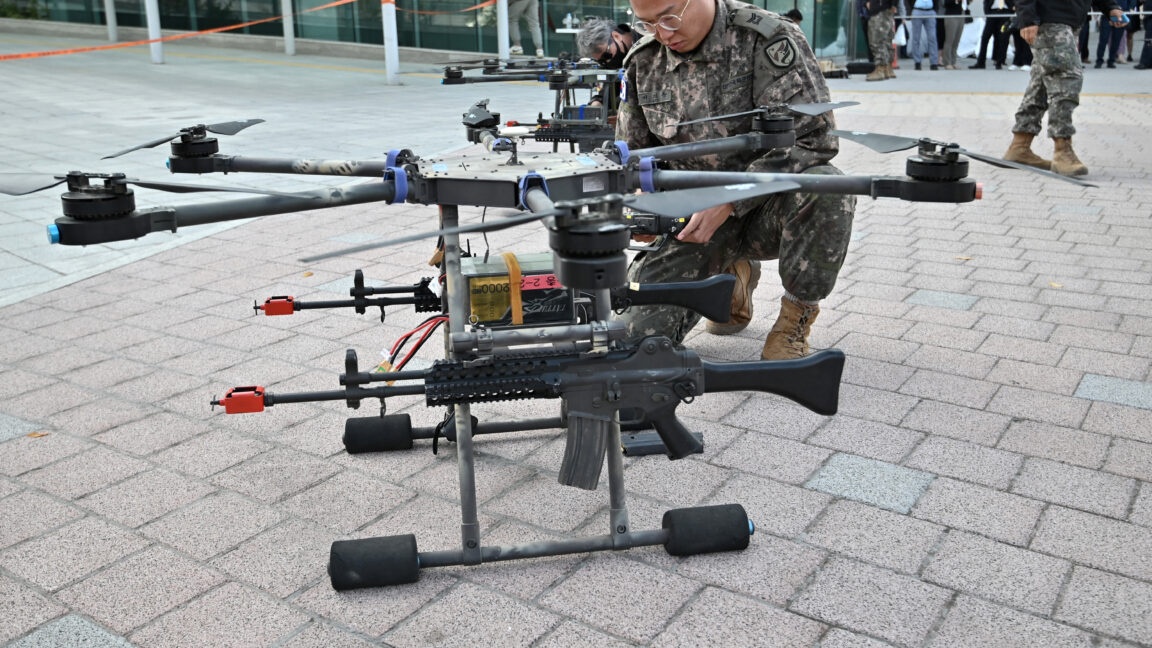
South Korean Defense Minister Ahn Gyu-back’s recent announcement has the force of a doctrinal shift: every member of the country’s nearly half-million-strong military must learn to operate drones as naturally as they handle a personal firearm. The news, reported by Reuters and The Korea Times, is not just a tactical update — it’s a signal that resonates with anyone working on deploying artificial intelligence in distributed, cloud-free environments.
The plan involves reorganizing the drone operations command into a hub for industry collaboration and commercial technology procurement, while units will be equipped with low-cost, expendable drones for surveillance and strike missions. At the same time, more counter-drone lasers and microwave weapons will be deployed. The minister explicitly cited the conflicts in Ukraine and the Middle East as real-world drivers of these reforms.
Drones and AI: inference can’t wait for the cloud
The mass training goal has a technological subtext. For a drone to become a personal weapon, the intelligence guiding it must live on-board or very close by — in a backpack, on a portable device, always off-grid. Machine learning inference (often convolutional neural networks for visual recognition) must work without latency, independent of satellite links or distant data centers, and under electronic jamming conditions. This pushes deployment decisively toward the edge: computation happens on the device or on a local server in the theater of operations.
This paradigm shift mirrors what enterprises already know. The same reasons a bank or a manufacturer refuses to send sensitive data to the cloud are amplified in defense. Data sovereignty, chain-of-command integrity, resilience against faults or cyberattacks — all converge on self-hosted architectures. And that brings the hardware constraints familiar to LLM and vision model practitioners: VRAM, power consumption, low-power processing capability. The task is not training from scratch but running inference on quantized models, often in INT8 or FP16, using embedded GPUs, NPUs, or FPGAs that must balance performance and battery life.
Boosting the on-premise AI supply chain
South Korea’s decision doesn’t emerge in a vacuum. The country hosts semiconductor giants and serves as a bellwether for hardware trends. Military demand for local inference chips — from night vision to autonomous targeting — can accelerate the development of more efficient components and, through osmosis, lower costs for civilian on-premise deployments. It’s the same pattern that advanced robotics and neural networks: defense funds frontier research that later matures for enterprise.
For those evaluating on-premise deployment, the trade-offs are analogous: the choice between compute power and mobility, the need to run ever-larger models on limited hardware, the importance of quantization and compression. South Korea’s path highlights a clear direction: AI is no longer a cloud luxury but a critical infrastructure that must be brought as close to the action as possible. AI-RADAR offers analytical frameworks to navigate such choices, comparing local stacks and calculating Total Cost of Ownership for on-premise infrastructures.
Personal drones: warfare as a proving ground for edge computing
The goal of turning drones into a “second rifle” raises the bar for software too. Models must adapt to fast-changing scenarios, with rapid fine-tuning or even secure over-the-air updates. This calls for edge orchestration frameworks capable of managing synthetic data pipelines and incremental training without ever leaving the security perimeter.
Looking ahead, the Korean drive could stimulate more open standards for autonomous system interoperability, accelerating the adoption of containers and modular platforms in military settings. Technologies like Kubernetes for tactical compute or model serving tools such as vLLM and TGI — conceived for data centers — may spawn lightweight versions for field use. This isn’t science fiction: recent conflicts have shown how technological advantage hinges on the ability to process information in a continuous cycle, where signal return must be instantaneous.
South Korea is not merely buying more drones. It’s redesigning how computational power is distributed along the entire chain of command, bringing inference and light training exactly where needed: the front line. For the on-premise AI industry, this is a national-scale test of the principles already guiding enterprise adoption: control, security, resilience.







💬 Comments (0)
🔒 Log in or register to comment on articles.
No comments yet. Be the first to comment!