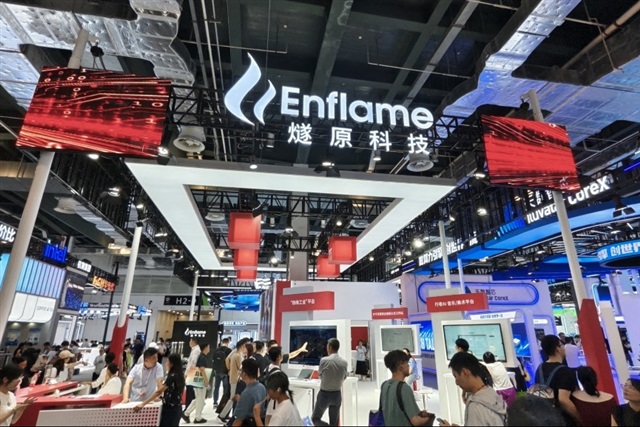
When a Chinese AI chip company decides to go public, the market is not just looking at revenue. It is looking at who stands behind it, who buys from it, and how much capital it takes to stay in the race. Enflame Technology is the latest example: its IPO puts its Tencent ties, deep losses and ambition to carve out a role in hardware for large models in the spotlight.
Tencent's involvement is not a corporate footnote. In a market where early demand often comes from a few major customers, having a cloud and consumer giant as shareholder or commercial partner can secure volume, but it also shifts the centre of gravity of the roadmap. A chip designed around one large operator's needs can become less neutral for the rest of the market, creating a dependency that a prospectus makes more visible than lab work does.
The deep losses point to the structural nature of the business: developing AI accelerators requires continuous investment in design, packaging, memory and software, well before revenue reaches sufficient scale. This is not an isolated weakness at Enflame; it is a feature of competing against players with an already consolidated ecosystem. The difference is that in the Chinese market this competition also plays out on a geopolitical level: export restrictions push domestic demand towards local alternatives, but demand alone does not make a profit and loss account sustainable.
China's GPU race is therefore not only about raw compute power. It is a race of financial endurance and software ecosystem maturity. An accelerator does not live on silicon alone: it needs drivers, compilers, framework support and an inference and training pipeline that does not force teams to rewrite everything. Anyone evaluating on-premise deployments knows that the cost of moving to new hardware is not measured in teraflops, but in the ability to integrate it without blocking workloads.
The Enflame case has second-order implications for the wider ecosystem. If domestic suppliers remain loss-making, enterprise customers face the risk of unstable roadmaps, reduced support or priorities driven by a single large shareholder. That can slow adoption even when industrial policy pushes towards data sovereignty. Conversely, if the Tencent relationship turns into stable demand and operational know-how, it can shorten the validation cycle and create a credible second hardware pole. For now both paths coexist, and that is exactly the point: the listing does not resolve the ambiguity, it makes it public.
In an on-premise deployment scenario, choosing a domestic accelerator is not purely technical. It involves data location, compliance constraints and supply-chain continuity. A listed supplier may offer more transparency, but also more pressure around quarterly margins. For teams running local infrastructure, the Enflame case is a useful reminder that technological sovereignty carries an operating cost that rarely appears in product presentations. On AI-RADAR, the /llm-onpremise framework helps map these trade-offs when comparing self-hosted solutions and alternative suppliers, without reducing the choice to a single benchmark.
China's GPU race needs more than an IPO. It needs companies able to turn ambitions into maintainable supply chains and software. Enflame's prospectus shows that the path has only just begun, and that the issue is not who arrives first with the fastest silicon, but who survives long enough to become infrastructure.







💬 Comments (0)
🔒 Log in or register to comment on articles.
No comments yet. Be the first to comment!