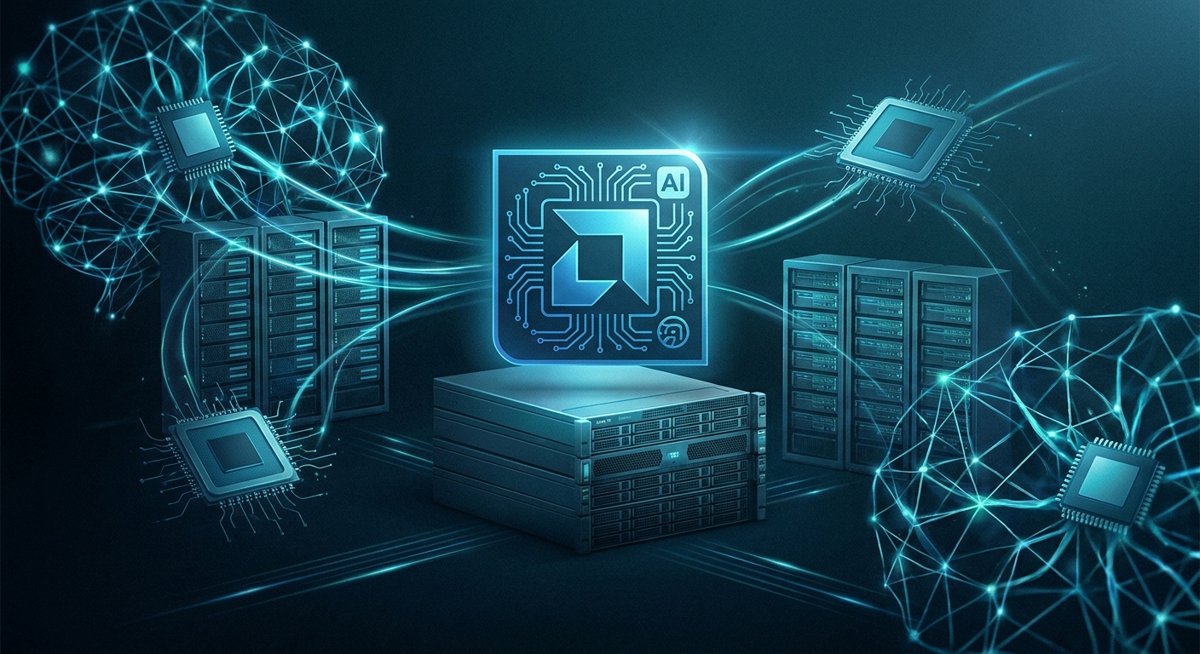
Beyond the supply deal: a multi-architecture worksite
The news is not a simple hardware supply contract. When AMD and Anthropic announce the construction of a large-scale “AI factory” that explicitly forgoes CUDA, the signal to the data center sector is unmistakable: the NVIDIA monolith is no longer the only viable choice for those designing infrastructure for LLM workloads. The most overlooked – but decisive – aspect is that for the first time we are not talking about an experimental cluster or a proof-of-concept, but a facility designed for continuous production of multi-trillion parameter models, with an industrial-scale commitment.
To grasp the magnitude of the shift, one must read the operation within the layering of hardware-software stacks that has characterized the last decade. NVIDIA’s dominance in AI data centers was never a matter of raw GPU power: competing architectures often offered competitive teraflops and bandwidth specifications. The competitive edge crystallized around CUDA and its ecosystem of libraries, compilers, profiling tools, and a developer community that reached unparalleled critical mass. Stepping out of this enclosure means accepting a migration cost that many enterprises have judged prohibitive.
Anthropic’s entry as a reference partner changes the terms because it does not merely buy hardware: it brings in a research and engineering team capable of contributing to the optimization of the software stack, progressively reducing that migration cost. The factory concept, with its connotation of continuous and standardized process, implies that the work on ROCm will not be a one-off experiment but an iterative investment with short feedback loops. It is a shift from “on-paper compatibility” to “sustained operability.”
For those, like the AI-Radar reader, tasked with making on-prem deployment decisions, the message is straightforward: multi-architecture is no longer a hyperscaler luxury but a tangible option to incorporate into roadmaps. What is needed now is to understand which layers of the stack are truly impacted and which trade-offs remain to be managed.
The hardware foundations: why Instinct MI300X matters now
The accelerator at the center of the operation is the AMD Instinct MI300X, based on the CDNA 3 architecture and featuring 192 GB of VRAM per card. The figure is not just a datasheet number: for inference workloads on large LLMs, the amount of VRAM available on each device determines model density, batch sizes, and the ability to handle long contexts without fragmenting the model across too many nodes with their associated communication overhead.
In a self-hosted scenario, where every watt and every rack unit can translate into direct operational costs, memory density becomes a key parameter for TCO calculation. Having 192 GB of VRAM means being able to run a 70-billion-parameter model with quantization on a single card or across very few parallel cards, reducing network complexity and bottlenecks. This does not mean NVIDIA has been surpassed on a technical level – its Blackwell architecture introduced significant innovations as well – but it indicates that AMD has reached a capacity threshold that makes the platform credible even for the most demanding workloads.
There is a second often-overlooked hardware aspect: system-level integration. AI factories are not made of GPUs alone, but of nodes, switches, high-speed fabrics, and cooling systems. AMD is investing in the OEM and ODM partner ecosystem to offer reference designs covering the entire physical stack. If an enterprise today evaluates an on-prem cluster for fine-tuning open-source models, the possibility of obtaining pre-configured nodes with MI300X and proven firmware support reduces integration risks, which are one of the main brakes on alternative hardware adoption.
It remains true that raw hardware availability does not solve the software issue, and it is precisely on this that the game will be played in the coming quarters.
The software challenge: ROCm and bridging the CUDA divide
For years, the automatic response of any MLOps engineer to the question “can we use AMD GPUs?” was a skeptical smile. The reason was not silicon quality, but software framework maturity. ROCm, AMD’s open-source initiative for accelerated computing, has made remarkable strides: it now supports PyTorch and TensorFlow with API-level compatibility that allows many workloads to run without substantial code changes. Third-party projects like vLLM for inference have added ROCm support, and the community is beginning to produce specific content.
The gap compared to CUDA, however, is not measured solely in API coverage. It hides in the details: optimized execution profiles, automatic kernel tuning, availability of specialized libraries such as those for flash attention or parallelism strategies. An AI hyperscaler like Anthropic has exactly the skills to intervene on these points: engineering teams working closely with the ROCm compiler, contributing to kernel tuning, and developing optimized deployment pipelines. The process closely resembles what large cloud providers did years ago to make their custom infrastructures competitive.
The leverage effect of such a partner should not be underestimated: when software improvements are developed for internal use and then released as upstream contributions, the whole ecosystem benefits. Within a few development cycles, optimizations created to train Claude could make the inference of Llama 3 or Mistral more efficient on AMD hardware, lowering the barrier even for small deployers. The direction is clear: ROCm is approaching a point of operational sufficiency – not yet full parity, but sufficient for well-defined production use cases.
Naturally, execution risk exists. Closing a software gap accumulated over more than a decade is an endeavor not measured in quarters. But the market signal is undeniable: demand for CUDA alternatives is strong enough to convince a company like Anthropic to commit strategically, and this shifts the center of gravity of expectations.
Implications for self-hosted: sovereignty, TCO, and bargaining power
We are entering the heart of the AI-Radar perspective. Enterprises that today evaluate self-hosted LLMs do so for a mix of reasons: data sovereignty, long-term operational cost control, regulatory compliance, and in some cases the need to avoid capacity bottlenecks in public clouds. Until now, designing an on-prem cluster for open-source model inference has meant, in the vast majority of cases, sizing the purchase around NVIDIA GPUs. Not out of technological dogma, but because internal teams know CUDA and because the surrounding tooling and support ecosystem is more predictable.
The AMD-Anthropic operation introduces a new variable into the TCO calculation. GPU purchase cost is only one line item: there are software licenses, engineering hours for integration, cooling and power costs, and above all the cost of lock-in to a single supplier. Historically, the bargaining power of those designing AI data centers has been limited precisely by the lack of a credible alternative. If ROCm continues to mature, enterprises will be able to put suppliers in competition not just on per-card price, but on the entire deployment architecture. This is not science fiction: in the traditional enterprise server market, competition between Intel and AMD produced similar dynamics for years.
There is a further structural advantage for self-hosted: the possibility of adopting a multi-architecture posture. Instead of tying the entire hardware fleet to a single vendor, one can think in terms of differentiated resource pools: NVIDIA nodes for workloads leveraging very specific libraries, AMD nodes for standardized model inference or routine fine-tuning. This approach reduces the risk of being caught off-guard if a supplier changes licensing terms or suffers delivery delays. It implies, however, greater internal maturity: teams must be trained on multiple stacks, investments in hardware-agnostic orchestration tooling are needed, and higher management complexity must be accepted.
The trade-off is therefore clear: those willing to invest in diversification can achieve lower TCO and greater resilience; those seeking the simplest path will continue to prefer NVIDIA uniformity. The arrival of a CUDA-free AI factory does not erase this tension, but it turns it into a concrete strategic choice rather than an unavoidable constraint.
The ecosystem effect: research, startups, and open-source models
The AMD-Anthropic AI factory will not only impact large hyperscalers. One of the less visible but potentially most disruptive effects concerns the entire ecosystem of independent research and startups. For years, university labs and small companies avoided AMD hardware because the software entry barrier was too high: unable to dedicate resources to kernel tuning, they relied on CUDA simply because “it just works.” If Anthropic demonstrates that frontier models can be trained on MI300X, the pull-through effect is immediate: researchers will begin requesting funding for AMD clusters, cloud service providers will add Instinct instances, and open-source library maintainers will dedicate resources to ROCm support.
This virtuous cycle is already partly visible: frameworks like PyTorch have made hardware choice more transparent, and the open-source community is naturally attracted to solutions that avoid proprietary lock-in. For open-source models – Llama 3, Mistral, Qwen, Falcon – the availability of a second mature hardware ecosystem means a broader user base and faster experimentation. It is no coincidence that several of these organizations have already begun testing their models on AMD GPUs.
For startups building MLOps, orchestration, and monitoring tools, the emergence of a multi-architecture ecosystem represents a differentiation opportunity: those able to offer unified management of mixed NVIDIA-AMD clusters will gain a competitive edge. At the same time, startups developing proprietary models will be able to assess whether to move part of training or inference to AMD hardware to reduce costs, further accelerating the feedback cycle.
The sore point remains skills: the MLOps workforce is today massively trained on CUDA. Universities and bootcamps will need to integrate ROCm into curricula, but the process will take time. In the short term, skills availability might be the real bottleneck for widespread adoption, not the hardware.
What to watch going forward
The announcement is the starting point, not the finishing line. For those designing on-prem infrastructures, the coming quarters will be decisive in separating signal from noise. There are several concrete indicators to monitor.
First, independent benchmarks. Comparative measurements on real workloads – batch inference, fine-tuning of tens-of-billion-parameter models, latency on long contexts – are needed, going beyond press releases. They will likely emerge from internal research teams at Anthropic, but also from the open-source community that will start publishing results on platforms like Hugging Face.
Second, the evolution of the ROCm software. AMD’s roadmap will need to be watched not only for API coverage, but for integration with orchestration tools such as Kubernetes, Kubeflow, and with monitoring systems. Support for specific libraries like FlashAttention or TensorRT-LLM (or their equivalents) will signal operational maturity.
Third, NVIDIA’s response. The Santa Clara giant will not stand still. It is foreseeable that it will accelerate the release of vertical libraries, strike exclusivity deals with some hyperscalers, or adjust pricing policies to maintain market share. The software community around CUDA could also receive additional investments to make the ecosystem even more integrated and harder to leave.
Fourth, adoption by other heavyweight players. If within a year we see other hyperscalers – or even large non-tech enterprises – announce large-scale clusters based on MI300X for AI workloads, it will mean that the Anthropic factory has produced the hoped-for pull-through effects. In that case, the market will enter a new phase of real competition, with tangible benefits for all deployers, from large clouds to small on-prem installations.





💬 Comments (0)
🔒 Log in or register to comment on articles.
No comments yet. Be the first to comment!