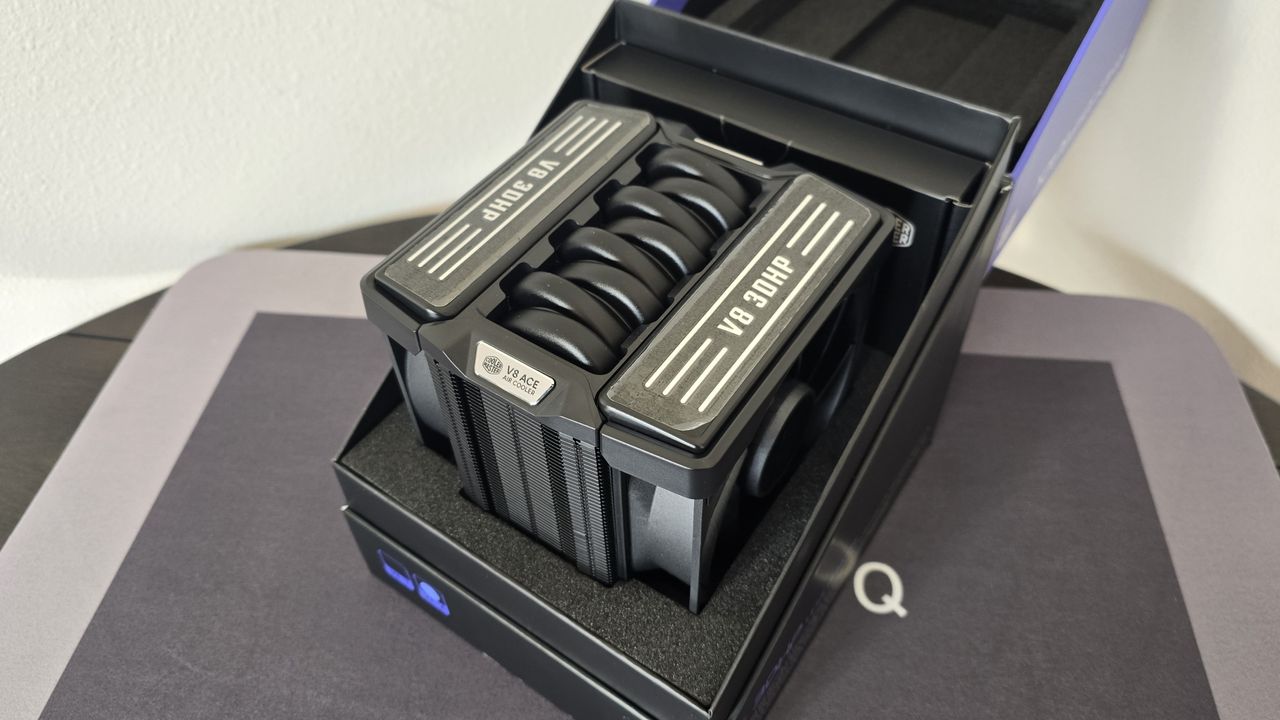
Albert Thomas isn’t a newcomer in the hardware world: from a 486 that blew up due to a wrong power cable, he built solid credibility as a Reddit moderator of tech communities and a contributor to outlets like Tom’s Hardware. His latest review, covering the Cooler Master V4 and V8 3DHP coolers, grabs attention more for the reviewer’s authority than for the products themselves, and offers a chance to look past the cold numbers of synthetic benchmarks.
In today’s landscape, where local LLM inference is back in the spotlight, cooling is never a secondary concern. Anyone building workstations to run models on-prem knows that thermal throttling is as silent a threat as a badly drafted batch. Sustained loads, such as inference over long token streams with full pipelines, stress the CPU for hours: in these scenarios, the gap between a carefully engineered cooler and a cut-rate solution shows up not just in decibels or degrees, but in the ability to hold boost frequencies without fluctuations, preserving predictable latency.
Thomas’s test, while limited to a piece that must cater to both enthusiasts and professionals, highlights an often-missed point: a cooler’s thermal architecture is part of the compute pipeline. Mainstream discussions usually focus on GPUs, VRAM, INT8 or FP16 quantization, while forgetting that the CPU remains the conductor for tasks like preprocessing, container orchestration, and, in many cases, inference itself on smaller models.
There’s a structural implication for anyone evaluating the Total Cost of Ownership of an on-prem deployment: choosing a cooler that excels in static heat dissipation without excessive noise isn’t an overclocker’s whim, but an investment in operational stability. In an air-gapped context, where every component must run uninterrupted for months, the marginal gain in thermal reliability translates into less throttling, lower overall energy consumption, and, over time, a tighter TCO.
It’s no coincidence that the review comes from a writer with three decades of hands-on experience: human judgment on real load curves, vibrations, mounting tightness – details that escape spec sheets – matters when a server has to sleep in a closet or in a noisy edge environment. Thomas’s article, beyond the two specific products, signals a renewed attention to “humble” components, the building blocks of local compute that rarely make headlines.
For those assembling their own inference node today, the message is clear: cooling is an enabler of data sovereignty, because hardware that can’t sustain real workloads undermines the promise of self-hosting. And a well-conducted review, even without revealing technological breakthroughs, serves as a reminder that every wasted watt is a lost token.



💬 Comments (0)
🔒 Log in or register to comment on articles.
No comments yet. Be the first to comment!