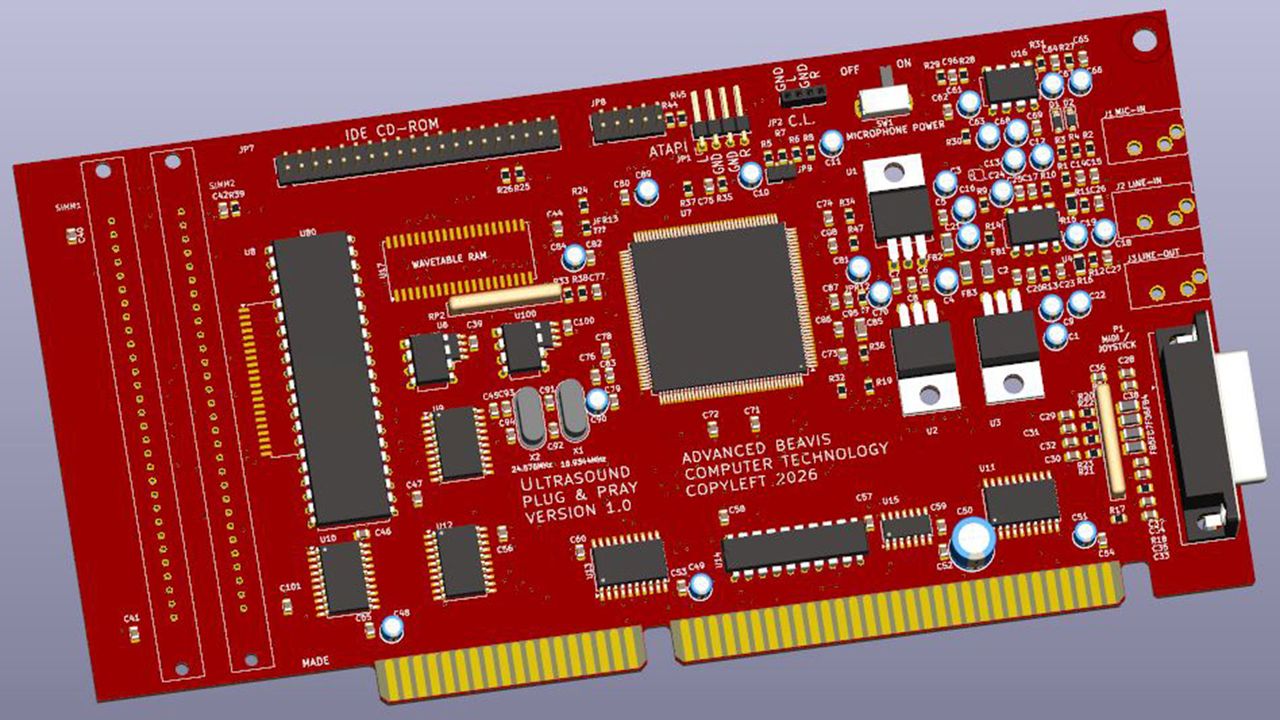
The news comes straight from maker repositories and the most devoted corners of retrocomputing: someone decided that the Gravis Ultrasound didn't deserve to remain an inaccessible relic. The Beavis Ultrasound project has published the entire design package – KiCad schematics, PCB layout, sample ROM files – giving anyone the ability to assemble, modify, or simply study one of the most legendary sound cards of the 1990s.
The operation feels like redemption for those who dreamed of owning one back then but couldn't afford it, or for those today who want to slot it into a vintage PC without suffering the scarcity and prices of the second-hand market. But the technical significance is more nuanced: releasing complete hardware sources – not just Gerber files, but the native KiCad project – lowers the barrier for FPGA porting, for building variants with modern components, and for collective debugging of a platform whose original silicon has been out of production for decades.
The weight of a well-documented clone
The Gravis Ultrasound, or GUS, was much more than a MIDI file player: thanks to hardware wavetable synthesis and dedicated sample memory, it delivered sound quality that outclassed Creative's Sound Blasters and let musicians break free from fixed sound libraries. The Beavis clone doesn't just replicate its components; it also distributes the ROM with the original samples – a non-trivial detail in a field where many open-source clones stop at the PCB without providing the firmware or binary data required to make it operational.
This transparency is especially interesting when compared with the growing wave of open-source hardware for accelerated computing. While AI is seeing a proliferation of inference board projects based on FPGAs or RISC-V chips, a clone of a historic peripheral like the GUS shows that an open development ecosystem can take root even on devices with a significant analog component – D/A converters, filters – where layout fidelity is never a purely digital exercise. Here, the value added isn't computing power, but reproducibility with no gray areas.
Beyond retrogaming: what it teaches hardware DIY
For those working on on-premise deployment of intensive workloads, the GUS affair might look like archaeology. Yet it hides a lesson: when a hardware project is opened up fully, its lifecycle detaches from single-vendor support and falls into the hands of a community that can fix bugs, adapt it to new interfaces (today PCIe, tomorrow maybe a high-speed USB bridge), and even upgrade components with current parts without having to reverse-engineer everything in the dark. It's the same logic that drives many teams to seek accelerator boards with public specifications, controllable firmware, and non-proprietary toolchains, to avoid getting trapped when a vendor changes direction.
Granted, a DOS sound card doesn't manage tokens per second or partition VRAM among neural network weights. But the principle of technical sovereignty – knowing exactly what's inside the silicon you buy, being able to modify and repair it without relying on a single supplier – runs on the same track. Open-source hardware, whether a microcontroller or an accelerator, reduces the risk of forced obsolescence and broadens long-term maintenance options, an aspect that escapes TCO assessments based solely on purchase price.
The Beavis clone won't dethrone NVIDIA or solve latency issues for edge GPUs. But it reminds engineers that complete documentation isn't a hobbyist quirk: it's the ingredient that turns a piece of hardware from a component into a platform.






💬 Comments (0)
🔒 Log in or register to comment on articles.
No comments yet. Be the first to comment!