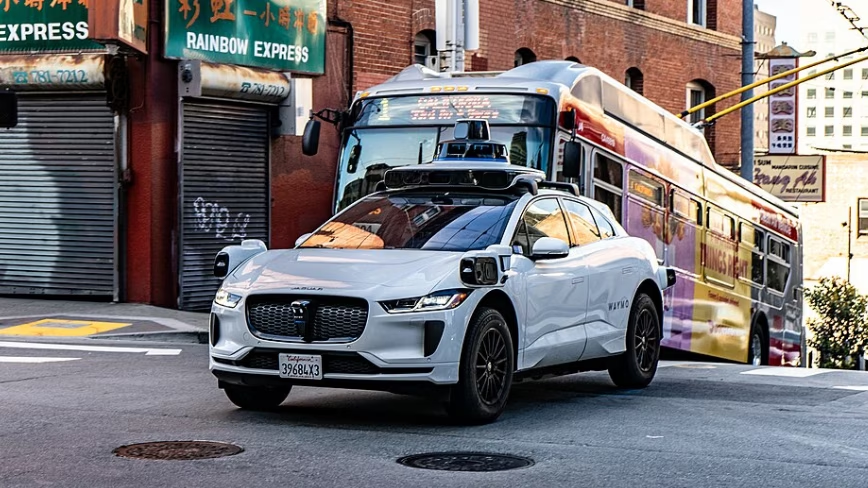
The news carries a sense of paradox: Waymo, the autonomous driving company born from Google, just raised $16 billion, delivers over 500,000 paid rides every week across ten American cities, and has announced international expansion to Tokyo and London. Yet it cannot place a single vehicle on the streets of New York City. The reason is not to be found in any hardware limitation, network latency, or perception system bug. The real barrier is political, built brick by brick by the taxi lobby and the unions representing drivers.
A Wall Built by Local Politics
As the New York Times detailed in a recent report, opposition has come from local politicians, labor unions, and interest groups that see autonomous driving as an existential threat to traditional work. The city, which is renowned as a tech laboratory, has chosen to erect regulatory obstacles that effectively keep Waymo out. This isn't an outright refusal; rather, it’s a series of hurdles—permits, safety regulations, operational constraints—that render entry uneconomical or simply impractical. It’s a strategy familiar in other industries: regulation as a tool to protect vested interests.
Growing Numbers, Sharp Boundaries
Waymo is no experiment. Its commercial service in Phoenix, San Francisco, and Los Angeles has reached volumes that many traditional taxi drivers can only dream of. The company closed a funding round that places it among the most heavily capitalized players in mobility, and the expansion into foreign capitals signals an aggressive strategy. Yet New York remains a blank spot on the map. The lesson is clear: even when technology is mature, its diffusion does not merely follow adoption curves and performance metrics. Environmental factors—rules, culture, social consensus—can become the sole bottleneck.
What It Means for AI Decision-Makers
The Waymo case is far from isolated. Large-scale AI projects, especially those touching public services or critical infrastructure, face similar dynamics. Data sovereignty, control over automated decisions, and community resistance can wipe out the advantages of centralized cloud deployment. For those evaluating model distribution architectures—whether for LLMs or computer vision systems—the New York case highlights a fundamental trade-off: relying on external platforms exposes one to regulatory and political risks that no commercial agreement can fully eliminate.
The Push Toward On-Premise
From this perspective, keeping inference and training on owned hardware, in self-hosted or on-premise environments, becomes a strategic lever. It’s not only about reducing latency or containing TCO: the ability to guarantee service continuity even when the regulatory landscape shifts is at stake. Those operating in finance, healthcare, or public transport know well that a sudden political blockade can paralyze a service reliant on someone else’s cloud. Technological autonomy thus turns into a shield against uncertainty, just as a fleet of robotaxis cannot afford to remain hostage to yellow cabs.
Looking at the Waymo story through a system architect’s eyes means recognizing that true AI maturity is not measured merely in tokens per second or accuracy percentages, but in the capacity to operate where it’s needed, when it’s needed, without asking permission from entrenched lobbies.









💬 Comments (0)
🔒 Log in or register to comment on articles.
No comments yet. Be the first to comment!