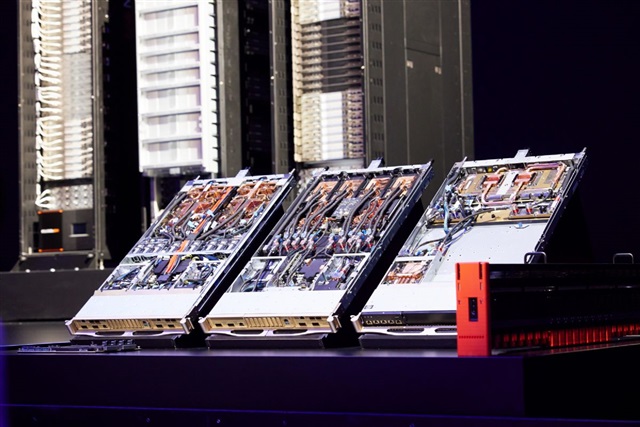
Nvidia's High-Stakes Bet on Next-Generation AI Cooling
The artificial intelligence industry is constantly evolving, pushing the limits of computational capabilities and, consequently, infrastructure challenges. At the heart of this transformation lies Nvidia, a key player in the AI hardware landscape, which is making a strategic bet on next-generation cooling. Investing in advanced heat dissipation technologies is not just a matter of efficiency, but an urgent necessity to unlock the future potential of LLMs and more complex AI workloads.
Modern GPU architectures, designed for inference and training of large models, generate ever-increasing amounts of heat. This makes traditional air-based cooling systems progressively less adequate. The ability to effectively manage heat has become a critical factor determining not only the sustainable performance of accelerators but also the reliability and longevity of the entire infrastructure.
The Heat Challenges in the AI Era
Latest-generation graphics processors, such as Nvidia's H100 series or future Blackwell, are true high-density computing centers. Each chip integrates billions of transistors and operates at high frequencies, consuming hundreds of watts and consequently producing an enormous amount of heat. This heat, if not properly dissipated, can lead to GPU throttling, reducing their performance and slowing down the execution of AI workloads.
Air cooling, while a consolidated and relatively simple solution to implement, quickly reaches its limits when dealing with high-density racks populated by dozens of GPUs. To maintain operating temperatures within acceptable limits, data centers must consume a lot of energy for air conditioning, increasing TCO and environmental impact. It is in this context that liquid cooling solutions, such as direct-to-chip or immersion cooling, are gaining traction, offering significantly higher thermal dissipation capacity.
Implications for On-Premise Deployments
For organizations choosing on-premise or self-hosted deployments for their AI workloads, cooling management takes on even greater importance. The choice of cooling technology directly impacts data center design, power requirements, and ultimately, the overall TCO. An efficient cooling system can drastically reduce a data center's Power Usage Effectiveness (PUE), optimizing long-term operational costs.
Adopting liquid solutions, while potentially involving a higher initial investment and greater infrastructure complexity, allows for the creation of ultra-high-density AI clusters. This is crucial for companies that need to maintain data sovereignty and operate in air-gapped environments, where scalability and performance must be guaranteed locally. The ability to host more GPUs in less space while maintaining optimal temperatures translates into better resource utilization and greater efficiency for local inference and training.
Future Prospects and Trade-offs
Nvidia's investment in next-generation cooling underscores a clear trend: the future of high-performance AI is intrinsically linked to innovation in thermal management. Liquid cooling solutions, while promising, come with their own trade-offs. They require specialized expertise for installation and maintenance and can introduce new complexities into the operational pipeline. However, the benefits in terms of performance, reliability, and energy sustainability are increasingly difficult to ignore.
For companies evaluating their AI deployment strategies, it is essential to consider these aspects. The choice between air and liquid cooling is not trivial and must be integrated into the overall infrastructure planning, taking into account initial costs, operational costs, and the specific needs of workloads. AI-RADAR offers analytical frameworks on /llm-onpremise to evaluate the trade-offs between different deployment architectures, including the impacts of cooling solutions on scalability and TCO. Nvidia's bet on advanced cooling is not just a technological step, but an indicator of the direction the entire AI industry is heading.









💬 Comments (0)
🔒 Log in or register to comment on articles.
No comments yet. Be the first to comment!