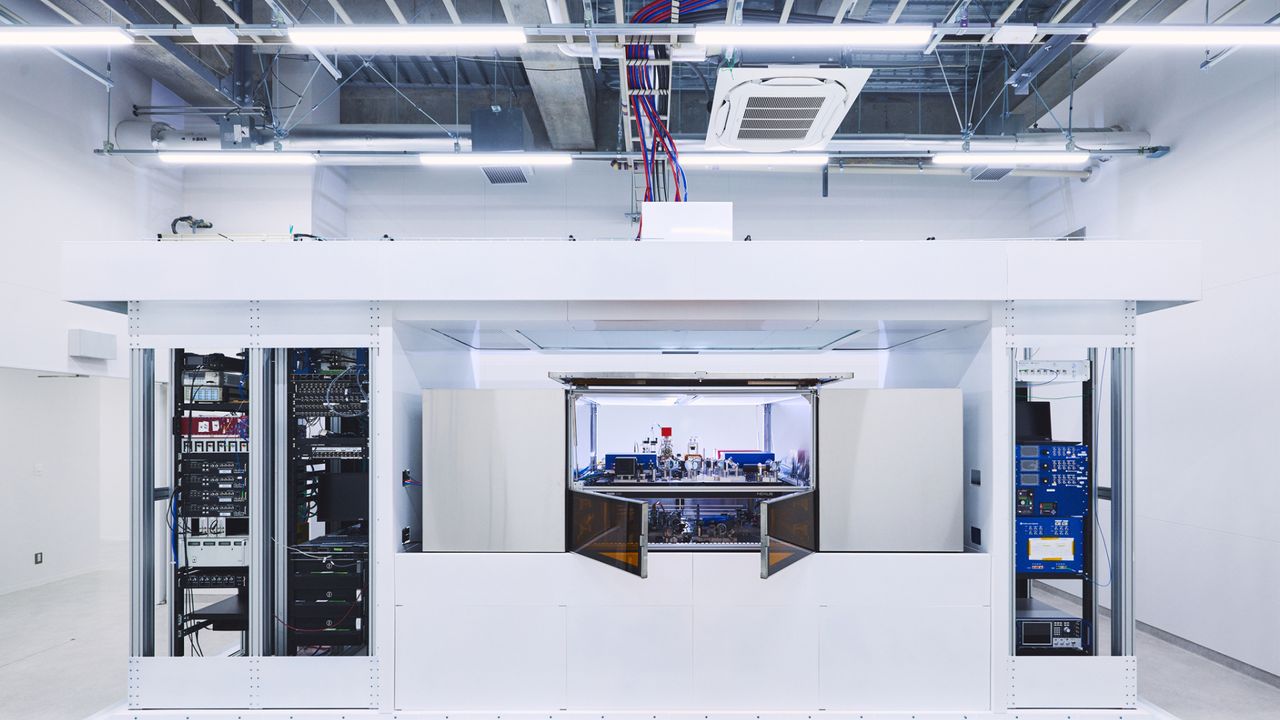
Superconducting circuit quantum computers and trapped-ion systems have been vying for the spotlight for years, but the real breakthrough may come from a quieter architecture: laser-cooled neutral atoms. The concept is simple almost to the point of being banal – trap individual atoms in an optical lattice generated by laser tweezers, manipulate their states with microwave pulses, and read out the results with high-sensitivity cameras – yet its consequences for computation are radical.
Unlike superconducting qubits, which battle noise and demand cryogenic temperatures, neutral atoms are naturally identical and do not interact without excitation: two properties that allow scaling qubit counts without loss of coherence, reaching grids of hundreds or thousands of individually addressable atoms. The roadmap for this technology – which we call neural atom quantum computing, for its affinity with neural networks in the ability to connect nodes in reconfigurable patterns – aims straight at breaking through the physical qubit barrier, bringing computations beyond the reach of any classical machine into reality in a realistic timeframe.
For those working with large language models (LLMs) and evaluating on-prem deployment, the signal is structural. Today, training and inference for models above a certain parameter threshold are economically tied to cloud GPU availability, with all the geopolitical dependencies and data residency concerns that entails. A quantum accelerator based on neutral atoms, if miniaturized and made operational at room temperature (as some prototypes suggest), would sever that link: it would bring the necessary compute capacity for fine-tuning and inference directly into enterprise data centers, reopening the game of data sovereignty without sacrificing performance.
The promise is not to replace GPUs in the short term, but to complement them in tasks where combinatorial explosion makes classical methods inefficient. Molecular simulations for drug discovery, graph optimization, correlation analysis on massive datasets: workloads we currently ship offsite, accepting latency and transfer costs, could be handled on-prem with a drastically reduced energy footprint.
This is precisely the kind of disruption that reshuffles power distribution between a few hyperscalers and the rest of the enterprise market. If the total cost of ownership (TCO) of a quantum node aligns with that of a high-end GPU rack, the incentive to keep data in-house would rise quickly, shifting investments and expertise toward locally managed hybrid classical-quantum architectures. AI-RADAR tracks the evolution of these technologies closely, because every change in the hardware substrate rewrites the rules of artificial intelligence deployment. And this time, the rules could be rewritten in a lattice of light.







💬 Comments (0)
🔒 Log in or register to comment on articles.
No comments yet. Be the first to comment!