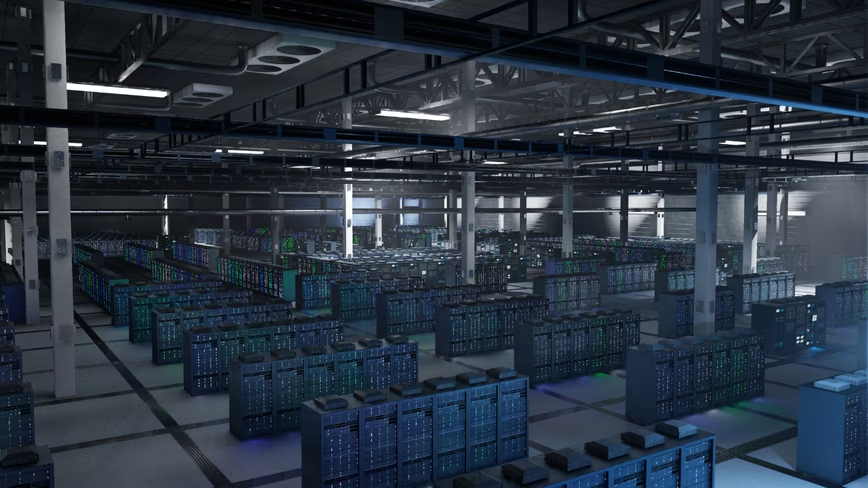
When an industrial kiln fires bricks, every kilowatt-hour counts. At the Belden Brick Company, an Ohio manufacturer that has been producing clay bricks since 1885 for landmarks like the Alamo and the University of Notre Dame, electricity bills had been a stable line item for years. Then artificial intelligence arrived in the Rust Belt—in the form of data centers—and within twelve months costs spiked by 90%. This is not an isolated incident: it’s the most tangible front of a silent energy war between the digital economy and the material one.
The mechanism is straightforward. The massive GPU clusters that train and serve large language models (LLMs) are energy gluttons. A single mid-sized data center can consume as much power as a town of tens of thousands. When these facilities cluster in a region—as is happening in Ohio, drawn by tax incentives and available land—the pressure on the local grid pushes up prices for everyone. Physical-goods producers, with already squeezed margins and energy-intensive processes, find themselves competing for a resource that until yesterday was abundant and predictable.
There is an underground paradox. The dominant narrative paints AI as an engine of cross-sector productivity, but its infrastructure is draining energy resources from traditional industries. This isn’t just a bill problem: it’s a hidden cost of the cloud-centric model, one that offloads the externalities of model growth onto the entire electrical system. And it raises an uncomfortable question: are we building an economy where artificial intelligence, to function, impoverishes the very producers of the physical goods that give it shape?
For those tracking AI deployment dynamics, the Belden case is a signal. The current data center boom rests on an assumption of abundant energy that often crumbles at the regional scale. When supply tightens, companies with predictable, on-premise workloads can find themselves in a better spot: they negotiate long-term supply contracts, invest in on-site renewable generation, and keep a lid on total cost of ownership (TCO) for energy without suffering the swings driven by cloud giants’ demand.
It’s not a one-size-fits-all fix, of course. On-premise infrastructure comes with capital barriers and technical expertise that few brickmakers can overcome. But the structural principle stands: energy has become the critical variable in the location of inference and training. AI data centers tend to form geographic clusters, altering local energy markets and triggering chain reactions that range from community conflicts to ever-stricter regulatory constraints. In Europe, where the Energy Efficiency Directive and GDPR already mandate transparency and limits, data sovereignty and physical resource control are pushing many organizations to evaluate self-hosted solutions also to reduce exposure to these grid-level turbulences.
The Belden Brick Company story, in short, is not just a local-news anecdote. It’s a wake-up call about who truly foots the bill for AI. While the spotlight focuses on ever-larger models and glitzy benchmarks, the Rust Belt’s rust reminds us that energy is not infinite—and that every architectural choice, from cloud to on-premise, has an impact that reaches far beyond the server rack.









💬 Comments (0)
🔒 Log in or register to comment on articles.
No comments yet. Be the first to comment!