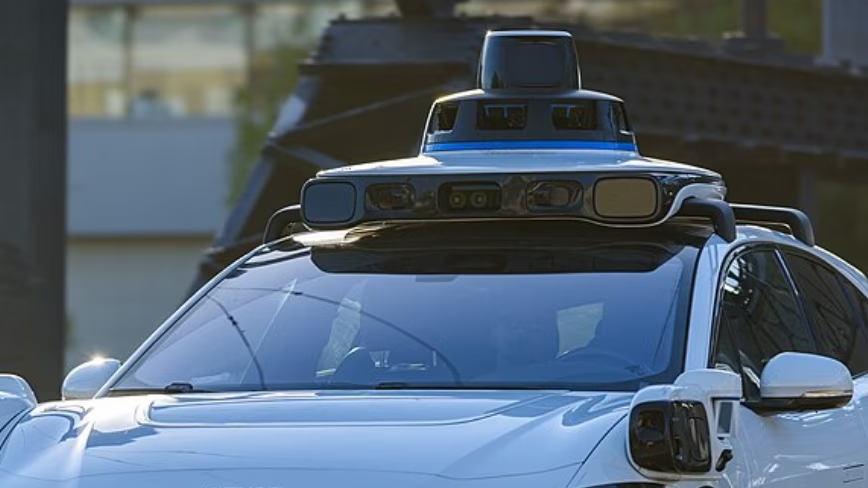
It doesn’t just copy humans. The self-driving model presented by Professor Jun Won Choi’s team at CVPR 2025 does something more radical: before steering, accelerating, or braking, it ranks every possible trajectory by safety. Only then does it pick the one that maximizes a harm-avoidance score — and it does so entirely on board, without ever pinging the cloud.
The gulf between this and the dominant behavioral cloning approach is stark. Mainstream systems train neural networks to imitate human driving from massive sensor-to-command datasets. They perform well in familiar conditions, but when a split-second decision in uncharted territory is needed, they struggle to explain why they picked one path over another. In a real hazard scenario, that opacity becomes a legal and technical headache.
The Korean model flips the problem into one of exhaustive evaluation. At each moment, the algorithm generates a set of candidate paths and tags each with a safety score based on collision probability, traffic-sign compliance, and predictability for other road users. It acts as a kind of universal judge before any action, a concept reminiscent of formal search in perfect-information games, transposed to real-world driving with all its structural uncertainty.
The hardware impact: local inference with no room for compromise
This computational burden is far from neutral. Evaluating hundreds or thousands of trajectories in real time before every decision demands substantial processing power, and latency cannot be offloaded to a distant data center. Inference must run on-vehicle, on GPUs or dedicated accelerators, within a power envelope that the car’s electrical system can sustain. The pressure pushes toward architectures optimized for high throughput at low precision — aggressive quantization, inference engines like TensorRT or Apache TVM, and models compiled for the specific silicon inside the vehicle.
For automakers, the message is unambiguous: a “good enough” chip no longer suffices. They need deterministic latency and result reproducibility, because a safety ranking that varies from one run to the next would torpedo any homologation. It’s a constraint familiar from avionics and industrial control systems, where certification hinges on hardware predictability as much as on accuracy.
Data sovereignty and compliance: the real edge advantage
There is a second-order, more structural layer here. A model that processes every decision on board never sends video or LiDAR streams to external servers. Data stays inside the car, drastically simplifying compliance with regulations like Europe’s GDPR or biometric-privacy laws in jurisdictions such as Illinois. It also removes the dependency on constant connectivity — a known vulnerability of cloud-based autonomous driving services.
This doesn’t mean training happens in isolation; the model is still trained on aggregated data. But road deployment becomes fully self-hosted. For manufacturers weighing differentiation strategies, a system that guarantees driver privacy and shrinks the telematics attack surface becomes a powerful commercial and legal differentiator.
Winners and losers
Cloud inference platforms tailored to automotive — historically tied to large US providers — see their value proposition erode as intelligence moves entirely to the edge. In contrast, high-performance embedded hardware vendors — NVIDIA with its Orin line and successors, Qualcomm with Snapdragon Ride, but also European startups focused on automotive NPUs — find an expanding market. Compilation and profiling tools for on-device models grow more strategic as well.
Regulators and insurers may ultimately be this approach’s biggest allies. A driving decision accompanied by an explicit safety rating for every alternative provides an auditable trail after an incident: you could check not just what the car did, but why it dismissed the other options. That’s a concrete step toward the explainability that AI regulations are making increasingly mandatory.




💬 Comments (0)
🔒 Log in or register to comment on articles.
No comments yet. Be the first to comment!