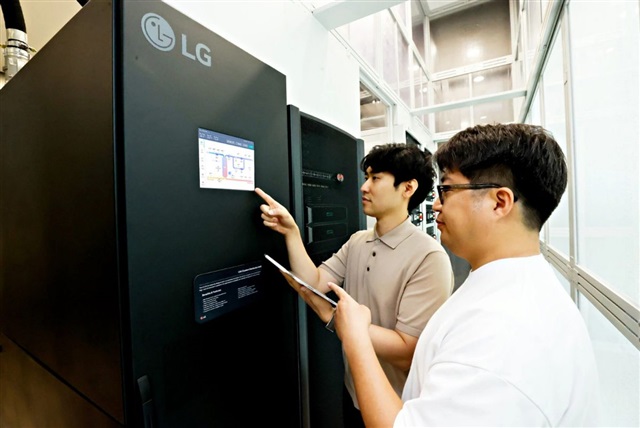
LG's latest move in the data center space reveals much more than a simple business announcement: by expanding its liquid cooling division, the Korean conglomerate aims to carve out a leading role in the infrastructure powering the ongoing AI boom. According to Digitimes, the company is stepping up contacts with Taiwanese server manufacturers to integrate its thermal management solutions directly into machines designed for AI workloads, from large-scale training clusters to distributed inference nodes.
Liquid cooling is not a new technology, but over the past three years it has become the focal point of a profound rethinking of data center design. When dealing with GPUs like the NVIDIA H100 or the upcoming B200, the bottleneck is no longer just compute density, but the ability to dissipate heat. A traditional air-cooled rack can handle power consumption of about 20–30 kW; by switching to direct-to-chip or immersion cooling, the same footprint easily exceeds 100 kW. For those managing on-premise deployments — research labs, financial centers, healthcare facilities — this leap is not a minor detail: often the decision to keep models in-house (due to privacy constraints, latency, or long-term TCO) clashes precisely with thermal feasibility. LG enters this space offering large-scale manufacturing expertise capable of lowering costs for components that have so far been dominated by specialized niches.
The focus on Taiwan is anything but coincidental. The island hosts the world's major server integrators — Quanta, Wiwynn, Inventec — and a production ecosystem that alone drives most of the hardware for large cloud providers. Getting closer to these players means LG can insert its cooling modules already during assembly, with the potential to unlock high-density configurations even for those building on-premise infrastructure far from hyperscalers. A picture emerges where liquid cooling moves from an option for HPC niches to a key component in the decision-making process: when a bank or a public agency evaluates a cluster for self-hosted LLMs, the choice of thermal technology becomes as strategic as selecting GPUs or the amount of VRAM.
In this scenario, the role of a player like LG signals a possible acceleration toward standardization. So far, liquid cooling loops have often been custom implementations managed by engineering firms. The entry of a major consumer electronics and industrial components group could push toward more modular form factors and a less fragmented supply chain, reducing the initial CapEx for deployers. However, open questions remain: interoperability with different server designs, predictive maintenance in unmanned environments, and above all, the impact on total cost of ownership when comparing the typical 5-7 year lifecycle of on-premise infrastructure with the accelerated depreciation allowed by the cloud.
From an AI-RADAR perspective, where we observe technologies that enable real local workloads, liquid cooling is increasingly a differentiating factor. Not only for hundred-GPU training pods, but also for distributed inference scenarios in edge data centers, where density per square meter is critical. For those evaluating on-premise deployment, there are precise trade-offs between energy efficiency, risks of fluid leaks, and the skills required for day-to-day management — aspects that often escape initial assessments, which tend to focus only on teraflops and model costs.








💬 Comments (0)
🔒 Log in or register to comment on articles.
No comments yet. Be the first to comment!