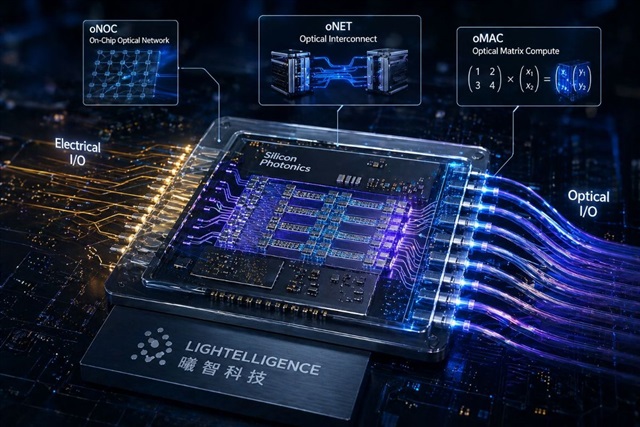
Lightelligence Lists in Hong Kong, CPO Commercialization in Focus for AI
Lightelligence, a Chinese company specializing in the production of photonics chips, has recently completed its listing on the Hong Kong stock exchange. This financial operation highlights the company's strategy to accelerate the commercialization of Co-Packaged Optics (CPO), an emerging technology poised to be fundamental for the evolution of artificial intelligence infrastructures.
The growing interest in photonics chips and CPO solutions reflects a broader trend in the technology sector, where the need to manage ever-increasing data volumes with reduced latencies is driving radical innovations in interconnection. For companies operating with intensive AI workloads, such as Large Language Models (LLMs), the efficiency and speed of data transfer between compute units become critical factors.
The Role of Co-Packaged Optics (CPO) in AI
Co-Packaged Optics (CPO) represent a significant evolution compared to traditional interconnection approaches. Instead of having optical modules separate from processing chips, CPO technology directly integrates optical components (such as lasers and modulators) into the same silicio package that houses processors like GPUs or ASICs. This integration drastically reduces the physical distance signals must travel, minimizing losses and increasing bandwidth density.
For AI workloads, particularly for LLM training and inference, the throughput and latency of interconnections are vital parameters. Large models require constant, high-speed communication among thousands of compute cores and memory blocks. CPO promises to deliver the necessary bandwidth to avoid bottlenecks, enabling systems to scale more efficiently and process a greater number of tokens per second.
Implications for On-Premise Deployments
The adoption of Co-Packaged Optics has direct and significant implications for on-premise deployment strategies. For CTOs, DevOps leads, and infrastructure architects evaluating self-hosted solutions, CPO can translate into higher-performing AI clusters with a potentially lower Total Cost of Ownership (TCO) in the long run. The increased energy efficiency, resulting from reduced distances and electro-optical conversions, helps decrease operational costs related to power and cooling in data centers.
In a context where data sovereignty and regulatory compliance are absolute priorities, the ability to build and manage AI infrastructures within one's physical and logical boundaries is fundamental. CPO, by improving the performance of local hardware, strengthens the feasibility and attractiveness of on-premise deployments, offering organizations more granular control over their compute resources and sensitive data. For those evaluating on-premise deployments, analytical frameworks are available on AI-RADAR to assess the trade-offs between performance, costs, and control.
Future Outlook and Trade-offs
The large-scale commercialization of Co-Packaged Optics is a crucial step towards the next generation of AI-dedicated data centers and supercomputers. However, integrating new technologies always involves trade-offs. Initial adoption costs, design and manufacturing complexity, and the need for standardization are challenges the industry must address.
Lightelligence, with its listing and strategic focus on CPO, positions itself as a key player in this evolving landscape. The drive towards "Powered by AI" solutions is not limited to algorithms alone but extends deeply into the underlying hardware, where innovation in photonics chips and optical interconnects will be decisive in unlocking the full potential of Large Language Models and other artificial intelligence applications.







💬 Comments (0)
🔒 Log in or register to comment on articles.
No comments yet. Be the first to comment!