
A GPU-Free Computing Giant
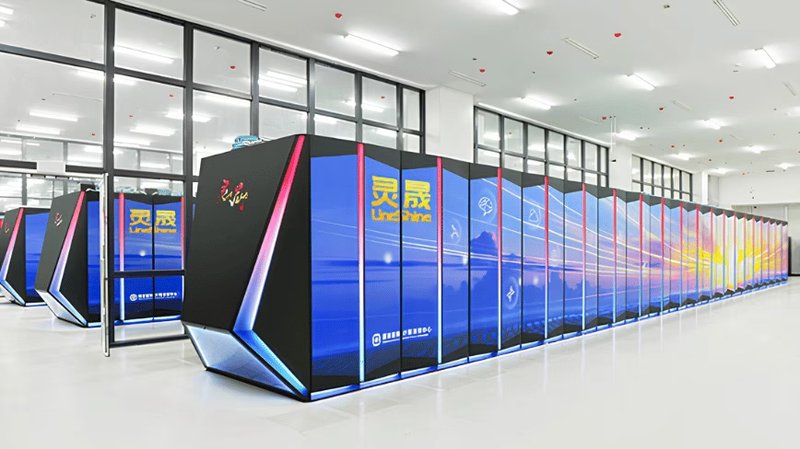
In the global High-Performance Computing (HPC) landscape, China has introduced LineShine, a new supercomputer distinguished by its bold and strategic architecture. With a declared computing power of 1.54 exaflops, LineShine not only positions itself among the most powerful machines globally but does so by adopting a radically different approach compared to the dominant trend that sees GPUs as the pillars of high-performance computing.
The peculiarity of LineShine lies in its "CPU-only" nature. This architectural choice is not accidental but represents a direct response to restrictions imposed by the United States on the export of advanced GPUs to China. By developing a system that relies exclusively on processors, the country aims to bypass these prohibitions, ensuring access to extreme computing capabilities for scientific research, defense, and potentially for complex workloads related to Large Language Models (LLM) and artificial intelligence.
Technical Details and Architectural Implications
The beating heart of LineShine consists of an impressive array of 2.4 million cores based on the Armv9 architecture, entirely designed by Huawei. This massive aggregation of CPUs demonstrates the engineering capability to develop large-scale computing solutions with indigenous components. The Armv9 architecture, known for its energy efficiency and flexibility, offers a valid alternative to x86 architectures and traditional GPUs for certain types of workloads.
While GPUs are often preferred for accelerating intensive parallel computations, such as those required for LLM training and inference, a CPU-only system of this magnitude can still offer advantages. CPUs excel in more general-purpose computing tasks and in managing large amounts of memory, crucial aspects for models with extended context windows or complex data pipelines. However, the main challenge for a CPU-only system in the AI domain lies in optimizing software and frameworks to best utilize parallelization across such a high number of cores, often requiring advanced distributed programming techniques.
Geopolitical Context and Technological Sovereignty
The deployment of LineShine fits into a tense geopolitical context, where technological sovereignty has become an absolute priority for many nations. Restrictions on the export of critical technologies have pushed countries like China to invest heavily in the development of proprietary hardware and software. This supercomputer is a striking example of how sanctions can accelerate internal innovation and the search for alternative solutions.
For organizations evaluating the deployment of AI workloads, particularly self-hosted LLMs, the LineShine story offers important insights. Reliance on a single vendor or a specific hardware architecture can entail significant risks in terms of supply chain, costs, and regulatory compliance. A country's ability to develop a supercomputer from scratch, based on a CPU-only architecture, underscores the importance of considering diverse hardware options and mitigating risks related to technology availability and control.
Future Prospects and Trade-offs in AI Computing
LineShine demonstrates that multiple paths exist to achieve extreme computing capabilities, even in the absence of the most advanced GPUs. However, adopting a CPU-only architecture for AI workloads, especially for training large LLMs, involves specific trade-offs. GPUs, with their architecture optimized for massive parallel computing and high VRAM, often offer superior throughput and greater energy efficiency for specific machine learning operations.
A system like LineShine could excel in scenarios where the flexibility of general-purpose computing is paramount or where restrictions on GPU hardware are an insurmountable constraint. For CTOs, DevOps leads, and infrastructure architects, the lesson is clear: the choice of hardware for AI workloads must consider not only pure performance metrics but also factors such as data sovereignty, supply chain resilience, TCO, and the ability to adapt to changing geopolitical contexts. Diversification of architectures and the ability to leverage different types of silicon become key elements for long-term deployment strategy.




💬 Comments (0)
🔒 Log in or register to comment on articles.
No comments yet. Be the first to comment!