A Deep Cleanup Operation for the Linux Kernel
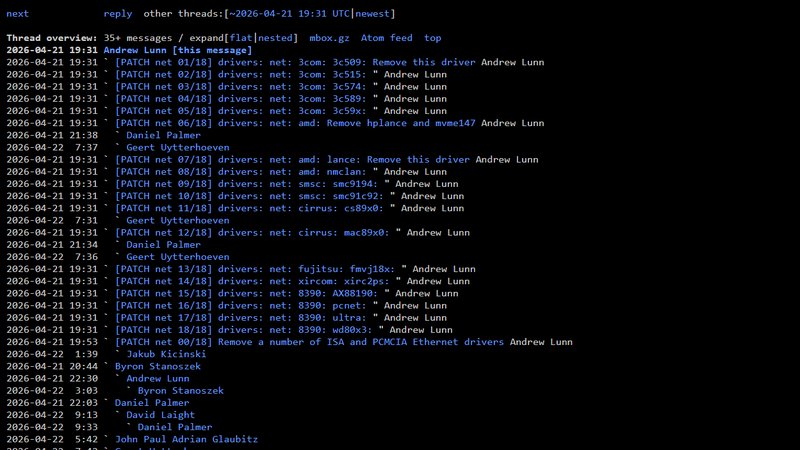
Linus Torvalds, the creator and lead maintainer of the Linux kernel, recently approved a significant pull request that marks the end of an era for some historical components of the operating system. The operation led to the removal of the Integrated Services Digital Network (ISDN) subsystem and numerous obsolete network drivers, many of which were developed for PCMCIA adapters, a technology now largely superseded. This "cleanup" effort eliminated approximately 138,000 lines of code, a considerable volume reflecting the ongoing commitment to maintaining and optimizing the core of Linux.
The decision to remove these code sections was not arbitrary. It was partly motivated by a recent influx of bug reports, some of which were generated by AI and Large Language Models (LLM) tools. These tools highlighted vulnerabilities or unexpected behaviors in code that, in all likelihood, no longer has active upstream users. The elimination of unsupported or unused components is an essential practice to ensure the health and security of a software project as extensive as the Linux kernel.
The Technical Details of the Operation: ISDN and PCMCIA
The ISDN subsystem represented a digital networking technology that, before the advent of broadband and ADSL, offered faster and more reliable connections than traditional analog modems. It was particularly prevalent in the 1990s and early 2000s, providing voice and data services over digital telephone lines. Similarly, PCMCIA (Personal Computer Memory Card International Association) adapters, also known as CardBus, were expansion cards primarily used in laptops to add functionalities like network cards, modems, or SCSI controllers, before USB and PCI Express interfaces became the dominant standard.
The removal of these drivers and subsystems reflects technological evolution. Maintaining code for obsolete hardware and communication standards incurs a significant cost in terms of maintenance, testing, and potential attack surface. Every line of code is a potential source of bugs or vulnerabilities, and "dead" or unused code represents a risk without a corresponding benefit. Torvalds' intervention and the development team's efforts are therefore a logical step to lighten the workload and focus resources on more modern and relevant components.
Context and Implications for Security and Maintenance
The elimination of obsolete code has several positive implications. Firstly, it reduces the overall complexity of the kernel, making the work of developers and maintainers easier. A leaner codebase is simpler to understand, test, and update. Secondly, and perhaps even more importantly, it enhances security. Less code means fewer potential bugs and a smaller attack surface for adversaries. The fact that bug reports were partly generated by AI/LLM tools underscores the emergence of new methodologies for code analysis. Tools based on these models can scan vast code repositories, identifying patterns, anomalies, and potential vulnerabilities with an efficiency that surpasses manual analysis.
For organizations relying on on-premise deployments, the stability and security of the Linux kernel are fundamental. A well-maintained kernel, with clean and updated code, contributes to a more resilient infrastructure less exposed to risks. While this specific update does not directly concern LLM deployment strategies, it highlights the importance of a solid infrastructural foundation and the growing relevance of AI tools for managing and optimizing system software.
Future Outlook: AI as an Ally in Code Maintenance
The episode of the ISDN and PCMCIA code removal from the Linux kernel offers an interesting insight into the future of software maintenance. The ability of LLMs to generate relevant bug reports, even for dated code, suggests a growing role for artificial intelligence in the software development lifecycle. These tools can act as additional "eyes," capable of analyzing millions of lines of code and identifying issues that might escape human attention or traditional testing methods.
While AI-RADAR focuses on the trade-offs and challenges of on-premise LLM deployments, this event showcases another facet of AI's impact in the tech world: not just as a workload to manage, but also as a tool to improve infrastructure management itself. The continuous evolution of the Linux kernel, with streamlining operations like this one, ensures it remains a robust and reliable platform, ready to support the most advanced computational needs, including AI/LLM workloads, in both cloud and self-hosted environments.





💬 Comments (0)
🔒 Log in or register to comment on articles.
No comments yet. Be the first to comment!