The Burden of Obsolete Drivers in the Linux Kernel
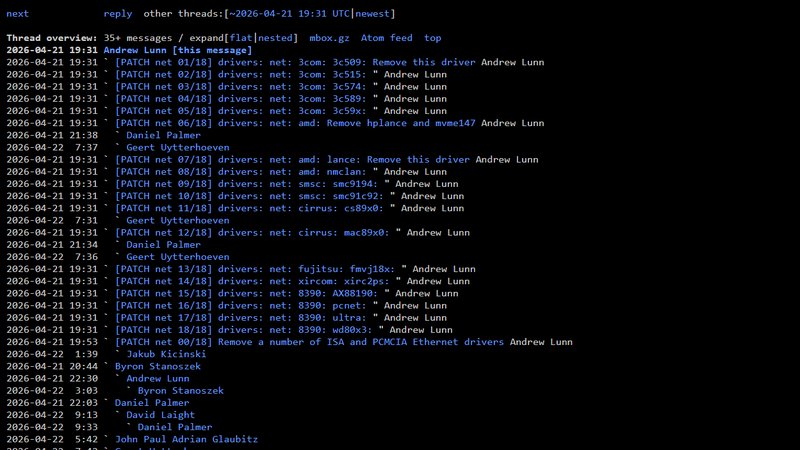
The management of obsolete network drivers within the Linux kernel presents a growing challenge for the development community. These components, often dating back to past eras, require constant commitment in terms of maintenance and updates, a burden that is becoming increasingly heavy in the current context. The need to ensure compatibility, stability, and security for a wide range of hardware, even older models, clashes with limited resources and the inherent complexity of such a large software project.
This scenario is further complicated by the fact that many of these drivers may no longer have active users, turning their maintenance into a costly and potentially superfluous exercise. The issue is not only about the efficiency of the development process but also the potential attack surface that code no longer actively used and tested can represent for the entire operating system.
The Impact of Artificial Intelligence on Bug Detection
The advent of advanced code analysis techniques, such as fuzzing, and particularly the adoption of AI-driven bug detection systems, has revolutionized the software security landscape. These tools are capable of exploring a vast number of execution paths and identifying vulnerabilities or anomalous behaviors with unprecedented precision and speed. Consequently, Linux kernel developers are facing an increasing flow of reports for potential bugs and security issues.
While the effectiveness of these tools in improving software robustness is undeniable, it also creates a paradox: an exponential increase in bug reports, many of which relate to legacy code sections that may no longer be in use. This poses a dilemma for developers: dedicate valuable time to resolving problems in marginal components or focus resources on more critical and actively used areas of the kernel.
Implications for Open Source Software Maintenance
This situation raises significant questions about the long-term sustainability of maintenance for large-scale software projects like the Linux kernel. Every bug report, regardless of its severity or the actual prevalence of the affected component, requires time and resources to be analyzed, verified, and, if necessary, resolved. When the drivers in question no longer have active users, the investment of resources for their maintenance becomes difficult to justify, diverting energy from more urgent innovations and improvements.
For organizations relying on self-hosted or air-gapped technology stacks, kernel stability and security are paramount. Removing obsolete and potentially problematic code can help reduce the attack surface and improve overall infrastructure efficiency, although it requires careful evaluation of compatibility with legacy systems. The decision to lighten the kernel of non-essential components is a trade-off between backward compatibility and modernization, with direct impacts on the security and performance of on-premise deployments.
Future Prospects and Trade-offs
The potential decision to remove these obsolete drivers is not without complexity. While it would lighten the maintenance load and improve the overall security of the kernel, it could impact niche users or very specific hardware that still depend on such components. The development community will need to carefully balance these trade-offs, considering technological evolution and the actual needs of users.
This scenario highlights how even the most mature software projects must continuously adapt to new challenges, including those posed by the adoption of advanced AI-driven analysis tools. The ability to make strategic decisions regarding legacy code management will be crucial to keeping the Linux kernel at the forefront in terms of security, efficiency, and innovation, while ensuring a solid foundation for all technological infrastructures.



💬 Comments (0)
🔒 Log in or register to comment on articles.
No comments yet. Be the first to comment!