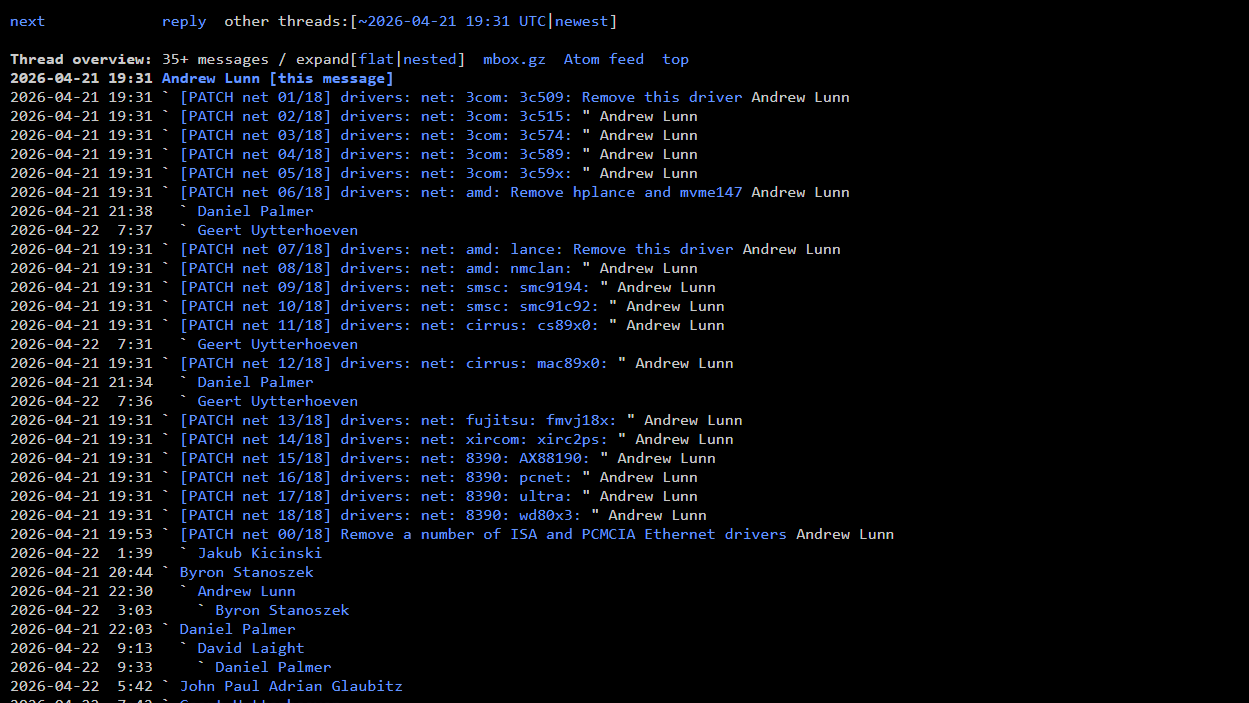
Linux and the Challenge of Obsolete Drivers
The Linux project is actively evaluating the removal of numerous network drivers considered obsolete from the kernel's source tree. This initiative, which will be implemented through specific patches, aims to streamline the codebase and reduce the overall maintenance burden. The decision is driven not only by the age of these components but also by increasing difficulty in managing their support.
Many of these drivers were developed for outdated hardware and are used in systems that, while still present in some niches, represent a minimal percentage of the global installed base. Maintaining compatibility and stability for these configurations requires significant resources, which kernel maintainers would prefer to dedicate to the development and improvement of more modern and widely adopted components. Balancing backward compatibility and code efficiency is a constant challenge for Open Source projects of this scale.
The Impact of AI-Generated Bug Reports
A crucial factor accelerating this decision is the surge in bug reports generated by artificial intelligence systems. While AI can offer valuable tools for code analysis and identifying potential issues, the influx of false or irrelevant reports is becoming a significant burden for development teams. Distinguishing a real bug from an artificially generated one requires human time and resources, diverting them from more productive development activities.
This phenomenon highlights one of the emerging challenges in the AI era: managing the “noise” generated by automated tools. As LLMs and other AI systems become more pervasive, their ability to produce convincing, yet not always accurate, output can overload review and validation processes. For a project like the Linux kernel, which relies on a rigorous review process and voluntary contributions, efficiency in managing bug reports is crucial for maintaining development speed and code quality.
Implications for Infrastructure and TCO
The removal of obsolete drivers from the Linux kernel will have direct implications for organizations managing on-premise or self-hosted infrastructures, especially those relying on legacy hardware. While most modern implementations use newer drivers, some specific environments might face the need to upgrade hardware or to self-develop and maintain drivers for components no longer officially supported.
This situation raises important questions regarding the Total Cost of Ownership (TCO). Maintaining obsolete systems, even if seemingly economical in the short term, can incur significant hidden costs related to security, compatibility, and difficulty in finding support. Linux's choice to lighten the kernel reflects a broader trend in the tech industry towards modernization and resource rationalization. For those evaluating on-premise deployments, it is crucial to consider the entire hardware and software lifecycle, including maintenance costs and any necessary upgrades to align with core software evolutions. AI-RADAR offers analytical frameworks on /llm-onpremise to evaluate these trade-offs.
Future Prospects for Kernel Maintenance
Linux's decision to address the issue of obsolete drivers and AI-generated bug reports marks a turning point in the management of large Open Source projects. It is a clear signal that even the foundations of technological infrastructure must adapt to the new paradigms introduced by artificial intelligence, both in terms of opportunities and challenges.
In the future, it is likely that we will see an evolution in software maintenance processes, with the introduction of more sophisticated tools to filter AI-generated contributions and automate bug management. However, the role of human expertise will remain irreplaceable in discerning the validity and priority of issues, ensuring that the evolution of the Linux kernel continues to be guided by principles of stability, security, and innovation. The Open Source community will need to find a balance between adopting new technologies and safeguarding the principles of quality and reliability that have led to its success.



💬 Comments (0)
🔒 Log in or register to comment on articles.
No comments yet. Be the first to comment!