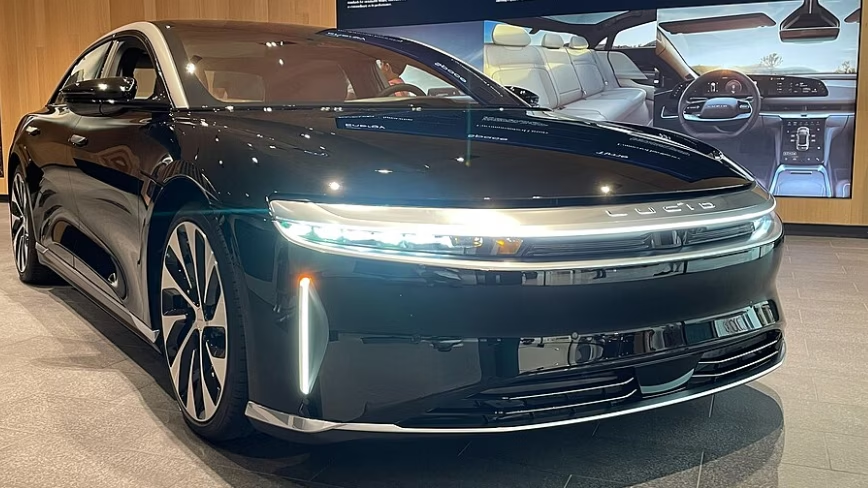
Lucid Motors announced on Thursday that its chief financial officer, Taoufiq Boussaid, is leaving the company. He will be replaced by Alexander De Bock, a veteran automotive finance executive and former CFO of TI Automotive, after a transition period. It is the latest in a wave of leadership changes under new CEO Silvio Napoli, who is reshaping the entire management structure of the California-based electric vehicle maker.
Such a sweeping overhaul is never just about personnel. In an industry burning billions on EV and autonomous driving development, leadership decisions often mirror a strategic pivot. Lucid, founded with the ambition to compete against Tesla and German luxury brands, has pushed engineering innovation – a compact electric motor, batteries delivering over 500 miles of range – but has struggled to turn promise into volume and margins. The arrival of a new CFO with a strong background in supply chain and capital management, as De Bock, may signal that Napoli wants to get the house in order for a phase where cost control and manufacturing efficiency matter as much as technology.
For those tracking the evolution of the automotive sector, such an executive shakeup raises a question: what happens to the artificial intelligence roadmap? Modern cars are software platforms on wheels, and Lucid is no exception. Its DreamDrive assisted driving, over-the-air updates, and predictive battery optimization all rely on machine learning models trained on the enormous data streams collected from the fleet. That’s where the deployment model – centralized cloud versus distributed on-premise architecture – becomes critical, especially when it comes to real-time processing and data sovereignty.
There is no public information on how the new leadership intends to approach the AI infrastructure question. But the market context offers general clues. Several automakers are bringing part of the training and inference compute in-house, driven by three factors: latency (safety-critical applications cannot depend on the public cloud), data ownership (the miles driven, driving habits, and camera video feeds are sensitive assets), and total cost of ownership control. Training a neural network for visual perception on tens of millions of video clips is an operation that, if done predominantly in the cloud, can generate unpredictable bills; scaling on-premise hardware, with enterprise-grade GPUs, allows stabilizing TCO and iterating faster.
Lucid, as a relatively young startup, probably leans on cloud providers for much of its development today. But the new leadership, with De Bock focused on costs and Napoli on the company redesign, could accelerate a path toward internalizing compute capacity. Not because there is any announcement to that effect, but because the industry trajectory points that way: the connected car generates a continuous data flow that is strategic to process as close as possible to the source, also for regulatory reasons (think of GDPR and data residency rules in Europe).
Of course, these are hypothetical scenarios. What is certain is that Lucid Motors stands at a crossroads: after proving it can build outstanding cars, it must convince the market it can sell them sustainably. The overhaul of the financial and operational leadership is one piece of this second phase. Whether the pace of investment in AI and on-board software will maintain its current trajectory will become clear in the coming quarters. For now, the message is clear: Silvio Napoli is assembling his team, and today’s choices will determine the technological architecture with which Lucid will race through the electric decade.






💬 Comments (0)
🔒 Log in or register to comment on articles.
No comments yet. Be the first to comment!