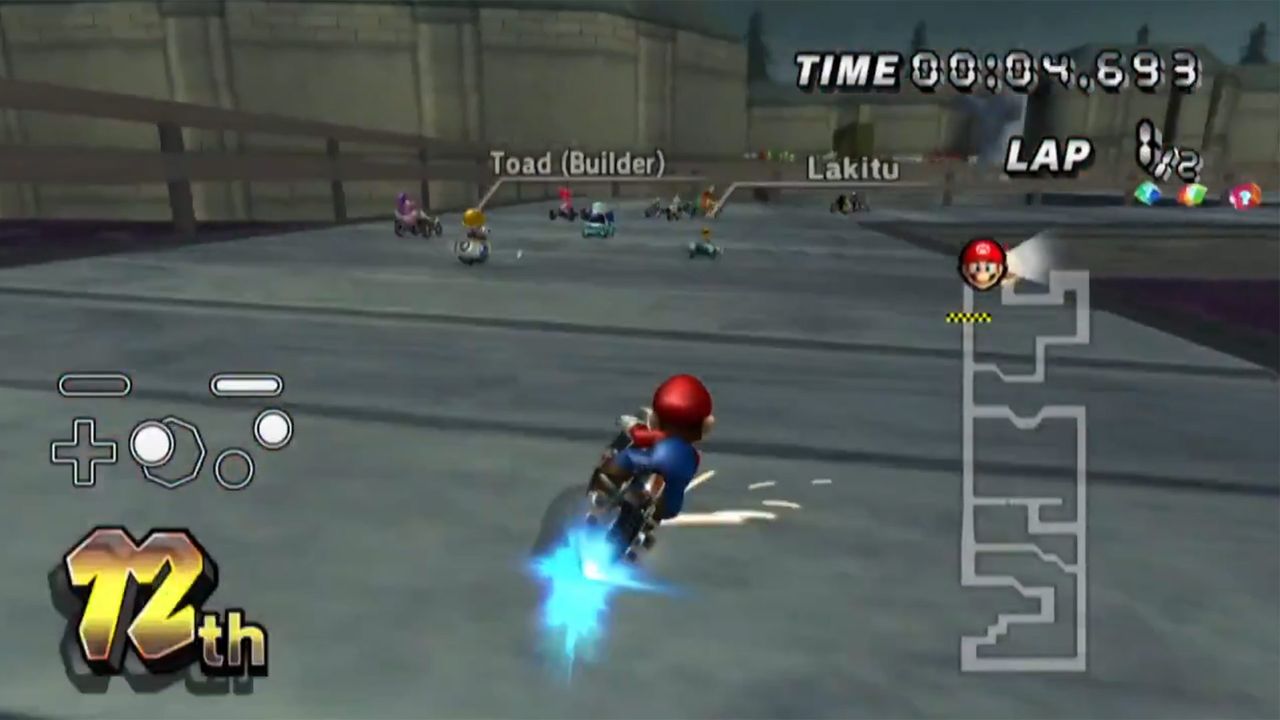
The thrill of drifting over a final banana at 1080p was no longer enough. So someone decided to bring Mario Kart Wii directly to x86 architecture, starting from the original Nintendo console code, without emulation. This is the first static recompilation of a Wii title, achieved with the help of artificial intelligence algorithms: a leap that gives the iconic 2008 game 4K resolution and frame rates unbounded by the hardware limits of fifteen years ago. And there’s a bonus mode unlocking over 200 tracks, thanks to integration with the Retro Rewind modding community.
Static recompilation is not emulation. Instead of simulating the entire Wii environment, the process translates the game’s instructions into native PC code. Traditionally, this requires an immense amount of manual labor. The injection of AI in this project automated the conversion from PowerPC to x86, recognizing patterns, functions, and system calls. It’s a concrete signal of how language and machine-translation models can be trained for targeted reverse-engineering tasks, drastically cutting porting times.
This touches a raw nerve in contemporary digital entertainment. Many publishers lean on cloud streaming to make back catalogs available, tying users to stable connections, subscriptions, and remote servers. This experiment shows that even mid-range consumer hardware can run classic titles with a significant facelift, provided there’s an upfront investment in intelligent recompilation tools. The political angle is not secondary: it becomes possible to exercise full control over owned software, without depending on third-party platforms and without the fear that a service might shut down overnight.
From a technical standpoint, 4K resolution and the unlocked frame rate aren’t mere vanities. They make the game seamlessly viewable on modern displays without scaling artifacts, and allow high-refresh screens to deliver a fluidity unimaginable on the Wii. Compatibility with over 200 tracks also signals that the method extends to community-created content—a value multiplier that walled-garden consoles have always struggled to embrace.
The use of AI during recompilation raises interesting questions for those designing code-transformation pipelines. It’s not an expensive cloud training run: the model appears to have been executed locally by the developers, with no dependence on external APIs. This aligns the project with the logic of data sovereignty and on-device computing: the game’s source bits never leave the user’s or developer’s machine. In an era where every byte seems destined for someone else’s server, this work is a reminder that a perfectly viable alternative exists.
Granted, such an operation demands non-trivial skills: decompiling a Wii binary, teaching a model to segment and translate the instruction flow, managing differences between graphics and audio subsystems. Yet the mere existence of this result indicates the barrier is lowering. With the evolution of transformers and code-specialized models, the line between abandoned game and renewed classic could thin rapidly. Unsurprisingly, after the announcement, retro-gaming forums and Discord servers buzzed with requests for porting other Wii titles, from Metroid Prime Trilogy to Xenoblade Chronicles.
For those evaluating on-premise AI workloads, the lesson is twofold: on one hand, it confirms that code-translation models can live entirely on user hardware, with no cloud needed; on the other, it suggests that the most disruptive use cases often emerge from independent communities, not from vendors. It’s a dynamic worth watching for anyone crafting strategies around technological sovereignty.






💬 Comments (0)
🔒 Log in or register to comment on articles.
No comments yet. Be the first to comment!