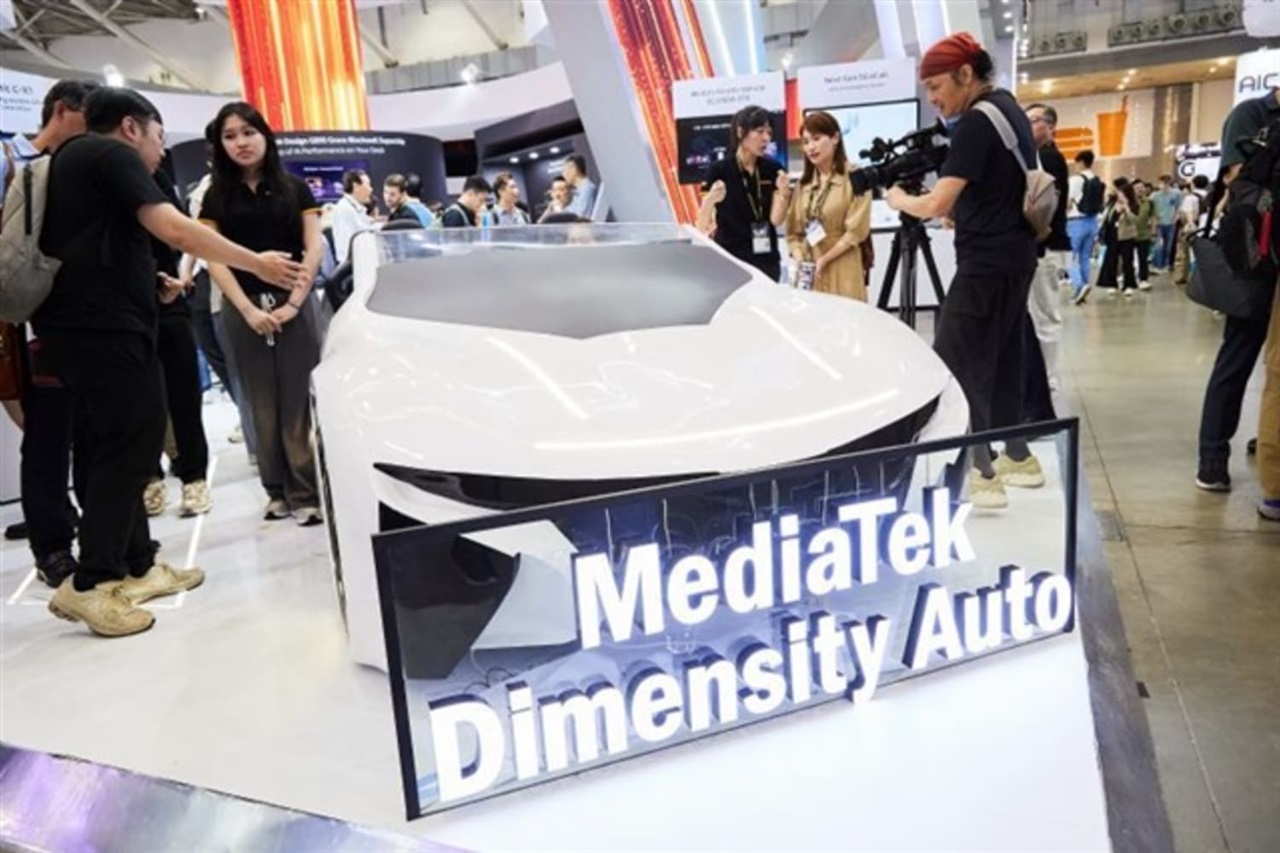
MediaTek Unveils AI Smart Cockpit for Next-Gen Vehicles
MediaTek, a leading semiconductor company, recently unveiled its "active AI smart cockpit," an innovative solution designed to revolutionize the driving experience in modern vehicles. This presentation marks a significant step forward in the advancement of "AI-defined vehicles," where artificial intelligence is no longer a mere accessory but the beating heart of the functionalities and interaction within the cabin.
The deep integration of AI into in-vehicle systems represents a key trend for the automotive industry. It shifts from isolated functionalities to a connected and intelligent ecosystem, capable of learning from the habits of the driver and passengers to offer a personalized and proactive experience. This approach promises to enhance not only comfort and entertainment but also vehicle safety and operational efficiency.
Technical Details and Implications of Onboard AI
The concept of an "AI smart cockpit" implies an architecture that processes a wide range of data in real-time, from driver and passenger monitoring to infotainment management and driving assistance. For "AI-defined vehicles," AI is intrinsic to the vehicle's design, influencing everything from onboard electronics to active and passive safety systems. This demands robust, low-latency local inference capabilities.
Processing artificial intelligence directly onboard the vehicle, known as "edge AI," offers substantial advantages. It reduces latency, which is essential for critical functions like driving assistance, and enhances data privacy, as sensitive user information can be processed locally without being sent to the cloud. Furthermore, it ensures greater operational reliability, especially in areas with limited or no connectivity. To support such capabilities, these systems require specific System-on-Chips (SoCs), equipped with dedicated Neural Processing Units (NPUs) and sufficient VRAM to run optimized Large Language Models (LLMs) or other AI models, often through quantization techniques to reduce footprint and memory requirements.
Context and Challenges of On-Premise (Edge) Deployment
The deployment of AI solutions in automotive represents a paradigmatic example of "edge AI," where processing occurs as close as possible to the data source. This scenario presents unique challenges compared to cloud deployments. Constraints include power consumption, the need for efficient thermal dissipation in varying environments, system robustness to withstand vibrations and extreme temperatures, and the management of software and model updates via Over-The-Air (OTA).
For manufacturers, evaluating the Total Cost of Ownership (TCO) is crucial. This includes not only the initial cost of hardware and software development but also long-term costs for integration, maintenance, security updates, and continuous optimization of AI models. Model optimization, for example through fine-tuning and quantization, is fundamental for them to run effectively on resource-constrained hardware, maximizing throughput and minimizing latency. For those evaluating on-premise or edge deployments, there are significant trade-offs between performance, cost, and flexibility, and AI-RADAR offers analytical frameworks on /llm-onpremise to evaluate these choices.
Future Prospects and Data Sovereignty
MediaTek's initiative is part of a broader trend that sees vehicles transforming into complex computational platforms. The future promises increasingly autonomous, personalized, and interconnected vehicles, where human-machine interaction will become more natural and intuitive thanks to AI. This development opens new opportunities for value-added services and a radically improved driving experience.
A fundamental aspect of these edge AI-based systems is data sovereignty. Local processing of sensitive user data, such as personal preferences or biometric data, can help meet stringent compliance requirements, such as GDPR, and strengthen consumer trust. MediaTek, with its proposal, contributes to defining the technological landscape for an era where artificial intelligence not only drives decisions but shapes the entire mobility experience.






💬 Comments (0)
🔒 Log in or register to comment on articles.
No comments yet. Be the first to comment!