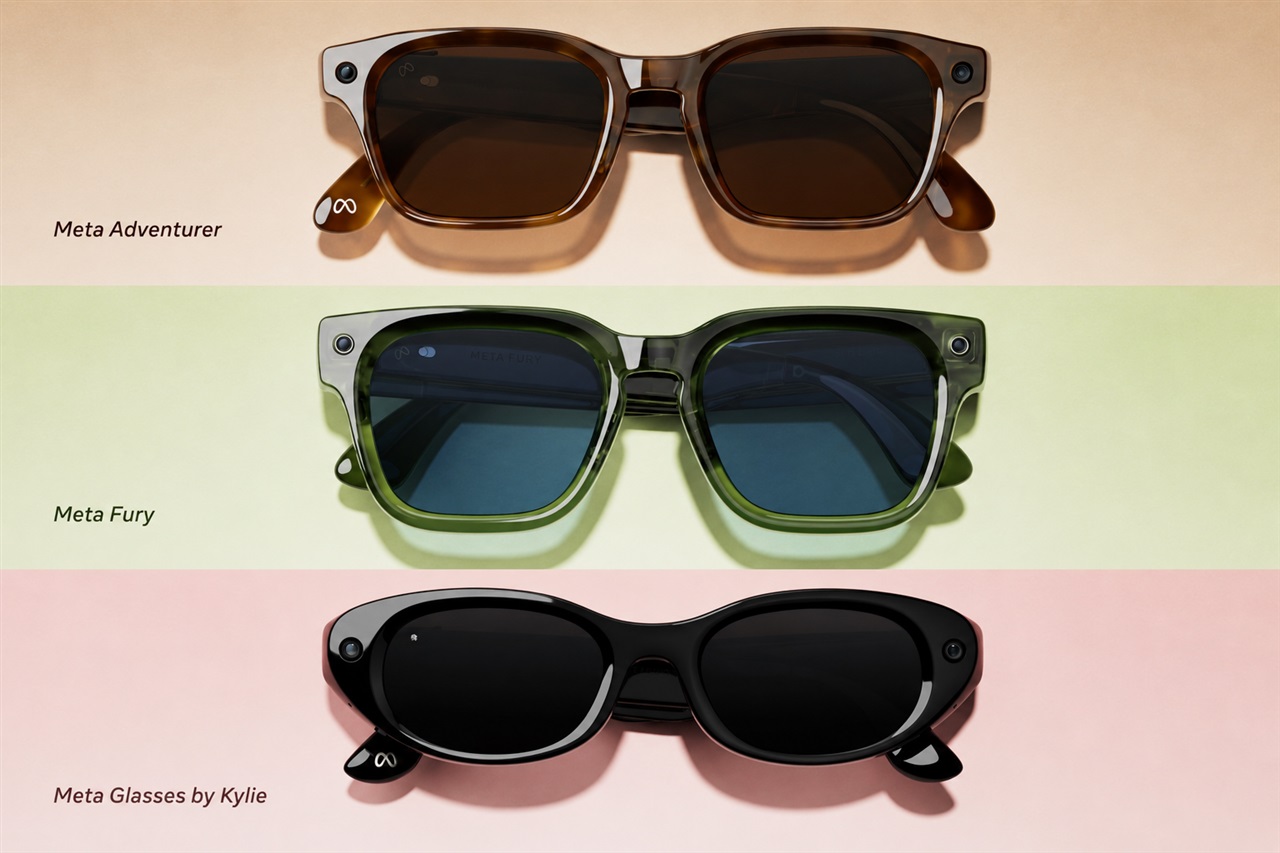
Meta and EssilorLuxottica have expanded their smart glasses family with a new budget-friendly line. The move brings the total portfolio to four models and confirms Menlo Park’s acceleration in wearable computing, just as the market tries to figure out whether AI should live in a pocket, on a wrist, or in front of your eyes.
The announcement and product strategy
The news, reported by Digitimes, comes without official technical details, but the industrial rationale is clear: after first- and second-generation Ray-Ban Meta smart glasses, the company led by Mark Zuckerberg is moving down-market with a proposition aimed at a broader audience. The well-established partnership with EssilorLuxottica merges optical and fashion expertise with software and AI capabilities, lowering the barrier for those still skeptical about smart glasses or who see them as expensive gadgets.
Having four models means differentiation: design, performance, price point. The budget model might sacrifice some sensors or limit connectivity, but the presence of generative AI – now a staple of Meta devices – remains the true distinctive feature. The crucial question for those developing or adopting AI architectures is where the intelligence resides: on the glasses themselves or in the cloud.
On-device versus cloud processing: the sovereignty dilemma
Smart glasses raise questions that go far beyond aesthetics. If the voice assistant and camera rely on remote servers, latency and privacy become critical. If inference happens locally, the hardware constraints of a wearable device come into play: low-power chips, limited memory, small batteries. This is the classic trade-off for anyone evaluating an AI deployment: data control versus computational power.
For Italian and European companies, the topic is even hotter. Processing images and voice captured by AI glasses falls under GDPR and forces clear choices on where data travels and is processed. A device that handles everything on-device would be a natural ally for regulatory compliance and air-gapped computing, but today’s technology doesn’t always allow that without compromise. Meta may well target a hybrid solution: quantized models for simple local tasks, cloud for heavier functions.
Wearable AI: market and implications for the on-premise ecosystem
Launching a budget line signals that Meta believes in scale. Lower prices mean more users, more data collected, more feedback to improve the Large Language Models powering the assistants. It also means multiplying the devices that generate personal data on the move, and this impacts those designing AI infrastructures. IT departments already running on-premise servers for inference may need to integrate streams from wearable endpoints, reviving challenges around networking, storage, and security.
AI-RADAR has closely followed the evolution of platforms for self-hosting LLMs. While the cloud remains the easiest path for serving consumer applications, the proliferation of edge devices like AI glasses makes the discussion around lightweight models, distributed inference, and orchestration tools running on local hardware ever more relevant. For those evaluating these scenarios, analytical frameworks on /llm-onpremise help weigh the trade-offs without shortcuts.
More than an accessory
The Meta–EssilorLuxottica move is not a mere style exercise. It signals that wearable computing is ready to become a commodity, and with it artificial intelligence embedded in everyday life. For system architects, the question is no longer “if” but “with what architecture” to integrate these new endpoints. The answer, as is often the case, lies on the line between latency, privacy, and TCO: a balance the industry is still seeking.







💬 Comments (0)
🔒 Log in or register to comment on articles.
No comments yet. Be the first to comment!