Meta Launches Forum: A New Approach to Groups with AI
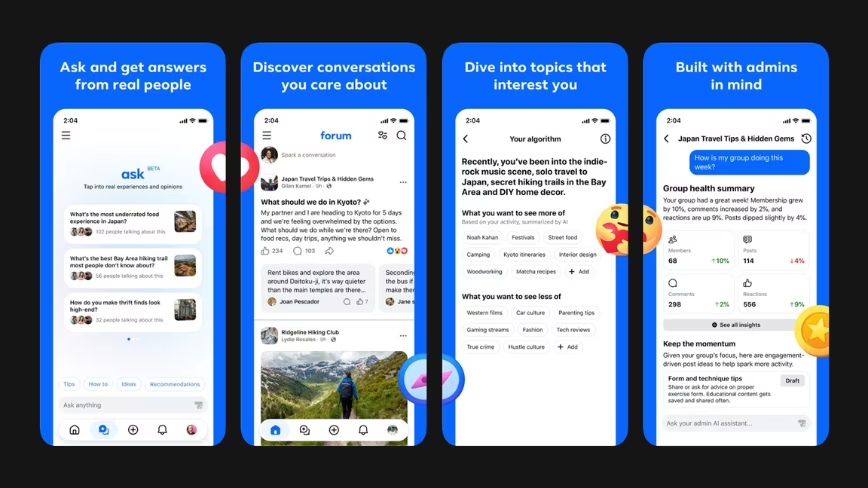
Meta recently introduced "Forum," a new standalone application designed to redefine the Facebook Groups experience. This quiet release, without a dedicated launch event, comes during a period of intense activity for the company, with Mark Zuckerberg and Chris Cox internally discussing the possibility of developing up to fifty new applications. This strategic move underscores Meta's intention to explore new directions in the social platform landscape.
Forum positions itself as an extension of Facebook Groups, offering an interface and functionalities that, according to initial observations, closely resemble the model of platforms like Reddit. The goal is likely to provide users with a more structured and focused environment for group discussions, partially diverging from the broader, more generalist experience of the main Facebook feed.
AI Integration: "Ask" and the Admin Assistant
One of Forum's most significant features is the integration of artificial intelligence capabilities. The app includes a dedicated tab, named "Ask," which presumably leverages Large Language Models (LLMs) to answer questions or provide information to users within groups. This functionality represents a significant step in incorporating AI directly into users' daily interactions, offering a potential tool for quick information retrieval or resolving specific queries.
Alongside the "Ask" tab, Forum also introduces an AI-powered admin assistant. This tool could support moderators in content management, enforcing group rules, and facilitating discussions, by automating repetitive tasks or providing suggestions based on conversation analysis. The adoption of LLMs for these functions requires robust and optimized infrastructure to ensure low latency and high throughput, crucial aspects for a smooth and responsive user experience.
Technical Implications and Deployment Considerations
The implementation of advanced AI features like those in Forum raises significant technical questions, especially for enterprises evaluating on-premise deployment of similar solutions. Efficiency in LLM Inference execution is paramount. Factors such as the amount of VRAM available on GPUs, the choice of Quantization level (e.g., FP16, INT8), and the optimization of serving Frameworks (like vLLM or TGI) directly impact performance and Total Cost of Ownership (TCO).
For those operating in sectors with stringent data sovereignty requirements or in air-gapped environments, the ability to manage the entire AI Pipeline locally becomes a critical factor. This implies not only adequate hardware but also the management of complete software stacks, from model Fine-tuning to their Deployment and monitoring. Decisions between a cloud approach and a self-hosted infrastructure involve complex trade-offs in terms of scalability, operational costs, and data control. AI-RADAR offers analytical frameworks on /llm-onpremise to evaluate these trade-offs and support strategic decisions.
Meta's Strategy and the Future of Social Platforms
The launch of Forum, with its emphasis on AI and a more structured user experience, reflects a broader trend in the tech industry towards the pervasive integration of artificial intelligence into everyday applications. For Meta, this initiative could represent an attempt to diversify its ecosystem and attract user segments seeking more targeted and managed interactions.
The company's focus on developing new apps and integrating AI suggests a long-term vision that extends beyond existing platforms. While the market observes how Forum will establish itself, it is clear that AI will continue to be a fundamental pillar for innovation and differentiation in the digital landscape, pushing companies to invest in increasingly sophisticated and flexible Deployment capabilities.





💬 Comments (0)
🔒 Log in or register to comment on articles.
No comments yet. Be the first to comment!