
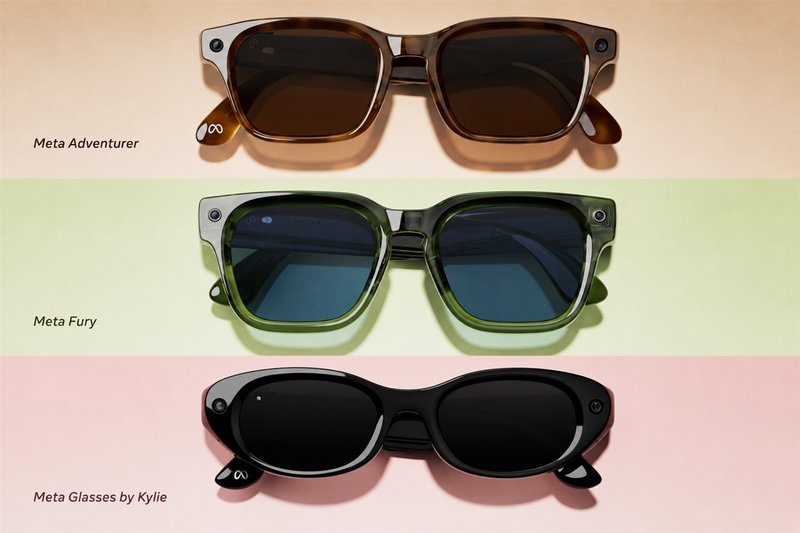
A pair of glasses co-designed with Kylie Jenner and speaking in her voice: Meta is using glamour to draw attention to its latest wearable hardware. The Starfire, the priciest model in the new Ray-Ban Meta lineup at $399, features a small gem on the lens. But the real novelty isn’t just cosmetic.
Beneath the celebrity collaboration, a less visible switch is flipped: the smart glasses’ voice assistant will respond with Jenner’s synthesized voice. For a fluid, real-time interaction, much of the processing has to happen directly on the frames. This isn’t a marketing gimmick—it’s physics and user expectations. Cloud round-trips would introduce unacceptable latency for a natural conversation. So manufacturers are packing wearables with chips capable of increasingly powerful on-device inference.
We’re looking at a mass-market example of edge AI, where speech recognition and synthesis run entirely locally. That brings two promises relevant to anyone thinking about deployment: less reliance on the cloud and tighter data protection. If Kylie Jenner’s voice is generated and dies inside the glasses, there’s no need to send audio streams to remote servers. Your conversations stay on the glass, a privacy feature that can influence buying decisions.
The same logic has become familiar to IT teams evaluating Large Language Models inside organizations. The ability to run inference on self-hosted hardware addresses the need for data sovereignty, control over recurring costs, and compliance with regulations like GDPR. Consumer devices are breaking ground: they prove that compact local processing is viable, and enterprises are starting to wonder whether the same approach can be replicated on their own servers—perhaps using LLMs optimized through quantization to run on corporate GPUs without external API calls.
It’s no coincidence that AI-RADAR, in its analysis for those building on-premise stacks, devotes attention to the trade-offs between edge and cloud: at /llm-onpremise you find lessons that travel from wearable devices to bare metal racks. The push toward local inference is reshaping skills and investment maps, both in data centers and in our pockets.
Sure, a $399 pair of glasses with a gem doesn’t make the Starfire a tool for data scientists. But the technology message is unmistakable: AI that speaks in our own voice is learning to do so without asking permission from a distant server. And that autonomy, before it becomes a tech-fashion statement, is a lesson enterprises can put to use right now.







💬 Comments (0)
🔒 Log in or register to comment on articles.
No comments yet. Be the first to comment!