
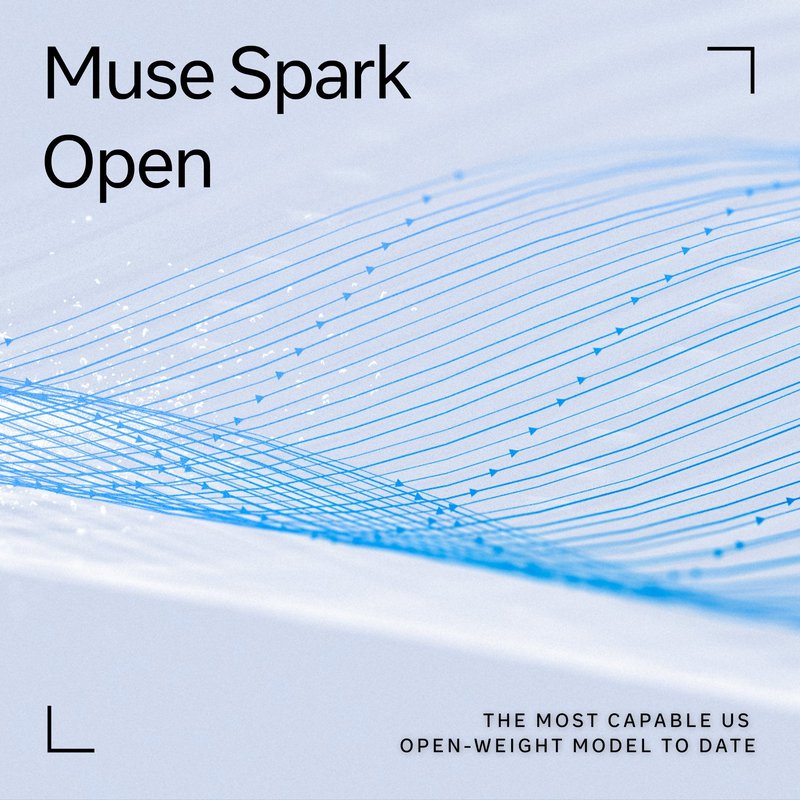
Meta released Muse Glimmer today, a 30-billion-parameter Large Language Model under the Apache 2.0 license, with a clear goal: bringing AI agents capable of operating locally on consumer hardware. Weights are already available on Hugging Face, and developers can immediately use it for tasks like local coding, function calling, and LLM-as-a-judge evaluation. This is not just another generalist model, but a bet on practicality: running agents directly on the user's machine, bypassing the cloud.
Meta's proposal targets one of the most pressing operational constraints facing teams working with language models: dependency on network connectivity and centralized infrastructure. Muse Glimmer is designed for workloads requiring an on-device model, such as personal agents with access to calendars, messages, files, and other private contexts. The idea is to enable fast, private interactions on data that organizations prefer – or are required – not to leave the device.
Benchmark performance, with mixed results
Meta's benchmarks place Muse Glimmer competitively against Gemma4-31B and Qwen3.6-27B, though without dominating across the board. On eight general agentic tests, Meta's model leads in five: standout scores include MCP Atlas (75.5 vs. 54.2 and 62.5) and DeepSearch QA (74.6 vs. 61.7 and 71.1), both measuring an agent's ability to work within scaffolds and handle multi-turn requests. In the banking domain (τ²-Banking), Muse Glimmer scored 23.5, a clear margin over peers.
However, Qwen3.6-27B keeps the lead on some relevant tests like GDPval-AA (1141 vs. 953) and OSWorld-Verified (75.6 vs. 65.9), the latter a benchmark simulating constrained tasks on real interfaces. On the coding front, the story is similar: Muse Glimmer tops SWE-Bench Pro (51.2 vs. 36.9 and 50.2) and holds its own on SciCode, while Qwen leads on SWE-Bench Verified and TerminalBench 2.1. Multimodal capability – the model accepts interleaved text and images via a dedicated perception encoder – shows near parity, with Qwen having an edge on ScreenSpot Pro and OmniDocBench.
These numbers require careful interpretation: testing agents in lab conditions doesn't replicate real-world performance when a system accesses an organization's files, contacts, and internal tools. Meta itself notes that local deployment demands custom scaffolds and a careful definition of accessible commands and repositories.
An architecture designed for home GPUs
Muse Glimmer's true differentiation lies less in benchmarks and more in its design for consumer hardware. A full-precision 30-billion-parameter model would need over 55 GB of memory, but Meta used 4-bit quantization to shrink the language model to under 20 GB. This leaves room for the KV cache, the perception encoder, and a speculative decoding drafter based on DFlash, which proposes token blocks to verify in parallel, speeding up generation without sacrificing output quality.
The goal is to fit within a 24-32 GB memory envelope, typical of cards like the RTX 5090 or the latest MacBook M4-Max and M5-Max, on which Meta tested the 17 GB K-Quant version with quantized drafter. The company describes the experience as fluid for conversation and real-time interaction, though no token-per-second figures, power data, or concurrency results were shared.
Integration with llama.cpp, MLX, and ExecuTorch, announced for the coming days, will ease experimentation across a broad range of devices.
The industrial signal: data sovereignty and local incentives
Muse Glimmer's release signals a structural shift in the open-model ecosystem. While cloud giants push centralized services, Meta is betting that a growing share of agentic workloads – those touching sensitive personal or corporate data – will migrate on-device. Developers targeting the European market, where GDPR imposes strict data-handling rules, may see models like this as a tangible alternative to cloud services. A local agent processing emails and notes without ever transmitting information over the network drastically reduces the attack surface and simplifies compliance obligations.
It is no coincidence that Meta included safety evaluations: on Siren AgentDojo, the attack success rate for Muse Glimmer is 28.4% versus 40.3% for Qwen, and on CI Memories the violation rate is less than half that of Qwen. In an operational context, safety goes beyond benchmarks, but a model less prone to undesirable behaviors lowers risks when connected to tools that can modify source code or interact with external systems.
The choice of an Apache 2.0 license – permissive and without usage restrictions – encourages commercial adoption and customization through fine-tuning. Companies can adapt the model to their domains without license constraints, a significant advantage for those building vertical applications in sectors like healthcare, finance, or manufacturing.
Open questions remain about real-world efficiency: without throughput and latency data under sustained loads, it's hard to judge whether the user experience matches that of a cloud agent. But the direction is set: increasingly capable models, compressed with aggressive quantization techniques, ready to run on the GPUs we already have on our desks. The next step will be to see whether the tooling ecosystems – scaffolds, orchestration, monitoring – can keep pace with this decentralization.




💬 Comments (0)
🔒 Log in or register to comment on articles.
No comments yet. Be the first to comment!