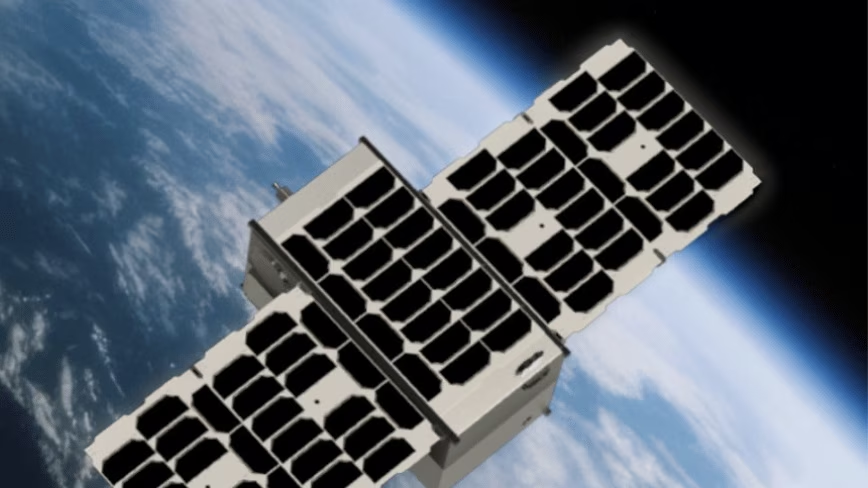
The Growing Impact of Space Weather on Satellite Infrastructure
Earth's orbit is becoming increasingly crowded. Currently, there are over 8,000 active satellites, a number set to grow exponentially, with projections indicating more than 25,000 units by 2030. This expansion, while crucial for communications, navigation, and Earth observation, exposes an increasingly critical infrastructure to significant environmental risks, particularly those stemming from space weather.
Geomagnetic storms, phenomena triggered by solar activity, represent one of the most concrete threats. During a solar maximum, the Sun can produce hundreds of these storms, some with the potential to cause catastrophic damage. It is estimated that a single high-intensity geomagnetic storm could cost the satellite industry up to $40 billion, a cost that includes not only hardware loss but also the disruption of essential services and recovery expenses. A tangible example of this vulnerability occurred in February 2022, when a moderate storm caused the loss of 40 newly launched Starlink satellites, highlighting the fragility of these constellations in the face of unforeseen events.
The Challenge of Forecasting Geomagnetic Storms
The ability to accurately forecast space weather has become a strategic priority. Geomagnetic storms result from coronal mass ejections (CMEs) and high-speed solar winds interacting with Earth's magnetic field. These interactions can generate induced currents, heat the upper atmosphere, and increase air density at low orbital altitudes, causing drag and de-orbiting of satellites. The complexity of these phenomena makes forecasting a significant scientific and technological challenge.
To address this gap, a fifteen-person startup is developing a dedicated space weather forecasting system. The goal is to provide timely and accurate warnings that allow satellite operators to take preventive measures, such as safeguarding satellites or modifying their orbits. The development of such systems requires the integration of data from solar observatories, complex physical models, and increasingly, machine learning techniques to interpret and predict the evolution of space phenomena. The ability to process large volumes of data in real-time is crucial for the effectiveness of these solutions.
Implications for Industry and Operational Resilience
The implications of unpredictable space weather extend far beyond the mere loss of satellites. The disruption of satellite services can have significant repercussions on vital sectors such as telecommunications, GPS navigation, weather forecasting, and terrestrial power grids. For operators, the ability to maintain operational continuity and protect in-orbit assets is fundamental not only for profitability but also for national security and economic stability.
In this context, infrastructure resilience takes on paramount importance. Organizations managing critical infrastructure, whether space-based or terrestrial, must carefully evaluate deployment strategies that ensure control, security, and data sovereignty. For those considering on-premise deployment of analysis and forecasting systems, for example, there are significant trade-offs in terms of TCO, performance, and customization capabilities compared to cloud solutions. The ability to keep data and models within a controlled and air-gapped environment can be a decisive factor for protection against external threats, including the impacts of space weather.
Future Prospects for Space Resilience
Modern society's increasing reliance on space infrastructure makes space weather forecasting no longer a luxury, but a strategic necessity. The initiative of startups specializing in this field underscores the urgency of investing in research and development to improve our understanding and ability to mitigate risks. Protecting in-orbit assets is not just an economic issue, but also one of security and continuity of essential services that support our daily lives.
The future of space exploration and utilization will largely depend on our ability to operate safely and resiliently in a dynamic and sometimes hostile environment. The development of advanced forecasting systems represents a crucial step towards building a more robust space infrastructure less vulnerable to the forces of nature, ensuring that the benefits derived from satellite technology can continue to thrive without unexpected interruptions.






💬 Comments (0)
🔒 Log in or register to comment on articles.
No comments yet. Be the first to comment!