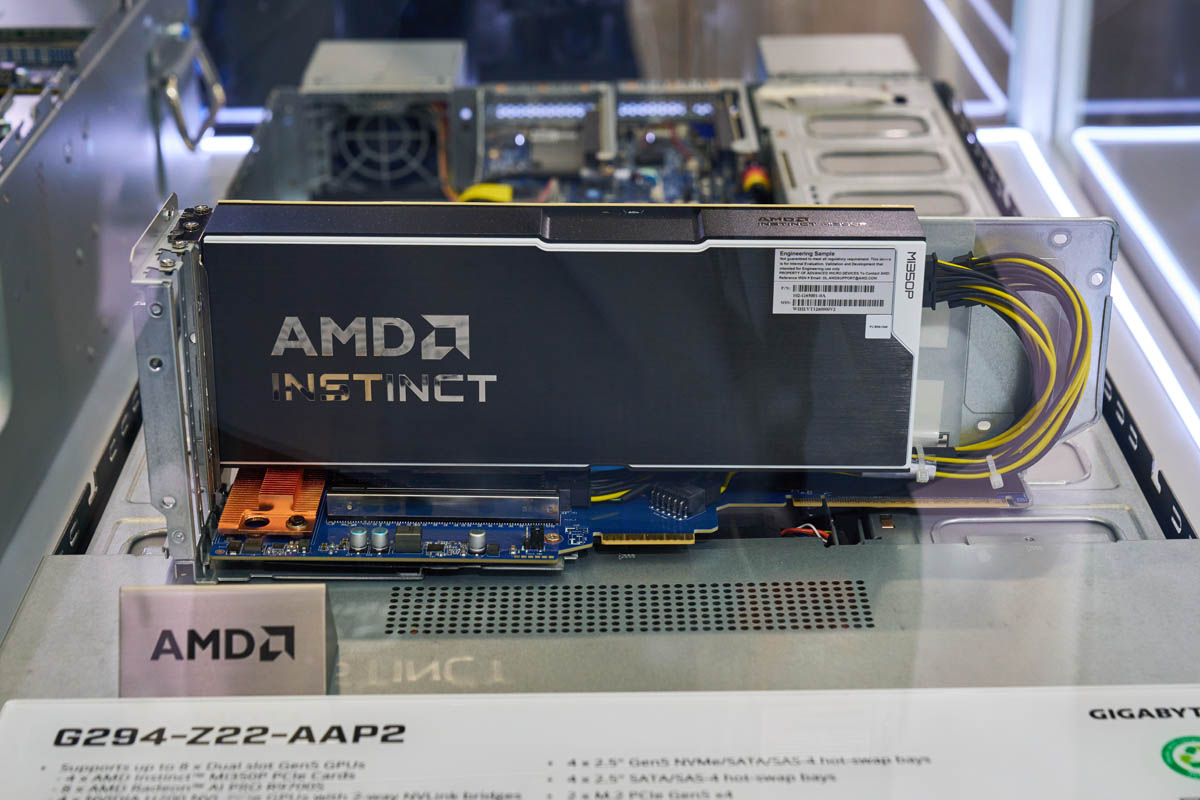
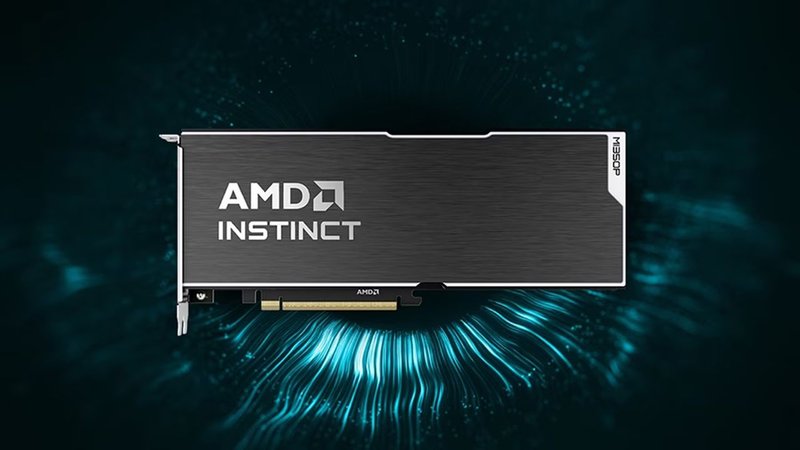
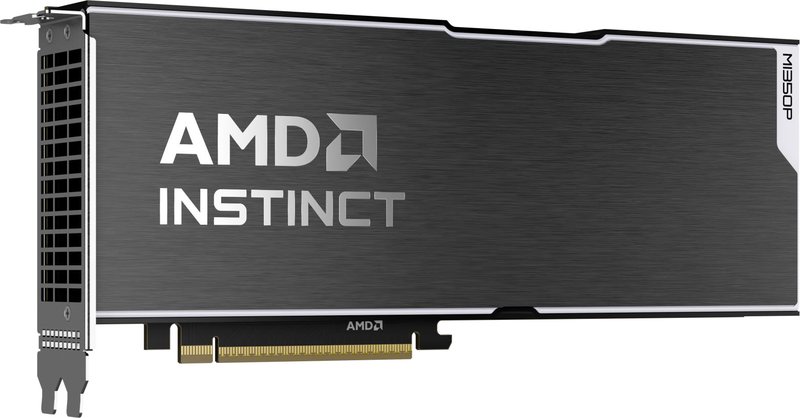
By now, you see it everywhere: in confidential briefings, in server vendor reference designs, in the conversations of those designing clusters for Large Language Models to be kept under their own physical control. The AMD Instinct MI350P seems tailor-made to get people talking, and not just because of its 144 gigabytes of HBM3E memory. The detail that is turning heads among industry insiders is something else: those bandwidth-laden stacks sit on a common PCIe form factor.
Until now, if you wanted to accelerate a model with tens of billions of parameters without throttling, you faced a fork in the road. On one side, PCIe cards with GDDR memory, capable but with bandwidth that, on extended context windows and sustained inference loads, becomes a silent but expensive bottleneck. On the other, OAM or SXM modules with HBM, which move mountains of data but demand dedicated systems, advanced cooling, and a rigid integration ecosystem that, over time, translates into a total cost of ownership (TCO) difficult to swallow for R&D labs, mid-sized enterprises, and managed service providers.
The MI350P attacks exactly that fracture. By putting HBM3E on an interface compatible with standard servers, AMD is not just proposing a larger memory card: it is redefining the equilibrium between computational density and ease of adoption. Those who have racks with latest-generation PCIe slots can, at least on paper, add local inference capacity without changing infrastructure architecture. This is a shift that moves the needle on data sovereignty: you no longer need an “exotic” system to keep a large LLM away from the public cloud, and that reduces decision friction inside organizations.
Second-order implications nestle in the supply chain and in the balance of power among vendors. Today NVIDIA guards the high end with HBM-based SXM modules, while its PCIe offerings remain anchored to GDDR. If the MI350P proliferates, server suppliers (Dell, HPE, Lenovo, Supermicro, and the ODMs serving cloud providers) would have a credible alternative to offer in their general-purpose AI systems. This could trigger a competitive chase, with knock-on effects on pricing and availability, but also pressure on hyperscalers to rethink their bare-metal instances: why lease GPUs in the cloud when an on-prem solution with comparable bandwidth starts becoming manageable at lower operational costs and without network latency?
There is also a third order of consequences, less immediate but structural. The arrival of HBM-based accelerators on PCIe normalizes the most expensive and complex-to-manufacture memory technology, making it an ingredient of “horizontal” platforms. This changes incentives for those developing serving and orchestration frameworks: more such easily integrable cards in Kubernetes or bare-metal clusters mean more opportunities to optimize local inference pipelines, from batching to load balancing, without running into memory bottlenecks.
It is no coincidence that the MI350P is appearing now. The race toward private deployment of generative models is in full swing, and GDPR compliance constraints, intellectual property sensitivity, and auditing requirements push toward self-hosted architectures. A card that promises to run massive models without imposing the “prison” of a closed system sends a clear message: the market is maturing, and the next battle will not be fought on abstract teraflops, but on the ability to deliver real capacity within the spaces and budgets of enterprises.
For those accustomed to looking at AI hardware through the lens of compatibility and TCO, the MI350P is more than a technical novelty: it is proof that technologies once exclusive to supercomputers are trickling down, and that the line between specialized accelerator and server component continues to thin.






💬 Comments (0)
🔒 Log in or register to comment on articles.
No comments yet. Be the first to comment!