Midjourney Ventures into Hardware with a Full-Body Medical Scanner
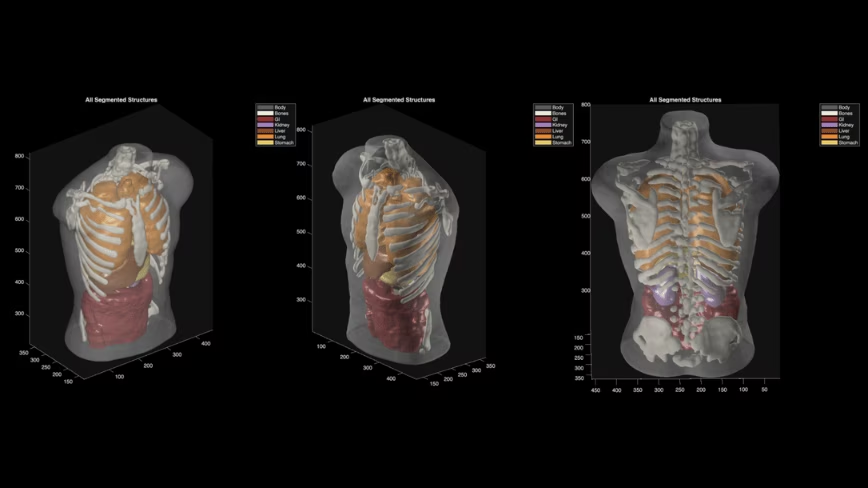
Midjourney, the company widely recognized for its AI-powered image generation platform, has surprised the industry by announcing its first hardware product. This is a full-body medical scanning device, named "The Midjourney Scanner." This step marks a significant expansion beyond its core software business, projecting the company into an entirely new and technologically intensive domain.
The announcement was made by founder David Holz during an event in San Francisco on June 17. The initiative also includes the creation of a new dedicated division, underscoring Midjourney's commitment to this ambitious project. Entering a specialized and regulated sector like healthcare represents a considerable challenge for a company previously focused on creative software.
Technical Details and Implications for AI in Medical Imaging
While specific technical details regarding the hardware and software architecture of "The Midjourney Scanner" remain limited, the entry of an AI player into the medical imaging field raises intriguing questions. Traditionally, medical imaging, including Magnetic Resonance Imaging (MRI), requires complex and costly infrastructure, with bulky machinery and lengthy analysis processes. A new approach could aim to optimize data acquisition and analysis processes, potentially leveraging advanced AI techniques for image reconstruction, noise reduction, or automated diagnostic analysis.
Efficiently processing large volumes of medical data is crucial. This often demands high-performance computing systems, which can be deployed either in the cloud or on-premise, depending on data sovereignty, latency, and throughput requirements. The integration of Large Language Models (LLM) or other AI models for result interpretation or report generation could necessitate significant computational resources, such as GPUs with high VRAM and optimized inference capabilities.
Data Sovereignty and On-Premise Deployment Requirements
The introduction of proprietary hardware into a sensitive sector like healthcare brings significant considerations for CTOs and infrastructure architects. Managing highly sensitive health data necessitates adherence to strict regulations, such as GDPR in Europe, often making on-premise or air-gapped deployments preferable. These solutions ensure direct control over data location and security, which are fundamental for compliance and data sovereignty.
If "The Midjourney Scanner" integrates AI processing capabilities directly on the device (edge computing) or requires local infrastructure for analysis and Fine-tuning of models, this would directly impact the Total Cost of Ownership (TCO) and the choice of inference hardware. The need to rapidly process data for immediate diagnoses could drive demand for low-latency, high-throughput solutions, typically associated with local deployments featuring dedicated GPUs, such as NVIDIA A100 or H100 series, to handle intensive workloads. For those evaluating on-premise deployments for AI/LLM workloads, AI-RADAR offers analytical frameworks on /llm-onpremise to assess the trade-offs between control, performance, and costs.
Future Prospects and Trade-offs in the Medical Sector
Midjourney's ambition to surpass MRI with its scanner is a bold claim that promises innovation. Success will depend on the company's ability to deliver not only superior image quality but also to navigate the complex operational and regulatory constraints of the medical sector. This includes obtaining necessary certifications, integrating with existing clinical workflows, and demonstrating long-term reliability and safety.
For healthcare organizations, evaluating such technology would involve a thorough analysis of trade-offs between initial (CapEx) and operational (OpEx) costs, ease of integration with existing healthcare information systems (HIS), and regulatory compliance. Midjourney's approach could open new avenues for diagnostic imaging, but it will require robust supporting infrastructure, whether on-premise for total control or hybrid to balance flexibility and data security.









💬 Comments (0)
🔒 Log in or register to comment on articles.
No comments yet. Be the first to comment!