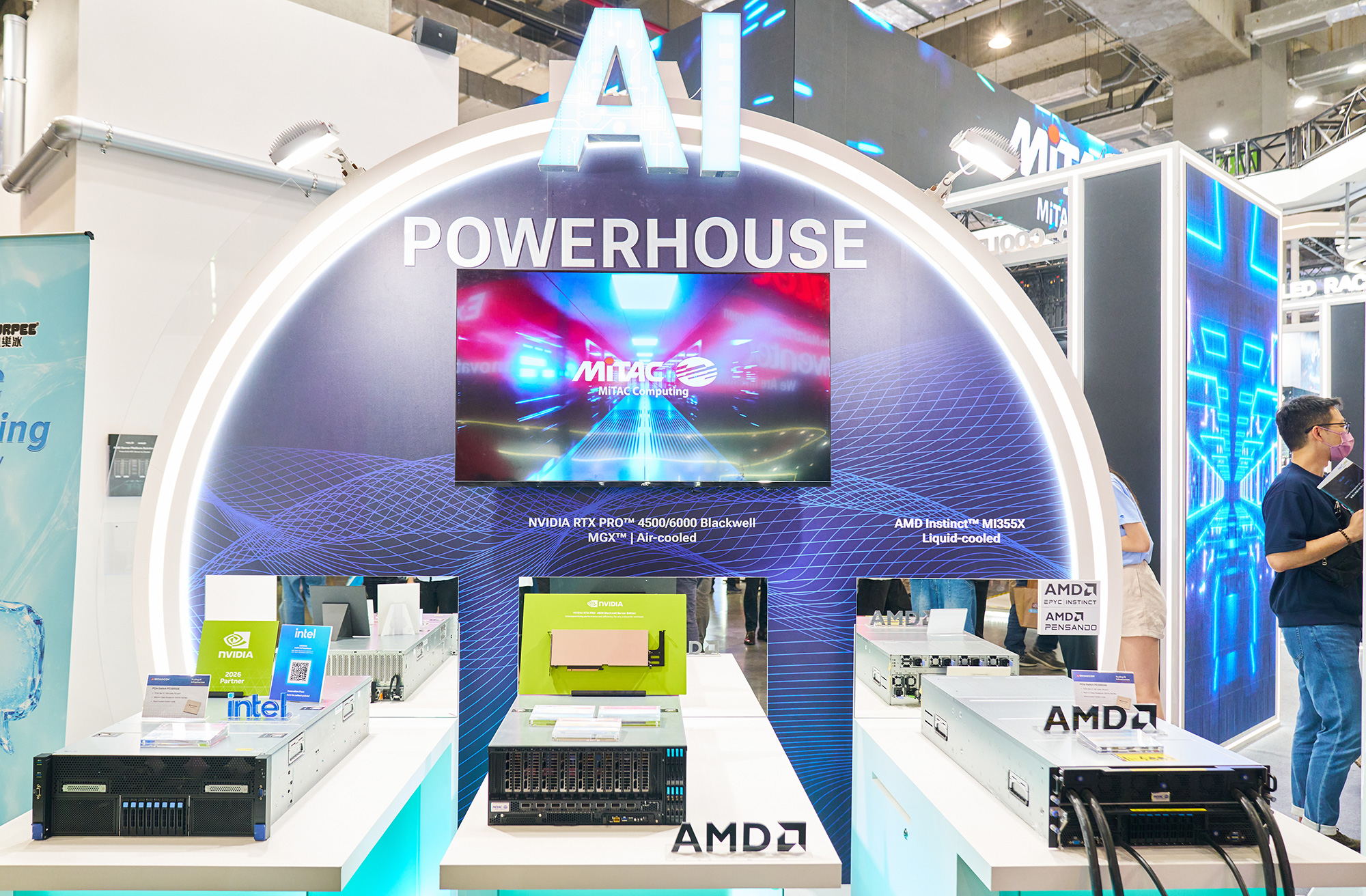
Among the booths at Computex 2026, MiTAC caught attention not just for the sheer number of servers on display, but for a striking novelty: diamond cooling. In an era where GPUs push systems to unprecedented thermal levels, the choice of a material with extreme thermal conductivity is not just exotic — it signals a paradigm shift for those designing on-premise infrastructure dedicated to Large Language Models.
Beyond copper: how diamond cooling works
Synthetic diamond boasts a thermal conductivity up to five times that of copper. Applied as an interface layer between the GPU die and the heatsink, it extracts heat more efficiently, reducing hotspots and enabling higher compute density without compromising reliability. MiTAC integrated this technology into some of the GPU systems shown, alongside liquid cooling and forced-air solutions. The goal is clear: enable increasingly dense racks, like the 52U models presented, where each unit can house cutting-edge accelerators.
The hardware underpinning on-premise LLM
At the show, cabinets were packed with enterprise-grade GPUs — likely NVIDIA H100 or Blackwell variants — and high-performance storage nodes. For those evaluating on-premise LLM deployments, the combination of density (more GPUs per rack) and advanced thermal management means a more predictable TCO: less physical space occupied, lower complexity in heat load distribution, and potentially optimized operating energy costs. The 52U units, in particular, reduce the number of racks needed to reach a given inference capacity, simplifying modular data center design.
Sovereignty and control: the thread of on-prem AI
MiTAC’s proposition fits into a broader picture: organizations that choose to run their LLMs on their own infrastructure do so to govern data, compliance, and latency. Systems with diamond cooling and ultra-dense racks reinforce this possibility by lowering the physical barrier to adopting powerful hardware in self-hosted environments. It’s not just about the chips; thermal and mechanical design becomes a determining factor in the feasibility of a sovereign AI strategy.
What it means for those building AI infrastructure today
For teams now evaluating on-premise solutions for LLMs, the evolution of cooling and form factors is no minor detail. MiTAC’s example shows that material innovation can multiply compute density without triggering a vicious cycle of unsustainable cooling costs. Meanwhile, the GPU server market is accelerating toward deeper racks and greater heights, forcing a logistical and contractual rethink. AI-RADAR will continue to track these developments, providing analysis and evaluation frameworks for those deciding where to run their LLM — among clouds, bare metal, and the diamond future.







💬 Comments (0)
🔒 Log in or register to comment on articles.
No comments yet. Be the first to comment!