
The Corsair Example: Customization Beyond the Consumer
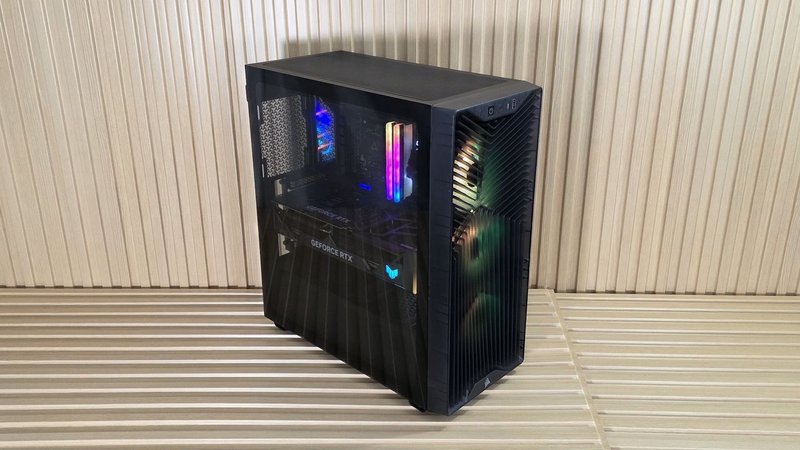
Corsair, a well-known name in the PC hardware landscape, has introduced its "Frame Configurator" for the 4000 Series cases. This tool allows users to explore dozens of customization options, offering significant flexibility in choosing materials and aesthetics, including the possibility of integrating elements like wood with special finishes. While this initiative is clearly aimed at the consumer market and the aesthetics of gaming or personal workstations, the underlying principle of deep hardware configurability resonates with far more complex needs in the enterprise world.
The ability to adapt a base product to specific individual needs is a value that transcends mere visual appeal. For system architects and DevOps leads, hardware modularity and customization represent strategic levers to address the challenges of on-premise deployments, especially in the context of workloads related to Large Language Models (LLM) and artificial intelligence.
Hardware Flexibility: From PC Case to Data Center
Corsair's "Frame Configurator," though applied to a relatively simple component like a PC case, highlights a fundamental concept: the ability to choose and combine elements to optimize a final solution. In the context of data centers and AI infrastructures, this philosophy translates into the ability to select servers, GPUs, storage, and networking that precisely meet performance, power consumption, and budget requirements. For example, choosing GPUs with high VRAM specifications or high Throughput interconnects is critical for LLM Inference and Fine-tuning.
Hardware modularity can directly influence the Total Cost of Ownership (TCO) of an infrastructure. A system designed with standard, easily replaceable or upgradeable components can reduce maintenance costs and extend the useful life of the investment. This is particularly true for self-hosted deployments, where the company has direct control over the entire hardware and software stack, allowing for optimization of every aspect for specific workloads.
Implications for On-Premise LLM Deployments
For organizations evaluating on-premise LLM deployments, hardware configuration flexibility is not a luxury but a necessity. Data sovereignty, regulatory compliance (such as GDPR), and security in air-gapped environments often mandate the adoption of self-hosted infrastructures. In these scenarios, the ability to select hardware that perfectly matches latency, Throughput, and memory capacity requirements (e.g., GPUs with 80GB of VRAM for large models) is fundamental.
A modular approach also allows for more granular infrastructure scaling, adding resources only when needed and optimizing the utilization of existing assets. This contrasts with cloud models, where flexibility is often constrained by provider offerings and can lead to less predictable operational costs (OpEx). For those evaluating on-premise deployments, significant trade-offs exist between initial CapEx and long-term OpEx, and the choice of configurable hardware can mitigate some of these risks. AI-RADAR offers analytical frameworks on /llm-onpremise to evaluate these trade-offs in depth.
The Customization Perspective in Enterprise AI
Corsair's initiative, while distinct from the world of enterprise servers, underscores a broader trend: the demand for customized and adaptable solutions. In the artificial intelligence sector, where computing and memory requirements evolve rapidly, the ability to precisely configure hardware becomes a competitive factor. Whether optimizing a cluster for training new models or implementing an infrastructure for low-latency Inference, the choice of flexible components and architectures is crucial.
Ultimately, the lesson from Corsair's "Frame Configurator" is that customization and modularity are not just for aesthetics or gaming. They are fundamental principles that, when applied at an enterprise scale, can unlock significant efficiencies, ensure greater control, and better support data sovereignty strategies for the most demanding AI workloads. The ability to "build to spec" one's own infrastructure is a strategic asset for the future of on-premise AI.








💬 Comments (0)
🔒 Log in or register to comment on articles.
No comments yet. Be the first to comment!