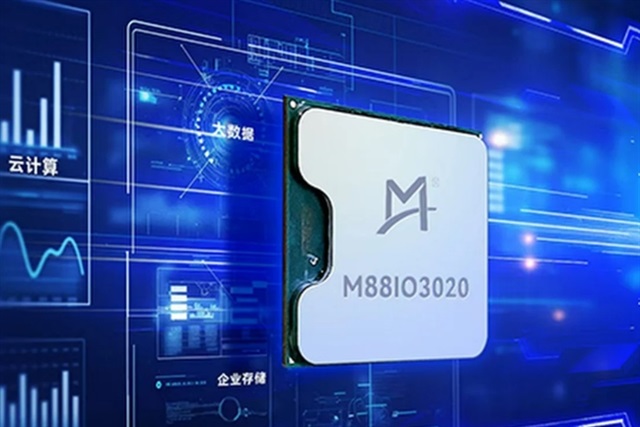
Montage Tech's Innovation for AI Servers
Montage Tech, a company specializing in memory interconnect solutions, has announced the start of sampling its new RCD06 (Registering Clock Driver) chip for DDR5 modules. This component has been designed to support data transfer speeds of up to 9200 MT/s, a significant achievement in the server memory landscape. The primary goal of this innovation is to upgrade memory capabilities in servers dedicated to artificial intelligence, a rapidly expanding sector that demands increasingly high performance.
In the context of Large Language Models (LLM) and other complex AI workloads, memory speed and bandwidth are critical factors. Processing large models, both during training and inference, generates an enormous amount of data that must be moved quickly between the CPU/GPU and system memory. A memory bottleneck can drastically limit the overall system performance, making even the most powerful GPUs less efficient.
Technical Details and Performance Impact
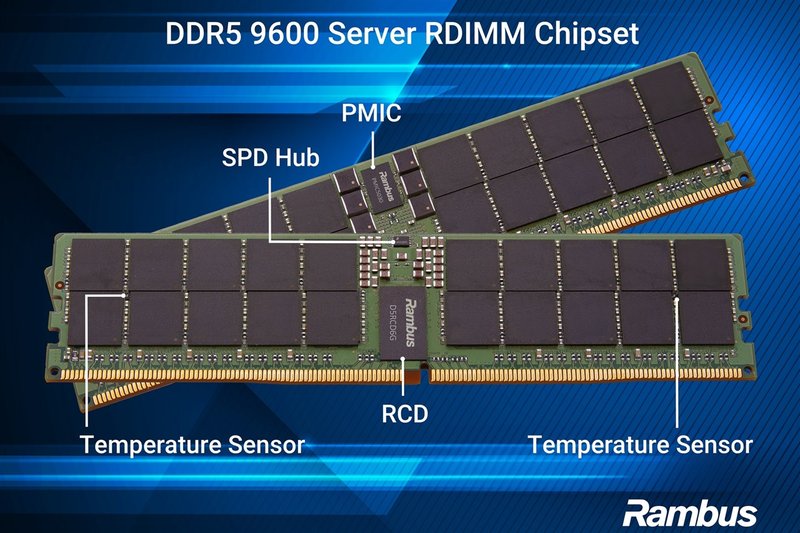
Montage Tech's RCD06 chip, operating at 9200 MT/s, represents a step forward for DDR5 technology. Registering Clock Drivers are essential components in Registered DIMM (RDIMM) memory modules, used in servers to ensure signal integrity and operational stability even at high speeds and with a large number of modules. By increasing the clock speed, these chips allow DDR5 modules to achieve higher data throughput, which is crucial for AI applications.
For AI workloads, an increase in memory speed directly translates into greater processing capacity. For example, during LLM inference, higher throughput can reduce latency and increase the number of tokens processed per second, improving user experience and operational efficiency. Similarly, in training, faster memory can accelerate algorithm iteration and the management of large datasets, reducing overall model training times.
Implications for On-Premise Deployments
The introduction of high-performance DDR5 chips like Montage Tech's RCD06 has direct implications for organizations evaluating or managing on-premise AI deployments. The ability to upgrade server infrastructure with faster memory offers a path to extend the useful life of existing hardware or to maximize the performance of new acquisitions, without necessarily resorting to cloud solutions. This approach can be particularly beneficial for companies that prioritize data sovereignty, regulatory compliance, or operate in air-gapped environments.
For those evaluating on-premise deployments, Total Cost of Ownership (TCO) analysis is fundamental. Investing in high-performance memory components may represent a higher initial CapEx, but it can lead to lower OpEx in the long term, thanks to greater energy efficiency and reduced reliance on consumption-based cloud services. AI-RADAR offers analytical frameworks on /llm-onpremise to evaluate these trade-offs, helping companies make informed decisions about the constraints and opportunities of different infrastructure approaches.
Future Prospects and Strategic Considerations
The sampling phase of the RCD06 chip indicates that Montage Tech is paving the way for large-scale commercialization. This development is a positive signal for the AI server market, suggesting that innovation at the hardware component level continues to push performance boundaries. For CTOs, DevOps leads, and infrastructure architects, monitoring the evolution of these technologies is crucial for strategic planning.
The adoption of 9200 MT/s DDR5 memory could become a standard for next-generation AI servers, influencing purchasing decisions and upgrade strategies. The ability to manage increasingly complex and demanding LLM workloads while maintaining control over infrastructure and data remains a priority for many companies. Silicon innovation, such as that proposed by Montage Tech, is a fundamental pillar for building robust and high-performing AI architectures in self-hosted environments.








💬 Comments (0)
🔒 Log in or register to comment on articles.
No comments yet. Be the first to comment!