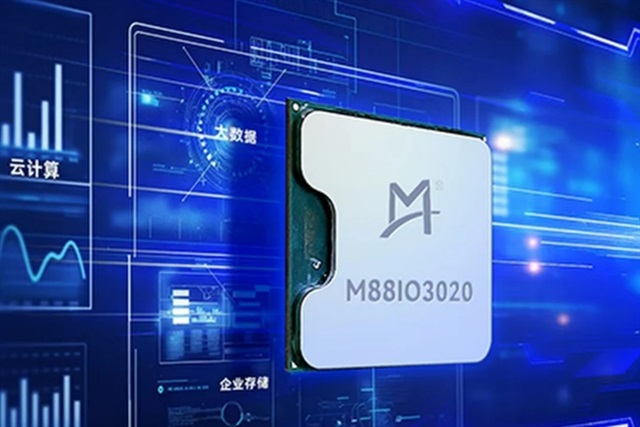
Montage Technology Capitalizes on AI Demand
Montage Technology, a Chinese company specializing in memory chip design, has reported a significant increase in profits. This positive outcome is primarily driven by the growing demand for DDR5 memory modules and the expansion of the artificial intelligence (AI) server market. Montage's financial performance reflects a broader trend in the tech industry, where the explosion of AI is generating unprecedented demand for high-performance hardware and advanced infrastructure components.
The increase in revenue for a key player in the memory chip supply chain highlights the pressure and opportunities that the AI ecosystem is creating. For companies developing and implementing artificial intelligence solutions, the availability and efficiency of these components are critical factors for the success of their projects, both in terms of performance and economic sustainability.
The Crucial Role of Memory for AI Workloads
In the landscape of artificial intelligence, particularly for Large Language Models (LLMs), memory plays a fundamental role. Both training and inference workloads demand extremely high bandwidth and low latency to process massive datasets and complex models. DDR5 technology, with its increased speed and capacity compared to previous generations, addresses these requirements, making it a key component for AI servers.
The availability of high-performance memory is directly correlated with the efficiency with which GPUs can process data, directly influencing throughput and the ability to handle larger batch sizes. For on-premise deployments, where hardware resources are finite and must be maximally optimized, choosing superior DDR5 modules is essential to ensure that the infrastructure can support the computational requirements of LLMs without significant bottlenecks.
Implications for On-Premise Deployments
The surge in demand for AI servers, and consequently for components like DDR5 memory, has direct implications for on-premise deployment strategies. Organizations opting to implement their LLM stacks locally, whether for data sovereignty, compliance, or to optimize long-term Total Cost of Ownership (TCO), must carefully consider the availability and cost of high-performance hardware. Investment in robust AI servers equipped with DDR5 can represent a strategic advantage for intensive and predictable workloads.
The choice between self-hosted and cloud-based solutions often boils down to a thorough analysis of initial capital expenditures (CapEx) versus operational expenditures (OpEx). For those evaluating on-premise deployments, AI-RADAR offers analytical frameworks on /llm-onpremise to evaluate these trade-offs, supporting decision-makers in selecting the most suitable architecture for their needs, balancing performance, control, and total cost of ownership.
Future Outlook and Market Challenges
The market for memory chips and AI servers is continuously evolving, propelled by innovation in Large Language Models and the increasing adoption of AI across various sectors. The ability of companies like Montage to capitalize on this demand highlights the importance of a robust supply chain and cutting-edge technologies. However, market volatility and rapid technological obsolescence present constant challenges for manufacturers and for companies investing in AI infrastructure.
For CTOs and infrastructure architects, strategic planning and careful evaluation of hardware specifications are crucial to ensure the sustainability and efficiency of their deployments. The need to balance performance, costs, and security requirements will continue to drive investment decisions in a rapidly expanding sector.










💬 Comments (0)
🔒 Log in or register to comment on articles.
No comments yet. Be the first to comment!