
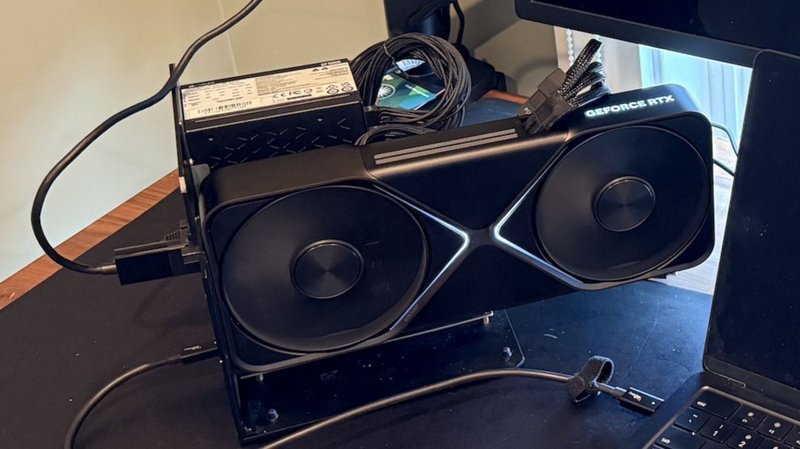
When a researcher opened the case on a whim, he found the power connector of his MSI RTX 5090 in critical condition. No errors, no artifacts, no crashes: the card had been running for days at 475–500W, chewing through diffusion model training and LLM inference. Only a visual inspection averted a potentially destructive failure.
The GPU was used exclusively for AI workloads, no gaming involved. The bent cable — likely a 12VHPWR adapter or 12V-2x6 — was giving way under the constant heat. It’s a wake-up call for anyone assembling local machines destined for long training runs: sustained loads at such high power levels turn physical installation into a top-tier risk factor.
Continuous power: a different ballgame from gaming
Gaming pushes GPUs with intermittent spikes, while AI training keeps them pinned at maximum draw for hours or days. The reported 475–500W sits within the RTX 5090’s specs, but the sheer continuity of the load magnifies any contact weakness. Bending cables near the connector reduces the effective contact area, raises resistance, and triggers localized overheating that can melt plastic and copper without any onboard sensors raising an alarm.
Those working on on-premise stacks tend to focus on VRAM, bandwidth, and throughput, but this episode drives home that physical deployment matters as much as software configuration. A replacement cable got the card back on its feet, but the safety margin had already been spent.
The cable factor in on-premise environments
In a self-hosted setup, where hardware often lives in tower cases or chassis not designed for uninterrupted operation, cable management becomes a TCO element. A cheap adapter, a forced bend to close the side panel, or a subpar extension can undo thousands of euros of investment. The user, who kept spare cables on hand (not the yellow MSI originals), was able to react quickly, but not everyone has backups ready.
The trend of running fine-tuning or inference on single workstations with extreme consumer GPUs — a popular choice for data sovereignty and lower upfront costs — carries a diligence debt that data centers address with certified connectors, mandated cable routing, and scheduled maintenance.
What to watch and why it matters
The Reddit post contains no benchmarks or throughput metrics. It doesn’t need to: the message is that on-premise reliability isn’t measured only in tokens per second or batch size, but also in the thermal endurance of contact points under prolonged stress. For anyone evaluating a local deployment, the incident suggests factoring into the sizing the selection of cables with generous bend radii — preferably those supplied with the PSU and certified for sustained loads — and checking connectors periodically.
The line between a stable configuration and an incipient fault can be invisible to logs. And in AI, where every lost training hour counts, prevention sometimes means an occasional visual check.






💬 Comments (0)
🔒 Log in or register to comment on articles.
No comments yet. Be the first to comment!