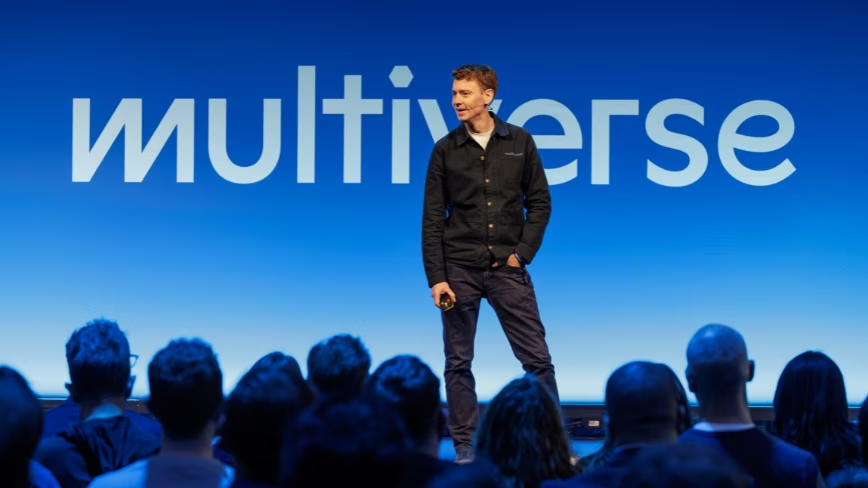
Multiverse Strengthens Position with New Funding Round
Multiverse, the London-based platform specializing in AI training and technological upskilling, has announced the completion of a $70 million primary funding round. The operation, led by Schroders Capital, has brought the company's valuation to $2.1 billion. This strategic investment follows a period of significant growth for Multiverse, which aims to consolidate and expand its service offerings for AI adoption across the European continent.
Founded by Euan Blair, Multiverse positions itself as a key player in the landscape of technological skills development, providing companies with the necessary competencies to navigate and leverage the potential of artificial intelligence. The ability to attract such substantial investment underscores investor confidence in the company's business model and the growing demand for qualified talent in the AI sector.
Growth Strategy and Market Impact
The success of this funding round is not an isolated event but is part of a well-defined growth strategy. Previously, in January, Multiverse acquired StackFuel, a Berlin-based company, strengthening its presence and capabilities in the European market. This strategic move was accompanied by remarkable growth, with a 50% year-on-year increase in revenue.
Multiverse's clients include prominent names such as AA, Babcock, and Capital, demonstrating the platform's ability to serve a wide range of industries. The stated goal is to drive AI adoption in Europe, an ambition that resonates with the current needs of enterprises seeking to integrate artificial intelligence solutions into their operational processes, whether in the cloud or in self-hosted environments.
The Importance of Upskilling for On-Premise AI
For organizations considering the deployment of Large Language Models (LLM) and other AI solutions in on-premise or hybrid environments, the availability of internal competencies is a critical factor. Investment in skills development platforms like Multiverse highlights the growing awareness that advanced hardware and robust Frameworks are not sufficient without a team capable of managing, optimizing, and maintaining them. Staff training thus becomes a fundamental element to ensure data sovereignty, compliance, and to maximize the Total Cost of Ownership (TCO) of infrastructural investments.
Managing local stacks, optimizing Inference on specific hardware such as GPUs with high VRAM, and understanding the security implications in air-gapped environments, all require specialized skills. Platforms that facilitate the acquisition of these abilities can reduce dependence on external providers and accelerate the return on investment in dedicated AI infrastructure. For those evaluating on-premise deployments, significant trade-offs exist between investing in internal training and relying on external managed services, and AI-RADAR offers analytical frameworks on /llm-onpremise to evaluate these options.
Future Prospects and Multiverse's Role in the AI Ecosystem
With the new capital available, Multiverse is well-positioned to accelerate its expansion in Europe, addressing the growing skills gap in the AI sector. The company aims to be a catalyst for widespread AI adoption, providing learning pathways that meet the specific needs of enterprises. This includes training on emerging technologies, optimizing AI development pipelines, and managing complex projects.
The success of initiatives like Multiverse's underscores a broader trend: the AI market is not just about model development or silicon production, but also, and above all, about the democratization of skills. Ensuring that companies have access to qualified personnel is essential to unlock the full potential of AI, whether it involves large-scale cloud deployments or strategic implementations in bare metal environments for control and performance requirements.










💬 Comments (0)
🔒 Log in or register to comment on articles.
No comments yet. Be the first to comment!