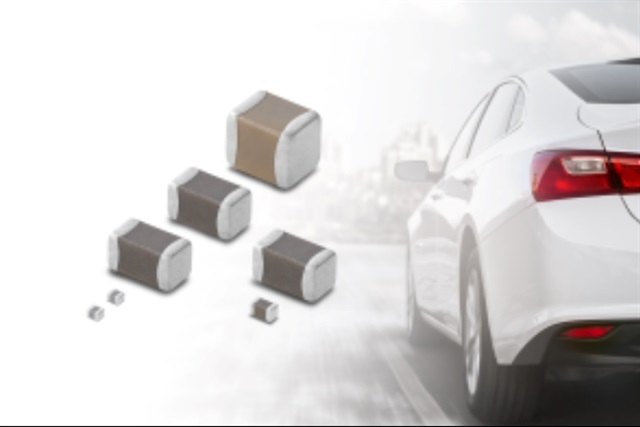
Murata and innovation in passive components for automotive
Murata Manufacturing, a global leader in the production of electronic components, has recently expanded its offering with seven new Multilayer Ceramic Capacitors (MLCCs) intended for the automotive market. These components, although often underestimated, represent a fundamental pillar for the reliability and performance of modern electronic systems, particularly those used in critical contexts such as autonomous driving and power supply infrastructures.
MLCCs are multilayer ceramic capacitors that play an essential role in circuit stabilization, noise filtering, and energy storage. Their importance grows exponentially in applications where precision and resistance to extreme environmental conditions are imperative. The introduction of new models specific to the automotive sector underscores Murata's commitment to supporting the technological evolution of a rapidly transforming industry.
The role of MLCCs in autonomous driving and power supply systems
Autonomous driving systems require a massive amount of computing power, often delivered by AI processing units that must operate under harsh environmental conditions, such as temperature variations, vibrations, and humidity. In this scenario, power supply stability is crucial for the correct functioning of sensors, control units, and Machine Learning algorithms. Murata's new MLCCs are designed to address these challenges, ensuring clean and stable power delivery.
Similarly, in the broader power supply market, these components contribute to improving the efficiency and lifespan of power converters, inverters, and other critical equipment. The ability to handle high loads and maintain consistent performance over time is a distinctive factor that makes these MLCCs suitable for applications extending beyond the vehicle itself, reaching infrastructures and devices that require high reliability.
Implications for edge AI and on-premise deployments
Murata's announcement highlights a key trend in the technology sector: the growing need for robust and specific hardware components to support the expansion of artificial intelligence to the edge. Autonomous vehicles are, by definition, edge AI platforms that require real-time inference capabilities, often in air-gapped environments or with limited connectivity. The quality and reliability of passive components like MLCCs are directly related to the stability and longevity of the entire hardware stack.
For companies evaluating on-premise deployments or self-hosted solutions for their AI workloads, the choice of high-quality components is a critical factor for TCO and for ensuring data sovereignty. A robust hardware infrastructure, built with reliable components, reduces downtime and maintenance costs, which are fundamental aspects for those managing private data centers or implementing AI solutions in industrial contexts. Innovation in this segment, while not directly related to GPUs or Large Language Models, is enabling for the entire AI development and deployment pipeline.
Future prospects for AI hardware
The evolution of passive components like Murata's MLCCs demonstrates how innovation is not limited to processors or Large Language Models, but extends to every layer of the hardware ecosystem. The ability to produce smaller, more efficient, and more resilient components is crucial for enabling the next generation of smart devices and systems, from autonomous vehicles to 5G network infrastructures, and next-generation data centers.
While the debate often focuses on chip performance and model architecture, the foundation upon which these innovations rest consists of precision electronic components. Investment in research and development in this area is crucial to ensure that the promises of AI, particularly those related to edge AI and on-premise deployments, can be met with the necessary reliability and scalability.







💬 Comments (0)
🔒 Log in or register to comment on articles.
No comments yet. Be the first to comment!