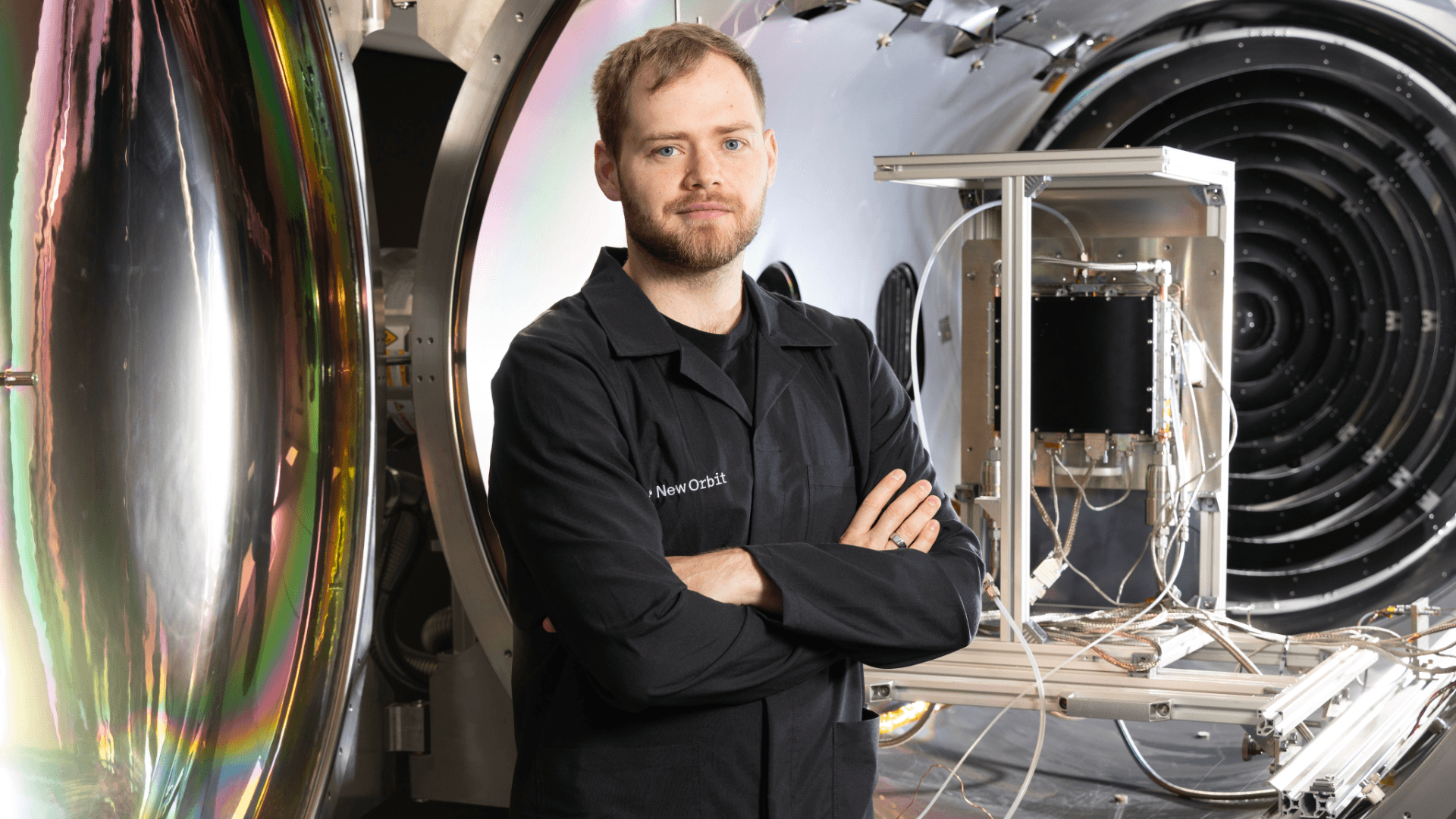
NewOrbit and the VLEO Frontier: An $18.5 Million Investment
The space sector continues to attract significant investment, with a growing focus on innovations that promise to redefine Earth observation and connectivity capabilities. In this context, NewOrbit, a UK-based satellite manufacturer, has announced the closing of an $18.5 million Series A funding round. The primary goal of this capital is to accelerate the commercialization of Very Low Earth Orbit (VLEO), a region of near-Earth space located between 200 and 300 kilometers in altitude.
This specific orbital band has historically remained inaccessible for commercial satellite operations, having been primarily used for government and scientific missions, such as spy satellites and the International Space Station. The oversubscribed funding round was led by Voyager Ventures, with participation from notable angel investors including David Kirk, former Chief Scientist at NVIDIA, and Lawrence Leuschner, co-founder and former CEO of TIER Mobility, as well as the Custos family office. Existing investors Atlantic.vc, Lifeline Ventures, LGF, and Illusian also participated.
Technical Details and VLEO Challenges
Operating in Very Low Earth Orbit offers distinct advantages over higher orbits. Proximity to Earth allows satellites to capture significantly higher-resolution imagery and provide lower-latency communications. NewOrbit claims its approach could enable drone-level imaging quality and direct-to-device connectivity, all at a considerably lower cost than existing satellite constellations. This aspect is particularly relevant for companies seeking connectivity and data collection solutions with optimized TCO and greater control over their infrastructure.
However, VLEO is not without its challenges. Extreme environmental conditions, characterized by increased atmospheric drag, the presence of atomic oxygen, and significant aerodynamic forces, have historically made long-term operations difficult. To address these obstacles, NewOrbit has developed purpose-built satellites equipped with proprietary propulsion technology, designed to operate in these harsh conditions for up to five years. This innovation is crucial for making the deployment of infrastructure in this orbit economically sustainable.
Implications for Observation and Connectivity
NewOrbit's vision for VLEO aligns with the growing demands for data sovereignty and dedicated infrastructure, central themes for tech decision-makers evaluating on-premise or hybrid solutions. The ability to obtain ultra-high-resolution Earth observation data and provide low-latency, direct-to-device connectivity opens up new possibilities for critical applications. Sectors such as precision agriculture, environmental monitoring, logistics, and security could greatly benefit from these capabilities, reducing reliance on shared cloud infrastructure for primary data acquisition.
Anatolii Papulov, CEO and co-founder of NewOrbit, emphasized that Very Low Earth Orbit is considered a largely untapped opportunity within the space economy. "For decades, very low Earth orbit has been considered too challenging for commercial satellite operations," Papulov stated. "We believe it represents a significant opportunity for new services and applications that are not possible with existing orbital infrastructure." This approach, which aims to build its own dedicated infrastructure, reflects a broader trend towards control and resource optimization, similar to what is seen in the deployment of Large Language Models (LLM) on-premise.
Future Prospects and Scalability
The secured funding will support the construction of NewOrbit's NEO Production Complex, a state-of-the-art manufacturing facility planned for 2027. This complex will be fundamental to the company's scalability strategy, enabling the production of its first commercial satellite ahead of a planned launch in 2028. Increasing the production capacity of the complex will be essential to meet future demand and expand operations.
The company is targeting specific applications including Earth observation and satellite-based connectivity. In these areas, operating closer to Earth can offer significant performance advantages over conventional orbital deployments. For CTOs and infrastructure architects evaluating solutions for large-scale data collection and processing, the emergence of dedicated space infrastructure like that proposed by NewOrbit represents an interesting evolution, offering new options for data sovereignty and pipeline control.








💬 Comments (0)
🔒 Log in or register to comment on articles.
No comments yet. Be the first to comment!