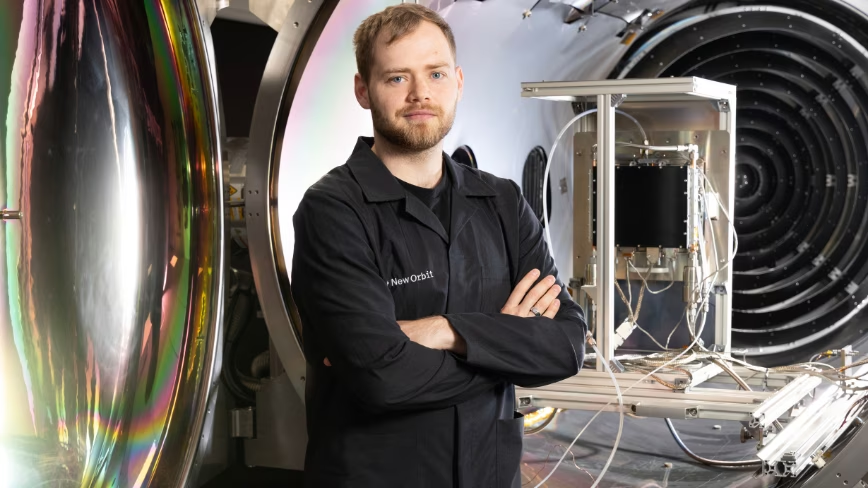
A New Horizon for Commercial Space Exploration
NewOrbit, a UK-based startup located in Reading, has announced the successful completion of an oversubscribed $18.5 million Series A funding round. This significant investment is earmarked to support the company's ambitious project of opening a new frontier for the commercial use of space: Very Low Earth Orbit, or VLEO.
NewOrbit's initiative is part of a global context of increasing interest in space sector innovation, where companies are striving to overcome technological and operational limits to access new market opportunities. The goal is to transform an area of space previously inaccessible for commercial purposes into a strategic resource for future applications.
The Challenge of Very Low Earth Orbit (VLEO)
VLEO spans an altitude band between 200 and 300 kilometers, uniquely positioned between the flight height of commercial aircraft (approximately 10 km) and conventional satellites (typically above 500 km). Historically, this region of space has been used almost exclusively for governmental purposes, such as spy satellites, or for scientific and research missions, including the International Space Station (ISS).
The reason for this limitation lies in the intrinsic technical challenges of VLEO. At these altitudes, although the atmosphere is extremely thin, residual aerodynamic drag is still sufficient to cause rapid orbital decay for satellites lacking active propulsion systems. This necessitates advanced technologies for orbit maintenance and for managing the operational lifespan of spacecraft, making commercial deployment particularly complex and costly. However, potential benefits, such as lower latency for communications and higher resolution for Earth observation, make VLEO an attractive target for innovation.
Implications and Market Prospects
The success of companies like NewOrbit in overcoming the challenges of VLEO could open entirely new scenarios for the space market. Access to this intermediate orbit could enable a new generation of services, from high-precision environmental monitoring to ultra-low latency telecommunications, and even new forms of critical infrastructure monitoring or navigation.
For companies operating AI and LLM workloads, the emergence of new high-resolution, low-latency data sources from space could have significant implications. The ability to acquire and process large volumes of geospatial data in near real-time might require robust processing solutions, potentially even on-premise, to ensure data sovereignty and minimize response times, especially in critical sectors. Although the source does not specify technical details, the opening of new space frontiers fuels the technological ecosystem as a whole.
The Investment Landscape in the Space Sector
NewOrbit's funding round reflects a broader trend of significant investment in the space sector, where startups are increasingly at the forefront due to their ability to innovate rapidly. Investors are attracted by the disruptive potential of technologies that promise to unlock new capabilities or drastically reduce the costs of accessing space.
Despite the enthusiasm, technical and financial challenges remain considerable. The development and deployment of new satellite constellations, especially in complex orbital environments like VLEO, require substantial capital and cutting-edge engineering. NewOrbit's success will depend on its ability to transform current technological potential into scalable and sustainable commercial solutions.






💬 Comments (0)
🔒 Log in or register to comment on articles.
No comments yet. Be the first to comment!