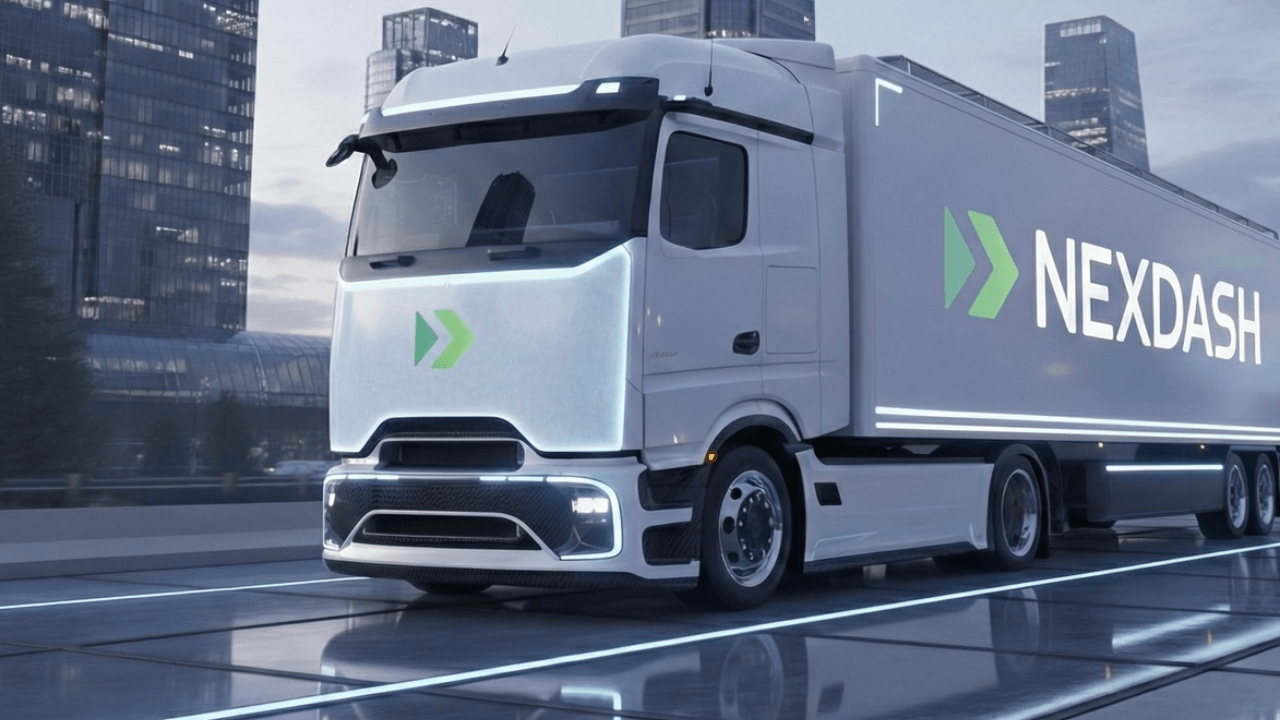
A Boost for Electric Freight Electrification
NexDash, a Berlin-based startup focused on road freight, has announced that it has secured €2.5 million in funding from EIT Urban Mobility. This investment represents a pre-Series A commitment, ensuring EIT Urban Mobility's participation in the company's future Series A round. The capital injection is intended to accelerate the expansion and conversion of NexDash's fleets in its core markets, a crucial step following the recent acquisition of March Transporte in Rheinbach, Germany.
The road freight sector is recognized as one of the most complex to decarbonize. Heavy-duty vehicles are responsible for over a quarter of road transport emissions in the European Union. Despite maturing electric truck technology and increasing regulatory pressure, adoption remains slow. The transition to electric vehicles requires significant capital, specific operational expertise, and the ability to manage a radically different fleet model—challenges that many small and medium-sized trucking companies, operating with tight margins and diesel fleets, struggle to overcome.
NexDash's Innovative Model and the NexOS Platform
NexDash aims to build the foundation for a new generation of logistics, directly addressing these challenges. Its operational model involves acquiring established mid-sized trucking companies, subsequently transitioning their fleets to electric vehicles, and managing operations through its proprietary AI platform, named NexOS. This integrated approach seeks to overcome the obstacles slowing the adoption of electric vehicles in the sector.
The startup was spun out of Platform Horizons (P6N), the investment platform created by Michael Cassau, founder and long-time CEO of Grover, a "unicorn" in the tech-rental sector. Cassau's vision for NexDash focuses on combining technology and operations to accelerate electrification at scale. The collaboration with EIT Urban Mobility, with its pan-European ecosystem and mission to foster greener, more efficient urban mobility, represents a fundamental step in advancing sustainable logistics.
Implications for Sustainable Logistics and Resilience
The joint initiative between NexDash and EIT Urban Mobility not only aims to accelerate the transition to zero-emission freight but also to strengthen supply chain resilience across Europe. Michael Cassau, CEO of NexDash, emphasized how EIT Urban Mobility's investment fuels the company's core mission: electrifying freight, fleet by fleet, route by route, across the continent.
Johannes Kirschner, Investment Manager at EIT Urban Mobility, expressed enthusiasm for the NexDash team, recognizing the startup as a new generation of freight operators in Europe, capable of combining technology and operations to accelerate electrification at scale. This type of partnership is crucial for overcoming barriers to the adoption of sustainable solutions in sectors traditionally slow to change.
The Role of AI and Deployment Choices for Proprietary Platforms
The proprietary AI platform, NexOS, is central to NexDash's operational strategy. The use of an AI system to manage and optimize electric fleets underscores the growing importance of artificial intelligence in improving the efficiency and sustainability of logistics operations. For companies that develop and rely on proprietary AI platforms, like NexDash, decisions regarding the deployment of the underlying infrastructure are crucial.
The choice between cloud and self-hosted (on-premise) solutions for Inference and training of Large Language Models or other AI models can have a significant impact on Total Cost of Ownership (TCO), data sovereignty, and compliance requirements. An on-premise or hybrid deployment often offers greater control over data and security, which are fundamental aspects for critical and sensitive operations. Although the source does not specify NexOS's deployment details, the emphasis on a proprietary platform suggests a willingness to maintain tight control over innovation and operations, a key factor for companies evaluating self-hosted alternatives for their AI workloads. For those evaluating on-premise deployment, AI-RADAR offers analytical frameworks on /llm-onpremise to assess trade-offs between performance, costs, and control.









💬 Comments (0)
🔒 Log in or register to comment on articles.
No comments yet. Be the first to comment!